Guide · evidence checked Sep 9, 2026
How to choose an iGaming game-development partner
A useful shortlist starts with the product and delivery evidence a studio can show, not a generic list of logos or claims.
- Written by
- Gaming Elite Network Editorial Team
- Reviewed by
- Gaming Elite Network Editorial Team
- Published
- Last material update
- Evidence checked
- Next review
- Editorial state
- approved

Start with the decision the game must survive
A game-development partner should be evaluated against the exact product, market, integration, and release decision in front of the buyer. A polished reel cannot replace evidence that the team can manage the required mathematics, client, server, integration, quality, documentation, and testing work.
Write a one-page brief before contacting studios. Name the product type, target devices, intended distribution path, target markets, internal owners, known standards, desired launch window, and what already exists.
Ask for evidence at the same level as the work
Evidence should match the responsibility the partner will own. If the supplier will own the release build, ask how it handles source control, acceptance criteria, test evidence, defect severity, dependency updates, and handover. If it will prepare a product for external testing, ask what artifacts it produces and how failed findings return to the delivery backlog.
| Decision area | Evidence to request | Warning sign |
|---|---|---|
| Product scope | Written inclusions, exclusions, assumptions, and dependencies | A price without a shared scope |
| Technical delivery | Architecture, environments, review controls, and acceptance process | No named owner for integration risk |
| Testing readiness | Test plan, evidence pack, defect workflow, and standards mapping | “Certification guaranteed” language |
| Handover | Repository, build, documentation, access, and support terms | Critical knowledge held by one person |
| Commercial fit | Milestones, change control, IP terms, and exit path | Ambiguous ownership or open-ended change costs |
Separate capability from fit
Capability asks whether a team can perform the work; fit asks whether its operating model suits this project. A large supplier can still be a poor fit for an experimental prototype, while a focused studio can be a poor fit for a multi-market platform program that requires several workstreams and long-term support.
Use the game-development supplier category to structure a shortlist, then carry the same questions into every conversation.
Treat testing and certification as external decisions
No development supplier should imply that it grants certification. Ask which standards and test artifacts the team has worked with, which external laboratory or authority makes the relevant decision, and which assumptions still require confirmation for the intended market.
The UK Gambling Commission’s testing strategy provides one jurisdiction-specific example of why exact scope matters: it identifies game, RNG, platform version, channel, live-like environment, integration, change-control and report fields, and says covered B2C licensees remain responsible for an up-to-date games register even when they use B2B content. Other markets have their own rules. Treat this as a brief-design example, not a global testing checklist or legal conclusion.
For work where Wizards may fit, review its casino game-development pathway alongside other qualified options. The relationship is disclosed because Wizards operates GEN.
Use a weighted scorecard, then investigate the gaps
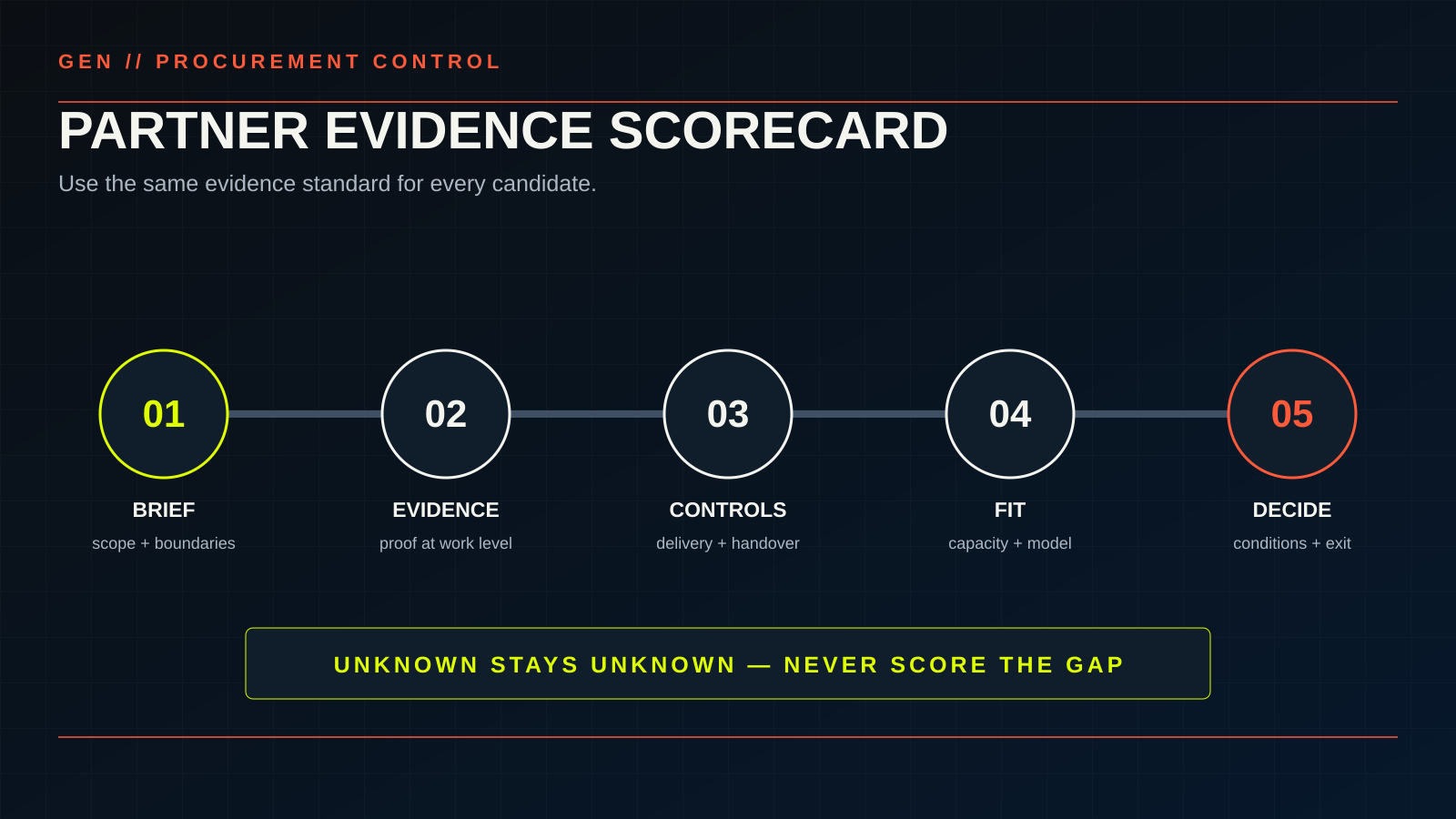
A scorecard makes trade-offs explicit but does not turn uncertain evidence into fact. Weight only the criteria that affect this project, record the source behind each score, and mark unknowns as unknown rather than awarding a neutral score.
The final recommendation should state why the preferred supplier fits, what could invalidate the choice, and which contract or technical questions remain open. If you want help structuring that brief, submit a project request with or without permission to share it beyond Wizards.
Frequently asked questions
Can a development partner guarantee game certification?
No. A partner can prepare software, mathematics, documentation and test evidence, but the relevant laboratory, regulator or other authority controls its own decision. Treat a guarantee as a warning sign unless the statement precisely describes a separate contractual remedy rather than the certification outcome.
Does a prior test report automatically cover a new platform or channel?
Not necessarily. Changes to the game, RNG, platform, integration, client channel or live environment may change the required scope. Confirm what earlier evidence can be relied on and what must be tested again for the exact build and jurisdiction.
What should a comparable customer reference establish?
It should establish only what the reference can observe: a similar scope, delivery model, integration, market context and support period. A logo or testimonial does not prove the candidate’s performance on this project or disclose the referenced contract, defects or outcome.
Should the lowest quoted price determine the shortlist?
No. Normalize scope first, then compare assumptions, exclusions, dependencies, evidence, internal staffing, change control, support, ownership and exit cost. A low price attached to an incomplete responsibility boundary is not a like-for-like offer.
Visual analysis
Source record and operator framework
The first visual fixes the sourced facts. The second turns those facts into a practical review or decision path.

Evidence record
Sources used on this page
Each source supports a defined claim. Provider pages are identified as provider-supplied evidence.
- Wizards game developmentWizards · accessed Sep 9, 2026
The disclosed operator offers game-development services and is therefore a potential provider in this category.
- GLI standards and technical specificationsGaming Laboratories International · accessed Sep 9, 2026
GLI publishes baseline standards for gaming devices and systems while stating that each jurisdiction retains authority to set its own standards.
- Testing strategy for compliance with remote gambling and software technical standardsUK Gambling Commission · accessed Sep 9, 2026
For covered Great Britain releases, the regulator describes test-scope, report, environment, integration, change-control and licensee-record responsibilities that a delivery brief should allocate explicitly.