Guide · evidence checked Sep 14, 2026
iGaming audit logs: what to prove before an incident
Do not accept a logging promise. Prove that one accountable team can reconstruct a disputed event across system boundaries, explain time skew, and detect access or alteration.
- Written by
- Fernando Polti
- Editor
- Fernando Polti
- Published
- Evidence checked
- Next review
- Editorial state
- approved

An iGaming audit trail is ready for acceptance when an accountable team can start with one disputed event and retrieve a coherent, protected record across the operator, platform, aggregator and remote game server. The record should identify the same business event, explain clock differences, show important state changes, and reveal who accessed or altered the evidence. “Logs are available” is not an acceptance result.
Executive takeaway: define the reconstruction question before selecting fields or storage. Then run a timed drill that crosses supplier boundaries. If the team cannot explain a missing event, an offset timestamp, a privileged change or the source of a displayed outcome, it has found an operational gap before an incident makes that gap expensive.
An audit trail is an evidence contract, not a log volume
Logging begins with the questions the business may need to answer. A security team may need to investigate unauthorized access. Operations may need to explain a disrupted game session. Compliance may need a record of a material configuration change. Customer support may need to connect a player’s visible outcome to the underlying game and account events. These questions overlap, but they do not require the same data or access.
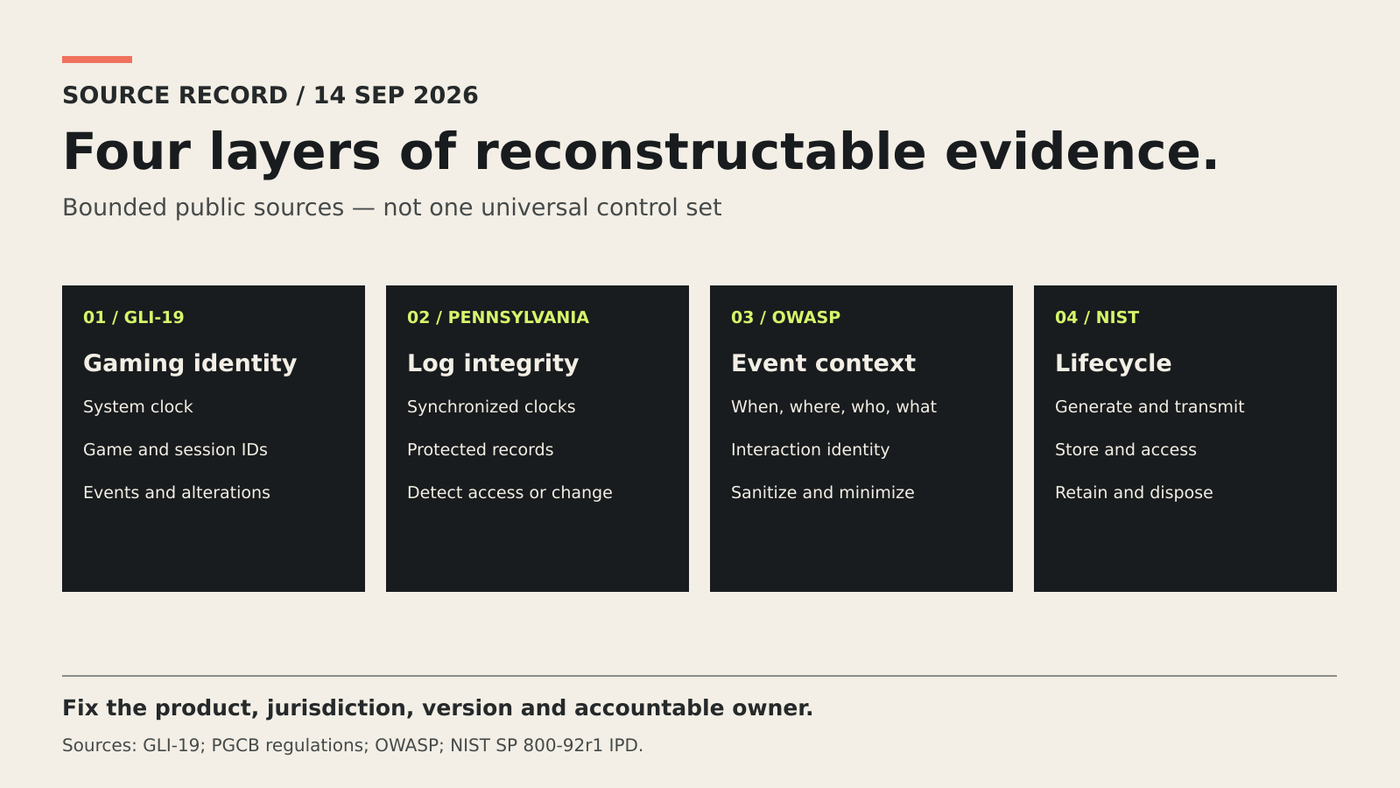
GLI-19 version 3.0 illustrates the gaming-specific breadth. It calls for timestamps on transactions, games and significant events; game-cycle or session identity in game records; and significant-event or alteration reports with event identity, the responsible user, a reason, and before-and-after values where applicable. Its significant-event examples include critical-component unavailability, voids, overrides, corrections and changes outside normal execution.
Those are standard statements, not proof that a particular deployment records enough context or that GLI-19 is the governing requirement. The Gambling Commission’s remote technical standards are explicitly a Great Britain framework and carry their own update history. Fix the product, jurisdiction, licence, standard version and system scope with qualified owners before converting any public document into a requirement.
GEN’s operational conclusion is narrower: the buyer needs an evidence contract that names the questions, source systems, fields, owners, protection, retention, retrieval path and acceptance drill. A supplier’s generic observability statement cannot substitute for that contract.
Give one event a durable identity across system boundaries
A reconstruction fails when every component reports a locally correct event that cannot be joined to the others. The OWASP Logging Cheat Sheet recommends an interaction identifier that links events produced by one user interaction instead of forcing investigators to infer the relationship later. Gaming systems also need the business identifiers relevant to their own architecture.
Start with an event envelope. The exact fields vary, but each boundary should disclose which identities it creates, receives, transforms and returns.
| Boundary | Identity to preserve or map | Question the record should answer |
|---|---|---|
| Operator account and channel | Account, brand, device or channel, session and support case | Which customer context and visible journey produced the disputed event? |
| Platform and wallet | Business transaction, request attempt, ledger entry and adjustment identity | Which financial or account state changed, and which message caused it? |
| Aggregator or gateway | Correlation, supplier, route, interface version and delivery attempt | Which downstream system received which normalized or transformed message? |
| RGS or game service | Game cycle, game version, configuration, session and result identity | Which executable game and configuration produced the recorded outcome? |
| Administration and release | Actor, role, approval, change, before/after value and release identity | Who changed material state, under which authority, and what was replaced? |
Do not assume an aggregator’s correlation ID is the operator’s transaction ID or the RGS game-cycle ID. Record explicit mappings and cardinality. One game cycle may produce several messages; one retry may create several delivery attempts without creating a new business operation. The wallet retry acceptance guide treats that financial case in detail.
Align clocks without hiding uncertainty
Chronology is evidence only when investigators understand the clocks behind it. The Pennsylvania Gaming Control Board’s public interactive-gaming regulation record describes synchronizing system-component clocks to an agreed accurate source and checking time skew periodically. GLI-19 also describes a system clock used for transaction, game and significant-event timestamps, with a synchronization mechanism.
An acceptance record should capture the timestamp format and offset, authoritative time source, synchronization status, measured skew, event time and ingestion time where they differ. Preserve the original source timestamp rather than silently rewriting it. If a supplier sends local time without an offset, make that ambiguity visible and resolve the contract before using the field to order events.
A useful drill deliberately introduces a bounded clock offset in a controlled environment. The goal is not to make every timestamp identical. The goal is to prove that the team detects the skew, retains the evidence and reconstructs order without pretending to have precision it does not possess.
Protect the record and record access to it
Centralizing logs improves retrieval, but a central store does not make evidence trustworthy by itself. The Pennsylvania record describes protection against tampering and unauthorized access, detectable modification or access, and the ability to see who viewed or altered a log and when. GLI-19 describes unique signatures for report versions, change logs and administrative-user audit trails in its security controls.
Translate those principles into a documented design: source authenticity, transport protection, write permissions, separation of duties, tamper detection, backup, availability, access review and disposal. A hash can help detect a later byte change, but it cannot prove that the source emitted a complete or truthful event. “Immutable” storage cannot recover an event that the application never produced.
Logging can also create risk. OWASP says teams should decide which data to exclude, sanitize event data from other trust zones and monitor access to logs. Do not copy credentials, session secrets, payment data or unrestricted personal data into a broad analytics store merely because they make debugging convenient. Define masking, tokenization, jurisdictional handling, retention and approved viewers with privacy and security owners.
Run a reconstruction drill before acceptance
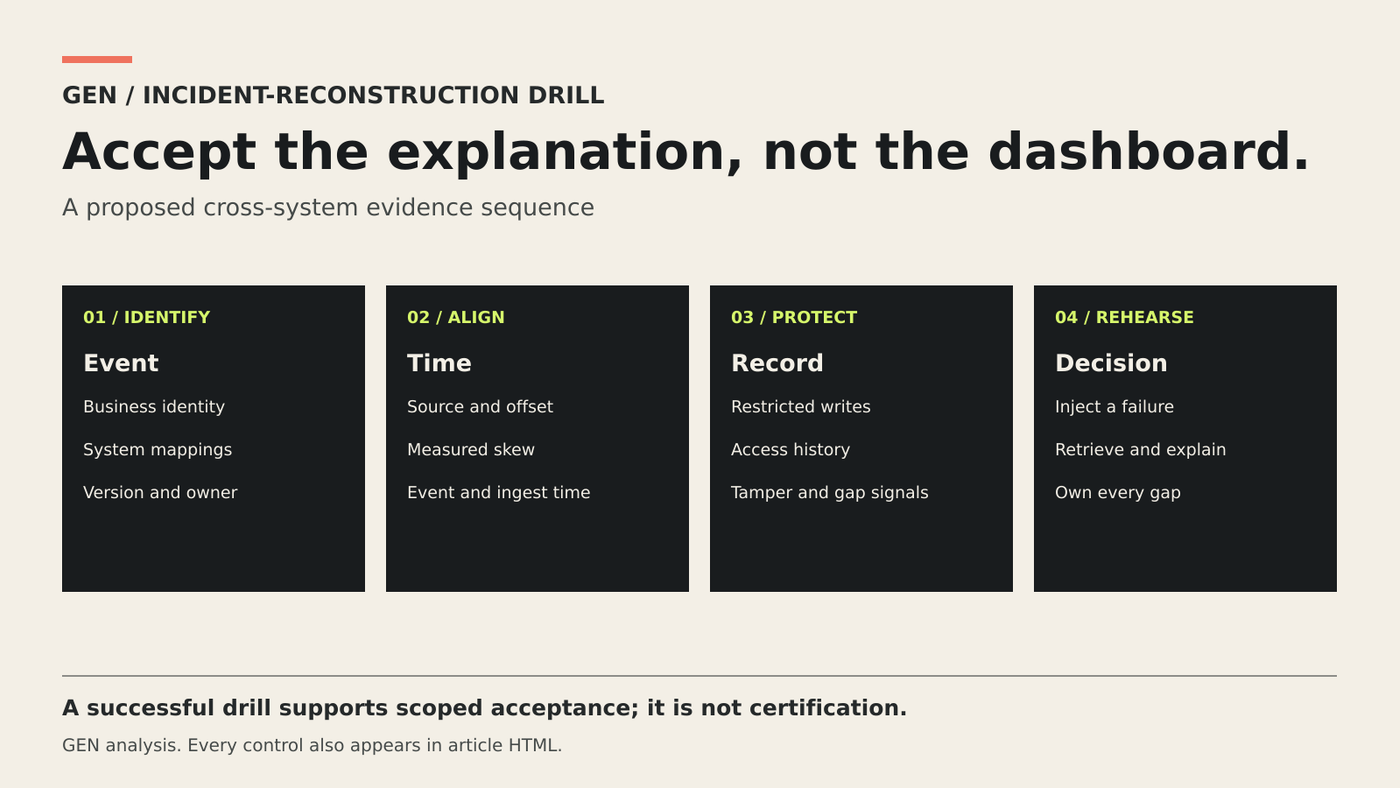
The drill should begin with a realistic question and a limited evidence packet—not unrestricted database access. Time the investigation, record every query or escalation, and require the team to distinguish known fact, missing evidence and inference.
| Injected condition | Evidence to retrieve | Acceptance question |
|---|---|---|
| Critical game service becomes unavailable | Component event, affected sessions, failed transactions, alert and restoration record | Can the team identify scope and recovery without estimating from complaints? |
| Material game or platform configuration changes | Actor, approval, previous value, new value, version and effective time | Can the team prove which configuration was active for a disputed cycle? |
| Supplier and operator clocks differ | Original timestamps, offsets, time sources, skew observation and ingestion times | Can the chronology be reconstructed with its uncertainty visible? |
| Log transport stops while the application continues | Source status, backlog or loss signal, alert, recovery and gap statement | Does silence trigger evidence rather than a false “no events” conclusion? |
| Privileged user reads or changes a record | Identity, role, access time, action, authorization and tamper signal | Is evidence access itself reviewable? |
| A customer dispute starts from a visible game result | Account context, session, game cycle, version, configuration and related transactions | Can support reach the authoritative records without exposing unrelated personal data? |
| A retained period is queried after a platform change | Source version, archive location, integrity check and query result | Does the documented retention and retrieval path still work? |
NIST’s log-management planning guide defines log management across generation, transmission, storage, access and disposal. That lifecycle is a useful review frame: a dashboard demonstrates only the access step. The drill should test the source, route, store, permissions, query and disposal assumptions that make the dashboard meaningful.
Record the drill environment, versions, identities, injected condition, expected evidence, actual evidence, elapsed retrieval time, unresolved gaps, accountable owner and release decision. A successful test supports the scoped acceptance decision; it does not establish certification or guarantee that future incidents will be reconstructed.
What this means for operators, aggregators and platforms
Operators should own the end-to-end reconstruction question, even when suppliers host most components. Specify who can retrieve each record, which supplier escalation is required and how customer, financial, security and regulatory investigations use different access boundaries.
Aggregators should disclose identity transformations, routing decisions, version context, retry attempts, source timestamps and evidence availability for every downstream dependency. A single API does not create a single incident boundary.
Platforms and RGS providers should show which events are native, configurable or unavailable; how privileged changes are recorded; how clocks and versions are identified; and what survives migration, failover and contract exit. Buyers can place these questions in the platform RFP evidence checklist and assign component owners with the RGS, aggregator, platform and operator responsibility map.
Before launch, agree a smallest viable evidence envelope, run the drill, resolve every unexplained gap and schedule a repeat after material architecture or supplier changes. The useful result is not more logs. It is a bounded event that the accountable team can explain.
Frequently asked questions
How long should iGaming audit logs be retained?
There is no safe universal duration. Applicable regulation, licence conditions, internal controls, contracts, dispute windows, privacy obligations and incident needs may set different periods. Record the authority for each class, the deletion method and the retrieval test. Do not copy one jurisdiction’s period into another deployment without qualified review.
Does a SIEM replace source-system records?
No. A security information and event management system can centralize and analyze events, but acceptance still needs to prove source completeness, identity mapping, protected transport, version context and access to authoritative business records.
What makes a log tamper-evident?
Controls can make unauthorized change or access detectable through restricted writes, version history, signatures or hashes, protected copies and monitored access. The design must state what each control proves. Tamper evidence does not prove that the application emitted every required event.
Should player personal data appear in operational logs?
Only the minimum approved data needed for the defined purpose should be present. Use stable pseudonymous identifiers where they satisfy the investigation, and agree masking, access, retention and lawful handling with privacy and security owners. Never put secrets or unrestricted personal records into logs by default.
Visual analysis
Source record and operator framework
The first visual fixes the sourced facts. The second turns those facts into a practical review or decision path.
Evidence record
Sources used on this page
Each source supports a defined claim. Provider pages are identified as provider-supplied evidence.
- GLI-19 Standards for Interactive Gaming Systems, version 3.0Gaming Laboratories International · accessed Sep 14, 2026
The standard describes system-clock use, game and session identifiers, significant-event records, before-and-after alteration fields, report signatures and administrative audit trails.
- Pennsylvania interactive gaming regulationsPennsylvania Gaming Control Board · accessed Sep 14, 2026
The public regulation record describes synchronized component clocks, protected audit logs, detectable access or alteration, documented review and fault logging for interactive gaming systems.
- Remote gambling and software technical standardsGambling Commission · accessed Sep 14, 2026
The Commission identifies its remote technical standards as Great Britain requirements and records a 31 October 2025 update, illustrating why jurisdiction and current version must be fixed before acceptance.
- Logging Cheat SheetOWASP Foundation · accessed Sep 14, 2026
The guidance describes when, where, who and what event attributes, interaction identifiers, time synchronization, log sanitization, data-exclusion decisions, tamper detection and access monitoring.
- Cybersecurity Log Management Planning Guide, initial public draftNational Institute of Standards and Technology · accessed Sep 14, 2026
NIST defines log management across generation, transmission, storage, access and disposal, and ties planning to incident investigation, operational diagnosis and retention needs.