Guide · evidence checked Sep 9, 2026
A safer iGaming engagement experimentation framework
Define the customer outcome, compliance boundary, evidence plan and stop conditions before optimizing an engagement or conversion metric.
- Written by
- Gaming Elite Network Editorial Team
- Reviewed by
- Gaming Elite Network Editorial Team
- Published
- Last material update
- Evidence checked
- Next review
- Editorial state
- approved

What should an operator optimize?
Optimize a defined customer and business outcome within explicit safety, compliance and operational limits—not “engagement” in isolation. Before a team changes onboarding, payments, recommendations, CRM, rewards or game discovery, it should specify the intended user outcome, the primary metric, the guardrail metrics and the conditions that stop the test.
The legacy articles consolidated into this page treated personalization, gamification, payments and AI as inherently beneficial trends. That framing was not adequately sourced and did not distinguish an implementation from a proven outcome. This framework replaces those assertions with a testable decision process.
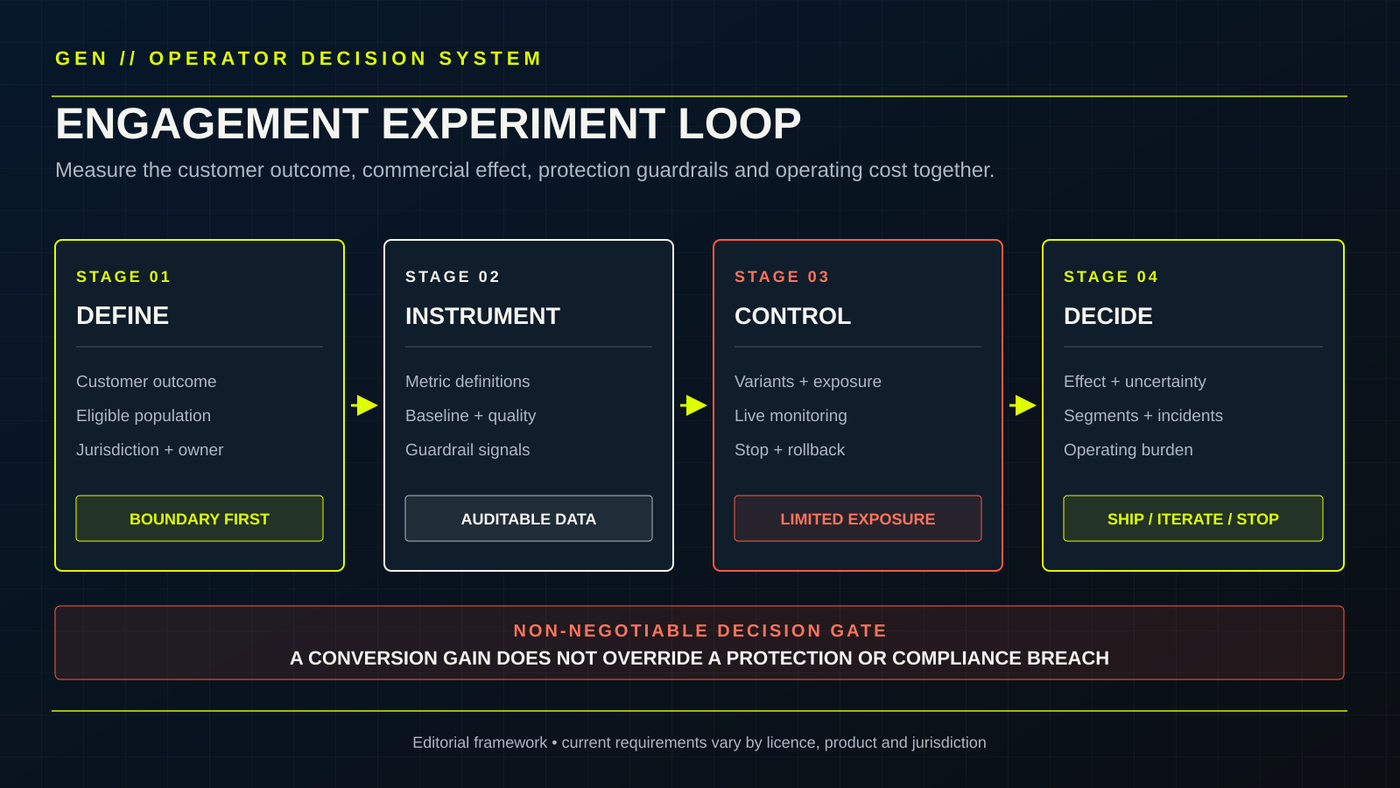
The four-stage experiment loop
| Stage | Required record | Decision question |
|---|---|---|
| 1. Outcome and boundary | user problem, eligible population, jurisdiction, licence, product surface, owner | Is this a legitimate outcome to pursue in this context? |
| 2. Evidence and instrumentation | event definitions, baseline, attribution window, exclusions, data-quality checks | Can the team measure the intended effect and credible adverse effects? |
| 3. Controlled test | hypothesis, variants, exposure rules, sample rationale, monitoring and rollback | Can the change be tested without uncontrolled rollout? |
| 4. Decision gate | effect estimate, uncertainty, guardrails, segment review, incidents and operating cost | Should the change ship, iterate, stop or be escalated for further review? |
Each stage should leave an auditable artifact. A slide saying “conversion increased” is not enough to reproduce the analysis, establish which users were affected or show whether an adverse signal was hidden by the aggregate.
Which metrics belong in the scorecard?
Use a balanced scorecard with at least four layers:
- Customer task: completion, time to complete, error recovery and support demand for the intended journey.
- Commercial outcome: qualified activation or conversion, incremental value, incentive cost, payment cost and downstream retention—using definitions fixed before the result is read.
- Protection guardrails: relevant harm indicators, limit-setting behavior, withdrawals, exclusions, complaints and customer-interaction outcomes.
- Operational integrity: failed transactions, fraud loss, false positives, model drift, manual-review load, latency, outages and reconciliation defects.
The layers prevent local optimization. For example, reducing payment friction may improve completion while also changing fraud exposure, support workload or withdrawal behavior. A production decision needs the combined record.
How should AI personalization be tested?
Treat an AI-assisted recommendation, promotion, churn score or support decision as a governed system, not a marketing label. Record its input categories, intended use, excluded uses, decision owner, explanation route, monitoring population, retraining trigger and fallback behavior.
The ICO and Alan Turing Institute guidance emphasizes transparency, accountability, context and impact for AI-assisted decisions about people. The ICO currently marks that guidance under review following the Data (Use and Access) Act, so it should not be treated as a frozen statement of current legal obligations. The ICO’s current statutory-change summary separately identifies information, representation, human-intervention and contest routes as safeguards for significant solely automated decisions.
Those records translate into practical test questions: can the team explain what the system affects, identify who owns the decision, inspect results by relevant segment, provide the required review and contest routes, and intervene when the output is inappropriate? The applicable answer still depends on the data, decision, jurisdiction and current law.
Do not infer that a model is effective because it can generate a score. Compare the model-assisted workflow with the existing process, include the cost of human review and downstream errors, and preserve a route for qualified privacy and legal review.
Where do responsible-product constraints enter?
They enter before variant design. In Great Britain, the UK Gambling Commission’s RTS 14 includes product-specific responsible-design requirements and its customer-interaction framework requires operators to identify, act and evaluate as an ongoing process. The current LCCP 5.1.1 also gives incentive teams concrete pre-test boundaries for applicable licences: wagering requirements cannot exceed ten times and one incentive cannot combine more than one gambling-product type. The detailed application depends on the licence, product and current rules; these Great Britain examples are not universal legal conclusions.
Create a jurisdiction matrix for the test surface. Record which requirement or internal control constrains copy, timing, incentives, withdrawals, limits, interactions, game behavior and targeting. If the team cannot identify an accountable reviewer or rollback owner, the test is not ready.
What evidence is enough to ship?
Use a pre-agreed decision rule. It should define the minimum meaningful effect, uncertainty tolerance, observation window, guardrail limits, excluded anomalies and required approvals. Review both absolute numbers and rates, and inspect whether a headline change comes from mix shifts, tracking changes or one high-volume segment.
The result can be one of four states:
- Ship: the intended outcome improved, guardrails remained acceptable and the operating burden is understood.
- Iterate: the signal is promising but the implementation, measurement or segment behavior needs another controlled test.
- Stop: the outcome did not improve reliably or a guardrail breached its threshold.
- Escalate: the result raises a legal, privacy, safer-gambling, fraud or model-governance question outside the experiment team’s authority.
The minimum experiment brief
Before exposure begins, capture:
- a plain-language hypothesis and customer outcome;
- population, exclusions, markets, products and dates;
- primary metric, denominator and attribution window;
- guardrails and stop conditions;
- event dictionary and data-quality owner;
- variant specification and release identifier;
- statistical or decision rationale;
- monitoring, incident and rollback owners;
- required compliance, privacy, security and operational reviews;
- publication rule for the final result, including negative or inconclusive outcomes.
This record is deliberately technology-neutral. AI, wallets, gamification and analytics are implementation choices. None is evidence of better conversion, retention or safety until a controlled, reviewable measurement supports that conclusion.
Common questions
Is a winning conversion test enough to ship?
No. A production decision also needs the pre-agreed protection, data-quality, operational and jurisdiction checks to pass. A conversion lift does not cancel a breached guardrail or an unresolved authority question.
Can one Great Britain incentive experiment mix product types?
For licences within the scope of the current UK Gambling Commission code, LCCP 5.1.1 prohibits including more than one of betting, casino, bingo and lottery within one incentive. Confirm the exact licence and offer scope against the current code before exposure; this is a bounded Great Britain example, not a global rule.
Is a named human reviewer enough for an automated decision?
Not by itself. The current ICO summary identifies information, representation, human-intervention and contest routes as safeguards for significant solely automated decisions, while its detailed AI-explanation guidance is under review. Record what the person can actually inspect, change and communicate, then obtain qualified privacy and legal review for the use case.
Can an aggregate improvement hide a harmful result?
Yes. A headline average can hide a breached guardrail, a tracking defect or a materially different result in an affected segment. Preserve the denominator, exposure record, segment checks, incidents and absolute counts needed to investigate the result.
Use the KYC and fraud provider evaluation framework when a test changes identity or risk controls, the platform RFP template when the dependency is vendor selection, and the GEN methodology for evidence and disclosure labels.
Visual analysis
Source record and operator framework
The first visual fixes the sourced facts. The second turns those facts into a practical review or decision path.

Evidence record
Sources used on this page
Each source supports a defined claim. Provider pages are identified as provider-supplied evidence.
- RTS 14 — Responsible product designUK Gambling Commission · accessed Sep 9, 2026
The current Great Britain remote technical standard defines product-specific responsible-design constraints, including frictionless withdrawals and prohibited encouragement patterns.
- LCCP 5.1.1 — Rewards and bonusesUK Gambling Commission · accessed Sep 9, 2026
For applicable Great Britain licences, the current social-responsibility code caps incentive wagering requirements at ten times and prohibits combining more than one gambling-product type within an incentive.
- Customer interaction guidance — Requirement 1UK Gambling Commission · accessed Sep 9, 2026
The formal guidance requires an ongoing identify, act and evaluate process, with evaluation designed in from the beginning rather than added after an intervention.
- Explaining decisions made with artificial intelligenceUK Information Commissioner's Office and Alan Turing Institute · accessed Sep 9, 2026
The guidance sets out transparency, accountability, context and impact principles for AI-assisted decisions about individuals; the ICO currently marks it under review following statutory changes.
- Data (Use and Access) Act summary — automated decision-makingUK Information Commissioner's Office · accessed Sep 9, 2026
The ICO's current statutory-change summary identifies information, representations, human intervention and contest routes as safeguards for significant solely automated decisions.