Guide · evidence checked Oct 5, 2026
UK gaming machine standards 2027: what suppliers and operators must build
The bulk of the changes apply to new category A, B1, B2, B3, B3A and B4 machines, not the existing fleet. Suppliers and operators have three dated implementation stages and one stated hard stop.
- Written by
- Fernando Polti
- Editor
- Fernando Polti
- Published
- Evidence checked
- Next review
- Editorial state
- approved

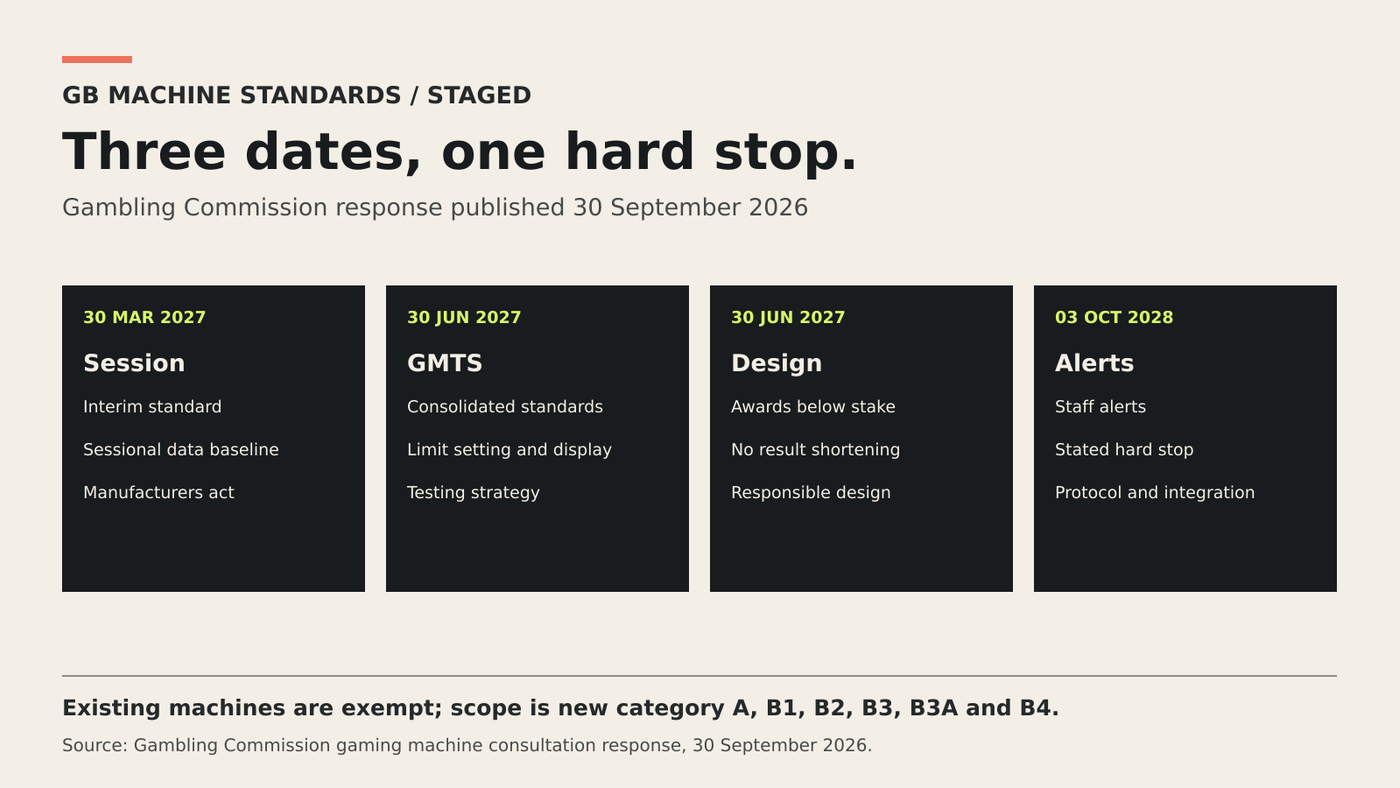
On 30 September 2026 the Gambling Commission published the response to its January 2025 consultation on the Gaming Machine Technical Standards (GMTS), the Gaming Machine Testing Strategy and the Licence Conditions and Codes of Practice (LCCP). The package introduces machine-level limit setting, sessional information and responsible-design requirements. Crucially, the new limit-setting and sessional-information standards apply to new category A, B1, B2, B3, B3A and B4 machines and games, not to the existing installed fleet. Implementation is staged: the session definition takes effect on 30 March 2027, the bulk of the changes on 30 June 2027, and the staff-alert requirement on 3 October 2028, which the Commission describes as a hard stop.
Executive takeaway: treat this as a product-roadmap and certification decision, not a documentation exercise. Confirm which of your machines and games are “new” under the finalised standards, design the session and limit-setting behaviour to the interim and consolidated wording, and book testing against the finalised testing strategy before the 30 June 2027 date. Do not retrofit the existing fleet to requirements the Commission has decided not to apply to it.
What the Commission decided, and what it did not
The response covers twelve proposals. The consumer-facing changes are three:
- new category B gaming machines must give consumers improved access to gambling management tools and sessional information showing how long they have played and how much they have won or lost;
- sessional information must be available to licensees so they can meet obligations such as interacting with customers showing signs of harm;
- responsible game design must ensure awards below the stake size are not celebrated and must prohibit features that let a customer reduce the time until a result is known.
The Commission also decided not to do several things it had consulted on. It removed existing gaming machines from the scope of the limit-setting and sessional-information display standards, citing the technical cost and the disproportionate burden on smaller licensees and the social-club sector. In the Proposal 7 record it estimated that including existing machines would have implied circa £70.85 million in potential replacement costs for machines that could not be updated. It also dropped the requirement for staff alerts when a customer reaches the first or second default time limit, to reduce alert fatigue and target staff time where risk is highest.
Two points matter for planning. First, the scope decision is what makes the programme deliverable: the burden falls on new product, not on a retrofit of an ageing estate. Second, the exemptions are conditional. Where a machine offers a new game alongside existing games or category C and D games, the finalised wording requires all games on that compendium to comply. An operator cannot assume an existing cabinet is permanently out of scope if a supplier later adds a new game to it.
The staged timeline: three dates and a hard stop
The Commission chose a graduated timeline so it can collect a dataset under a common session definition before the substantive standards bite.
| Date | What takes effect | Who acts first |
|---|---|---|
| 30 March 2027 | The interim gaming machine “session” definition and its data collection | Manufacturers and networked-machine suppliers |
| 30 June 2027 | The consolidated GMTS (including GMTS 15.1a–15.1c), the responsible-design standards and the finalised Testing Strategy | Product, platform and certification teams |
| 3 October 2028 | GMTS 15.1d staff alerts | Machine, protocol and systems integrators |
The interim session standard is explicitly a measurement instrument: the Commission wants a three-month window of sessional data under one definition before the consolidated standards come into force. That makes the 30 March 2027 date the real start of the technical work, even though most consumer-visible changes arrive on 30 June 2027. The 3 October 2028 staff-alert date is the outlier. The Commission extended it to two years and called it a hard stop, while encouraging licensees to keep or adopt staff-alert technology sooner where they already can.
Who is in scope, and who is exempt
The finalised wording for GMTS 15.1 applies to new category A, B1, B2, B3, B3A and B4 machines and games, and to all games on a compendium once a new game is added. The interim session standard is scoped to licence types and fee categories that are reasonably capable of delivering the definition, including networked machines, machines already offering limit-setting functionality under trade-association voluntary codes, and machines included in earlier sessional-data exercises.
| Layer | Evidence question | Likely owner |
|---|---|---|
| Machine category and status | Is this a new machine or game, or part of the existing fleet? | Product management, compliance |
| Game compendium | Does adding a new game pull existing or category C/D games into scope? | Product, platform engineering |
| Session engine | Can the machine produce the session start and end points in the standard? | Firmware, systems, manufacturers |
| Limit setting | Can customers set time and monetary limits with the required defaults and breaks? | Game and cabinet engineering, UX |
| Sessional display | Is elapsed time and net position shown by default, hideable by the customer? | Cabinet and game UI, systems |
| Testing | Which finalised testing-strategy route applies to this product? | Certification, test houses |
GEN’s casino game certification-readiness checklist is a useful companion for the evidence side, but it does not decide GMTS applicability. That requires the actual machine category, the approved configuration and the finalised standards.
Limit setting: the defaults that must be built
The finalised GMTS 15.1 wording is where the engineering effort sits. Under 15.1a, a machine or game must require customers to make an active choice for both a time limit and a monetary limit: either set their own, or use the default. The customer must be shown, at the same time and with equal prominence, a free-text option to set their own limit and an option to select the default.
Under 15.1b the ceilings are explicit. At the start of a session, customer-set time limits must not exceed 60 minutes, customer-set monetary limits must not exceed a net loss of £450, default time limits must not exceed 20 minutes, and default monetary limits must not exceed a net loss of £150. If a customer continues after a break in play, the additional limits are bounded in the same way, with different treatment depending on whether the session is in a net loss or a positive net position. Customers must not be able to choose “no limits”.
The consequences are concrete. A limit engine that only understood a rolling daily or weekly cap will not satisfy a machine-level, session-based time and net-loss model. “Net position” here means total winnings minus total losses since the start of the session, mirroring the concept used in remote standards, and the Commission declined to redefine it around deposited or committed sums. Products that display a different monetary concept - turnover, stake, or cash-in - will need a second, correctly labelled figure.
Session definition: the measurement baseline
The session definition is the hinge of the whole package, because limit setting and the display of elapsed time and net position both depend on it. It is intentionally close to the definition manufacturers historically used for sessional-data collection. Under the interim standard a session:
- begins when a game is played, if no session is already in progress;
- ends when machine credit is below the value of the lowest available single stake for 60 seconds from the end of the last game cycle;
- ends when there is no customer input for 240 seconds from the end of the last game cycle, regardless of credit;
- ends when the customer presses Collect and all uncommitted credit is cashed out;
- ends on any interruption to normal operation, such as a power cut, power-off, malfunction or door-open;
- for multi-game machines, is measured at the machine (system or platform) level on the main menu.
The Commission noted that no definition can track an individual’s gambling with complete accuracy without mandatory account-based play, which is a matter for government. It also confirmed there is no tracking while a machine is in demonstration or tournament mode. Teams should test the session boundaries explicitly - the 60-second and 240-second endpoints, the Collect path and the interruption path - rather than assuming a session equals a login or a single game.
Sessional information and responsible design
Two further changes carry product consequences. First, sessional information: for new category A, B1, B2, B3, B3A and B4 machines, net position and elapsed time must be displayed by default and hideable by the customer, at the game level while the customer is actively playing, and additionally at the machine level on the main menu for compendiums that include a new game. The Commission accepted industry’s alternative to make the information available at machine level and adopted a blended approach, which is why the standard now requires display by default rather than merely “one action away”.
Second, responsible design. The new standards require that awards below the stake size are not celebrated, and they prohibit features that let a customer reduce the time until a result is known. Those are game-design constraints, not cabinet constraints, and they belong in the design-review gate rather than in a post-build fix.
What this means for suppliers, operators and testing teams
Machine manufacturers and systems suppliers own the session engine, the limit-setting behaviour and the sessional display. Build the interim session definition first, because it is the data model everything else depends on, and because it is the earliest dated requirement.
Land-based operators should separate the new-product question from the estate question. Confirm which cabinets and games will be treated as new, watch for the compendium trigger where a supplier adds a new game to an existing machine, and confirm that staff-alert capability is scheduled well before the 3 October 2028 hard stop.
Compliance and product teams should turn the twelve proposals into a clause-level delta register: what moved, what changed, what is new, and what remains interpretation. Do not convert a staged timeline into a single “2027” ticket.
Test houses and certification teams should align the product plan to the finalised Gaming Machine Testing Strategy effective 30 June 2027, and distinguish design review from formal submission scope. A product can be prepared against the finalised wording now; formal conclusions still depend on the applicable configuration and process.
Platform and aggregator teams should note that this package sits on the machine side of the boundary. It is separate from the Remote Gambling and Software Technical Standards, which govern remote gambling software; the Commission separately confirmed remote deposit-limit changes under RTS 12 with effect from 30 September 2026. A supplier that serves both land-based and remote customers should keep the two programmes distinct in scope and evidence.
A five-step readiness sequence
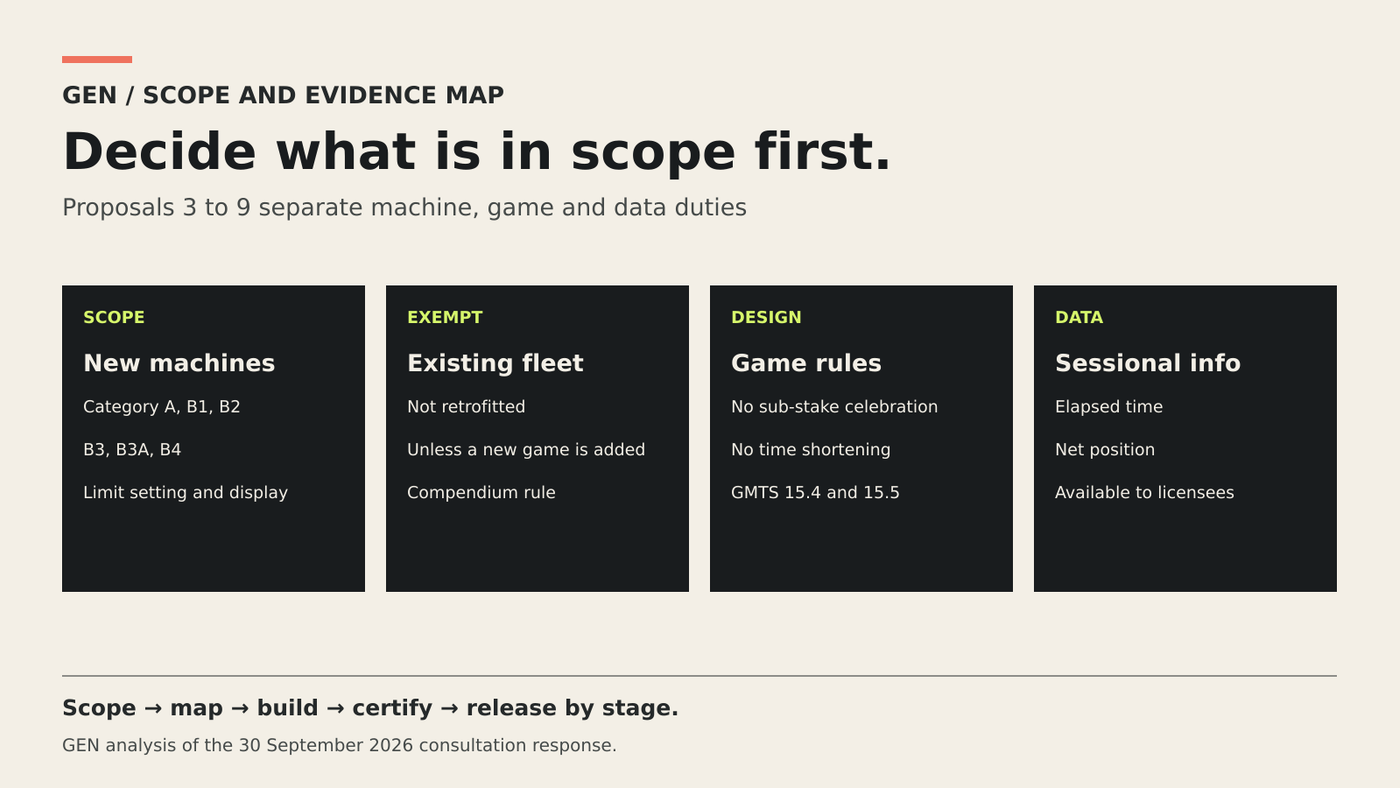
- Scope: list every machine and game, its category, and whether it is new or existing under the finalised standards.
- Map: convert the twelve proposals into owned requirements with a named engineer, designer and compliance reviewer.
- Build: implement the interim session definition and the 15.1 limit-setting behaviour, including the required defaults, breaks and display.
- Demonstrate: test session boundaries, limit ceilings, break durations and sessional display, and record every unavailable field or manual dependency.
- Release: book certification against the finalised testing strategy and stage deployment to meet 30 March 2027, 30 June 2027 and the 3 October 2028 hard stop.
Frequently asked questions
Do the new gaming machine standards apply to existing machines?
The Commission decided not to apply the limit-setting and sessional-information display standards to existing gaming machines. The exemption is conditional: where a new game is added to a compendium, the finalised wording requires all games on that compendium to comply.
When do the changes come into force?
The session definition comes into force on 30 March 2027. The bulk of the changes, including the consolidated standards and the finalised testing strategy, come into force on 30 June 2027. The staff-alert requirement comes into force on 3 October 2028.
What are the default machine limits?
Under GMTS 15.1b, default time limits must not exceed 20 minutes and default monetary limits must not exceed a net loss of £150. Customer-set limits are capped at 60 minutes and a £450 net loss. Customers cannot choose “no limits”.
Is this the same as the remote deposit-limit rules?
No. The gaming machine standards govern land-based gaming machines. The Remote Gambling and Software Technical Standards govern remote gambling software, and the Commission separately confirmed remote deposit-limit changes under RTS 12 with effect from 30 September 2026.
Should a supplier claim compliance now?
A supplier can document how a current product maps to the finalised wording. It should not present that mapping as certification, approval or a compliance finding. Formal conclusions need the adopted standard, the applicable configuration and the authorised testing route.
The decision rule
Decide scope before you decide spend. Identify which products are genuinely new under the finalised standards, build the session and limit-setting behaviour to the exact wording, and stage certification so the 30 March 2027 and 30 June 2027 dates are met with tested evidence rather than intentions. The existing fleet is exempt by design; the new-product roadmap is where this work belongs.
Visual analysis
Source record and operator framework
The first visual fixes the sourced facts. The second turns those facts into a practical review or decision path.
Evidence record
Sources used on this page
Each source supports a defined claim. Provider pages are identified as provider-supplied evidence.
- January 2025 Consultation on proposed changes to the GMTS, Testing Strategy and LCCP: Consultation ResponseGambling Commission · accessed Oct 5, 2026
The response sets out the Commission's final position on twelve proposals covering the Gaming Machine Technical Standards, the testing strategy and the LCCP, and the staged implementation dates.
- New machine rules to support consumers and operators to reduce harmGambling Commission · accessed Oct 5, 2026
The news article summarises the package, states that existing gaming machines are exempt, and confirms a staged implementation with the bulk of the changes coming into effect in June 2027.
- Blog — Gaming machine consultation update, September 2026Gambling Commission · accessed Oct 5, 2026
The blog records the consultation changes the Commission accepted, the three-stage timeline, the two-year staff-alert period described as a hard stop, and the request that stakeholders start planning now.
- Consultation Response — Final wording (Gaming Machine Technical Standard 15)Gambling Commission · accessed Oct 5, 2026
The final wording sets out requirements 15.1a to 15.1d for limit setting, including default time and monetary limits, break-in-play durations, and the staff-alert exception for the first and second default time limits.
- Consultation Response — Proposal 3, defining a gaming machine 'session'Gambling Commission · accessed Oct 5, 2026
Proposal 3 gives the definition of a session, its start and end points, and the interim standard that applies between 30 March 2027 and the consolidated standards.
- Gaming machine technical standards (finalised documents and dates)Gambling Commission · accessed Oct 5, 2026
The standards page lists the finalised interim session standard effective 30 March 2027 and the finalised Gaming Machine Technical Standards and Testing Strategy effective 30 June 2027.