News · evidence checked Oct 9, 2026
Brazil's MP 1.394 betting ban: the wind-down clock for operators
The measure has immediate force but must survive a Congressional vote to last. Operators face a platform shutdown before the authorisation itself lapses, a balance-refund chain executed through banks by taxpayer ID, and retained five-year data duties.
- Written by
- Fernando Polti
- Editor
- Fernando Polti
- Published
- Last material update
- Evidence checked
- Next review
- Editorial state
- approved

On 25 September 2026 President Luiz Inácio Lula da Silva signed Provisional Measure (Medida Provisória) 1.394, published that day in an extra edition of the Diário Oficial da União. The measure prohibits the exploitation, offer, intermediation and advertising of fixed-odds betting — the bets — across Brazil. It covers both bets on real sports events and online games, it applies to federal authorisations and to state and district concessions alike, and it has the force of law from publication. For any B2B team with Brazilian exposure, the decision to make is not whether the market closes but how the wind-down is sequenced, who executes each step, and what still has to be evidenced to the regulator afterwards.
Executive takeaway: treat MP 1.394 as a dated wind-down programme, not an open policy debate. The platform shutdown arrives before the underlying authorisation is extinguished; the player refund is executed by banks and payment institutions rather than by the operator; advertising and sponsorship removal runs on its own ten-day clock; and the five-year data, tax, anti-money-laundering and reporting duties survive the market’s closure. The measure’s own survival now depends on Congress, which is the single largest uncertainty in the file.
What MP 1.394 actually prohibits
Article 1 bans, in national territory, the exploitation, offer, intermediation and advertising of fixed-odds betting lotteries, in physical or virtual media, including where they are run by an agent based abroad that offers them to a person located in Brazil. Article 1(1) makes explicit that the ban reaches bets on real sports events and on virtual online game events. Article 1(2) carves out the other lottery modalities already authorised by law — this is not a prohibition on all Brazilian lotteries.
Article 2 extends the measure to exploitation licensed by the states and the Federal District, and provides that state and district concessions, permissions or authorisations are extinguished on the same timetable as the federal ones. Article 3 fixes the definitions, including a “fixed-odds bet” as staking value for a prize whose amount is set by a multiplier, and an “online game” as an electronic channel enabling a virtual bet on an outcome produced by a random-number generator under the ruleset. Article 29 revokes Chapter V of Law 13.756/2018 and large blocks of the 2023 betting law, Law 14.790/2023, that the regulated market was built on.
The scope matters commercially. A supplier, aggregator or platform that believed its Brazilian footprint was outside the licensed perimeter because it sat behind a federal licensee now has to test each entity and domain against Article 1’s extraterritorial clause.
Two clocks: the platform shutdown runs ahead of the authorisation deadline
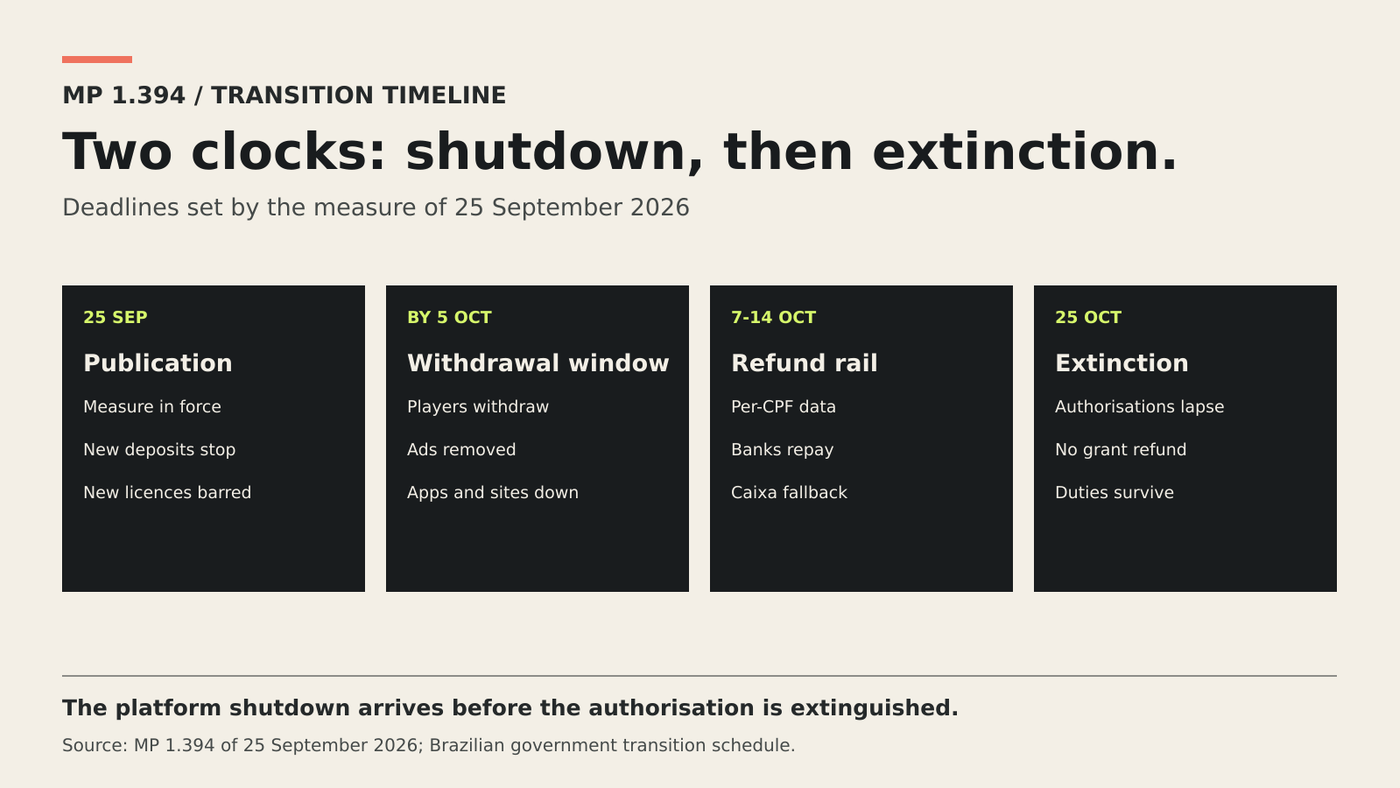
Confusing the two timetables is the most common operational error. The authorisation itself is extinguished 30 days after publication — by 25 October 2026 — under Article 4. But Article 7 requires operators to make their betting websites and internet applications unavailable, including in virtual stores, within ten days of publication, by 5 October 2026, under penalty of blocking. The Brazilian government’s published schedule has the platforms offline from 6 October.
| Date (2026) | What MP 1.394 requires |
|---|---|
| 25 September | Measure published in an extra Diário Oficial edition; new deposits into player transactional accounts prohibited |
| By 5 October | Players may voluntarily withdraw balances; operators must remove advertising and sponsorship material |
| By 5 October | Betting websites and applications made unavailable, including in app stores |
| 7–8 October | Operators report remaining balances to financial and payment institutions by CPF, deliver the same information to the Secretariat of Prizes and Betting (SPA) and prove the refund funds are available |
| 9–14 October | Financial and payment institutions execute full refunds |
| From 14 October | Balances that cannot be returned are transferred to a dedicated Caixa Econômica Federal account |
| 25 October | Concessions, permissions and authorisations are extinguished |
Two obligations are easy to miss because they start earlier than the shutdown. From publication, Article 7(1) bars new funds entering player transactional accounts, with a narrow exception for amounts demonstrably arising from the redemption, maturity, sale or settlement of financial assets already held, and only where they are used to meet the wind-down obligations. And Article 6 immediately stops new concessions, permissions or authorisations, while any application not yet decided on publication is set aside.
The refund is executed by the banks, not the operator
Article 7 also settles the open-bet question. Bets still open whose result has not been determined within the ten-day window are treated as without effect, with full restitution of the amount staked and no deductions permitted. Bets resolved inside the window keep their prizes. That is a clean line, and it removes a common dispute over whether an unresolved market should settle or void.
The refund chain is then imposed on the operator and, crucially, on the payments rails. Within two days of removing access, Article 8 requires the operator to ensure the availability and liquidity of the funds needed for full restitution — including available balances, the amounts for void bets and the prizes owed — to send the financial and payment institutions maintaining its transactional accounts an itemised per-CPF list of player, amount and source account, and to send that same information to the SPA with proof of the funds. Those refund funds stay segregated from the operator’s own estate and cannot be moved for anything other than paying players. Failing the Article 8 duties exposes the operator to a daily fine of R$200,000 until it complies, on top of other sanctions.
Article 9 then puts a seven-day clock on the banks and payment institutions, running from receipt of the operator’s data, to make full restitution by transfer to an active account held by the player identified by CPF, preferentially the account the money came from. Funds that cannot be returned move to a dedicated Caixa Econômica Federal account for payout under Ministry of Finance supervision. Article 9(4) is the sentence treasury teams should read twice: the bank-side refund does not discharge the operator’s responsibility for amounts not made available, for discrepancies found, or for other obligations arising from running the betting business.
For a payment team, this is a reconciliation problem before it is a legal one. It requires per-player balances mapped to CPF, a segregation model, a bank file format agreed with each institution, a dispute path for beneficiaries who cannot be paid, and an audit trail that satisfies both the banks and the SPA. GEN’s wallet reconciliation guide covers the failure paths that make this hard when a balance is disputed.
Advertising, app stores and the payment rails
Chapter IV turns the prohibition into controls on four intermediary layers.
- Advertising and sponsorship. Article 16 bans communication, advertising, marketing and sponsorship of fixed-odds betting in any physical or digital medium, reaching any content that offers, promotes, publicises or facilitates access to betting directed at the Brazilian public, whatever the format or whether it is paid. Existing advertising and sponsorship material must be withdrawn within ten days of publication (Article 16(2)). Article 17 preserves pre-existing editorial content where betting advertising is merely ancillary. Breach is treated as abusive advertising under Article 37(2) of the Consumer Defence Code, exposed to administrative sanctions including counter-advertising (Article 18).
- Internet applications, app stores and operating systems. Articles 19–21 place a duty of care on internet application providers to prevent and impede the circulation of banned content, even when generated by third parties, and to remove third-party content on notification by a consumer-defence authority or the Ministry of Justice; app stores and operating systems must prevent banned products and services being offered. Sanctions under Article 22 run from a warning, to a fine of up to 10% of the economic group’s Brazilian revenue in its last financial year (or, absent revenue, R$10 to R$1,000 per registered user, capped at R$50 million per infraction), to daily fines, temporary suspension and prohibition of activity.
- Payment rails. Article 14 prohibits financial institutions, payment institutions and the participants in payment arrangements, including instant payment, from processing, settling or enabling transactions for fixed-odds betting outside the wind-down and refund exceptions, under Banco Central rules. Article 15 requires the Banco Central to build an electronic data-communication system to reject transactions and interbank-return funds linked to illegal fixed-odds betting in real-time fund transfers. That is a structural change to how Pix-era rails screen betting traffic, not a one-off instruction.
- Site blocking. Article 23 lets the Ministry of Finance and the Ministry of Justice require the blocking or redirection of betting sites, with Anatel distributing the orders to internet providers and the Internet Steering Committee (CGI.br) handling names registered under “.br”.
No refund of the grant, and no compensation
Article 4’s sole paragraph is the most consequential commercial clause for licensees. The extinction arises “from a motive of public interest” and confers no right to a total or partial refund of the grant consideration paid under Article 12 of Law 14.790/2023, and no right to indemnity from the state. The government’s statement confirms the same position. It records that 85 authorisations had been granted, each at R$30 million, totalling R$2.55 billion.
That framing is deliberate: it answers, in advance, the argument that an expropriation-style taking should be compensated. Whether it holds is now a matter for the courts and Congress, not for the operator’s own balance sheet — and anyone modelling recovery value should treat the compensation question as contested and unresolved rather than settled.
The obligations that survive the market
The measure is explicit that closing does not clear the books. Article 10 keeps the operator bound, after extinction or cessation, to its regulatory, tax and pecuniary obligations including the statutory revenue destinations; to its anti-money-laundering, counter-terrorist-financing and proliferation-financing, responsible-gambling and sports-integrity duties; to providing authorities with the information needed for supervision; and to keeping data, documents and records — including on players, bets, financial operations and prize payments — intact and accessible for at least five years.
Article 11 keeps the operator transmitting activity data to the SPA through the Betting Management System (Sigap), including on players, bets, prizes, deposits, withdrawals, transactional accounts, remaining balances, refunds, revenue and legal destinations. Article 5 preserves the SPA’s supervisory authority over conduct during the period the authorisation was valid, and keeps operators obliged to maintain current legal-representative and contact details.
There is one narrow relief valve. Article 13 suspends administrative sanction proceedings not finally decided by the publication date; those proceedings are archived if the operator timely meets all of the chapter’s obligations. It is a compliance-completion incentive, not an amnesty.
The 120-day question that decides whether this lasts
MP 1.394 has the force of law now, but a provisional measure is temporary by construction. The Congress explainer states that a measure has an initial 60-day term, automatically extended by a further 60 days if voting is not concluded in both houses, and that it must be approved by the Chamber and the Senate to become ordinary law. The Congress matter record sets deliberation from 25 September to 23 November 2026, with amendments open to 13 October and the urgency regime — which blocks the agenda — from 9 November. The Senate’s own reporting frames the outer limit as a 120-day review.
In parallel, the Executive lodged bill PL 5.477/2026, which would typify five fixed-odds betting offences — exploitation (four to six years’ imprisonment), promotion or player solicitation, use of personal data to recruit bettors, financial facilitation, and provision of a betting application — with the Loteca sports lottery expressly excluded. The bill starts in the Chamber of Deputies and would need to pass both houses to become law.
The practical read: the wind-down requirements are in force and should be operated as such, but the durable legal position is unresolved. A measure that lapses, or that Congress rewrites, changes the end-state even though it does not undo the transition steps already under way. Rather than speculate on the vote, a supplier or operator should track two dates — the amendment window closing on 13 October and the deliberation deadline on 23 November — and re-verify primary records at each.
What this means for operators, platforms and payment teams
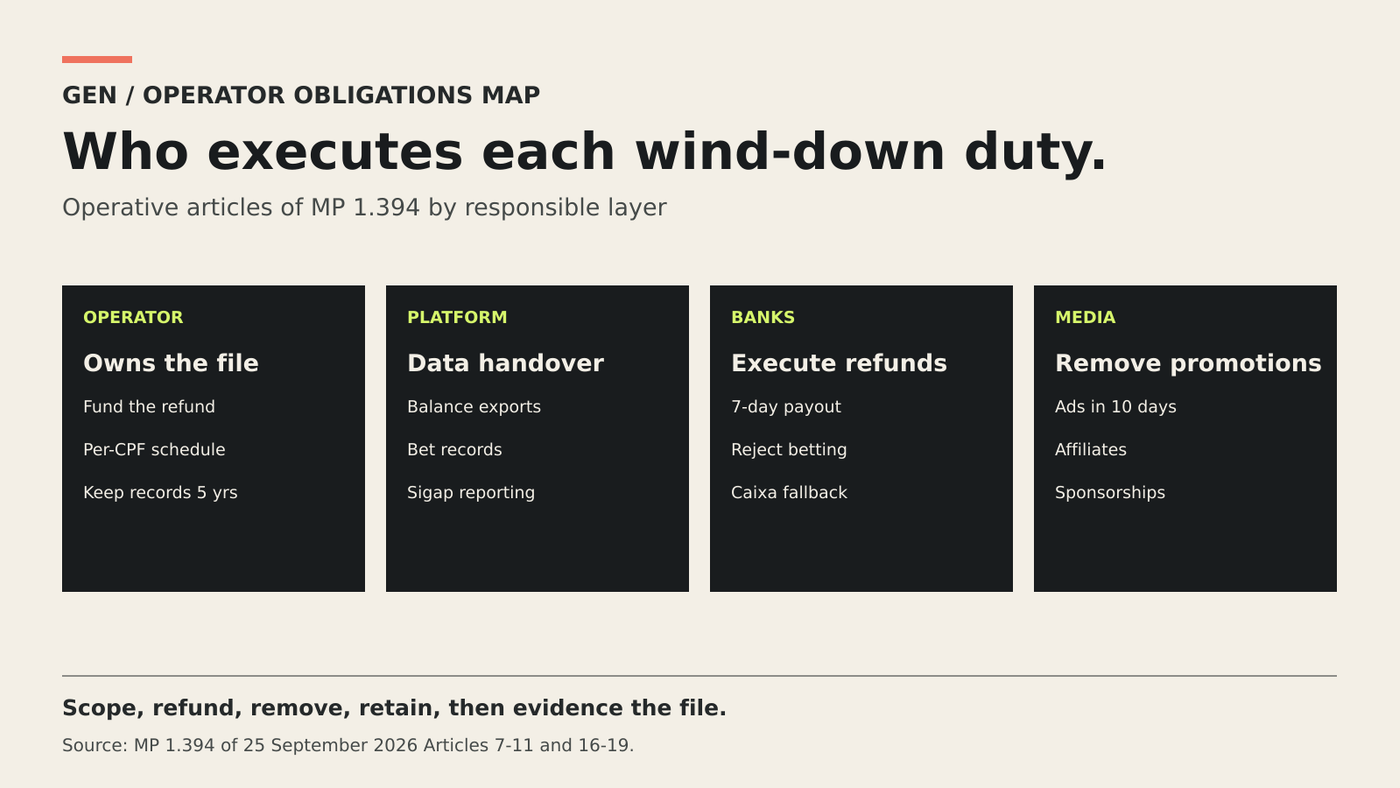
Licensed operators own the wind-down plan and the evidence file. That means the platform shutdown before the authorisation deadline, the per-CPF balance reconciliation, the segregated refund funds, the segregation and bank files, the advertising and sponsorship removal, and five years of retained data and Sigap reporting. The R$200,000 daily fine makes the refund-funding step the one to sequence first.
Platforms and PAM suppliers should expect their contracts to be re-read against the wind-down. Where the platform holds player balances, bet records or the transactional-account structure, the operator cannot complete Article 8 without the supplier’s cooperation on exports, reconciliation and retention. Those data-handover and exit clauses belong in the platform contract and the platform RFP evidence set, and GEN’s RGS/aggregator/platform responsibility map is the boundary to fix before assigning duties.
Payment institutions and banks carry the execution risk. Article 9 puts the refund obligation on them once the operator delivers the per-CPF data, Article 14 forces a change to how betting transactions are screened, and Article 15 points to a new Banco Central rejection-and-return system. Institutions serving Brazilian betting traffic should be re-testing their detection, rejection and refund mechanics now.
Affiliates, media and sponsors face the advertising prohibition directly. Article 16 reaches content directed at the Brazilian public whatever the format or whether it is paid, and Article 16(2) required existing material removed within ten days. Media operations with Brazilian betting inventory should treat their exposure as immediate.
Aggregators and white-label providers should not assume the operator’s shutdown covers them. Where the game content, the transactional accounts or the player data sit with the supplier, the operative duties still have to be evidenced by the entity holding the Brazilian authorisation, or by the supplier under Article 19’s duty of care.
A wind-down readiness sequence
- Map the perimeter: test every group entity, brand, domain and app against Article 1, including offshore agents offering to Brazilian players.
- Stop the inflow: close new deposits into player transactional accounts on publication, keeping only the narrow asset-settlement exception.
- Reconcile balances: build the per-CPF schedule of available balances, void-bet amounts and owed prizes, and segregate the refund funds.
- Shut the shopfront: take websites and apps, including app-store listings, offline before the ten-day deadline.
- Hand over the file: deliver the bank and SPA data, then track the bank-stage refunds and the Caixa fallback for unpayable balances.
- Close the surface: remove advertising and sponsorship material, and screen affiliate and media inventory against Article 16.
- Keep the record: preserve five years of player, bet, financial and prize records and keep Sigap reporting live; hold the file for the length of the Congress review.
Frequently asked questions
Does MP 1.394 ban all gambling in Brazil?
No. Article 1 prohibits fixed-odds betting — bets whose prize is set by a multiplier — covering real sports events and online games. Article 1(2) expressly leaves the other lottery modalities authorised by law untouched, and the accompanying bill excludes the Loteca sports lottery.
When do betting sites have to go offline?
Article 7 requires betting websites and internet applications to be made unavailable, including in virtual stores, within ten days of publication — by 5 October 2026 — under penalty of blocking. The government’s published schedule has platforms offline from 6 October. The underlying authorisation is not extinguished until 25 October, thirty days after publication.
Does the operator repay players, or do the banks?
Both, in sequence. Operators must fund and itemise the refund by CPF and prove the funds are available; the financial and payment institutions execute the actual transfers within seven days of receiving the operator’s data, with a Caixa Econômica Federal fallback for balances that cannot be returned. The operator’s responsibility is not discharged by a bank-stage refund.
Do operators get their licence fees back?
No, per Article 4’s sole paragraph: extinction arises from public interest and confers no right to a refund of the grant consideration and no indemnity from the state. The government records 85 authorisations at R$30 million each. Whether that position survives legal challenge is unresolved.
Is the ban permanent?
Not yet. A provisional measure has immediate force but must be approved by both houses of Congress to become ordinary law; it has a 60-day term, automatically extended by 60 days if voting is unfinished. The Congress matter record schedules deliberation to 23 November 2026, with the urgency regime from 9 November. A companion bill, PL 5.477/2026, would criminalise betting offences but has not passed.
The decision rule
Read MP 1.394 as a compliance programme with a hard calendar, not a policy story to wait out. Shut the platforms before the authorisation clock runs out, build the refund around the banks rather than the operator, remove advertising on its own ten-day deadline, keep the five-year record and the regulator reporting alive, and treat the compensation claim and the Congressional outcome as live uncertainties. The market has been ordered to close; the discipline now is proving that the wind-down was executed and evidenced, whatever Congress decides next.
Visual analysis
Source record and operator framework
The first visual fixes the sourced facts. The second turns those facts into a practical review or decision path.
Evidence record
Sources used on this page
Each source supports a defined claim. Provider pages are identified as provider-supplied evidence.
- Medida Provisória nº 1.394, de 25 de setembro de 2026Presidência da República / planalto.gov.br · accessed Oct 9, 2026
The measure text prohibits the exploitation, offer, intermediation and advertising of fixed-odds betting lotteries, covers real sports events and online games, applies to state and district authorisations, extinguishes the authorisations 30 days after publication without refund of the grant or indemnity, sets the ten-day platform shutdown, the balance-refund chain through financial and payment institutions, the advertising ban, the internet-provider and app-store duties, the blocking route through Anatel and CGI.br, and the surviving five-year data, tax and anti-money-laundering obligations. It enters into force on publication.
- MPV 1394/2026 — Congresso Nacional matter recordCongresso Nacional · accessed Oct 9, 2026
The Congress record confirms publication in the Diário Oficial da União of 25 September 2026, Extra Edition A, pages 1–3, and the processing timetable: deliberation from 25 September to 23 November 2026, an amendment window to 13 October 2026, and the urgency regime from 9 November 2026.
- MP proíbe bets e determina encerramento das operações em 30 diasAgência Senado / Senado Federal · accessed Oct 9, 2026
The Senate news service records the 30-day extinction of authorisations, the prohibition on new deposits from publication, the 5 October withdrawal deadline, the 6 October platform shutdown, the bank refund route, the R$200,000 daily fine, the Banco Central communication system for rejecting and returning payments linked to illegal betting, the advertising and sponsorship ban, the app-store and internet-provider duties, the blocking route, and that the measure must be examined within 120 days to become permanent law.
- Presidente Lula assina Medida Provisória que proíbe as bets no BrasilMinistério da Saúde (Brazil) · accessed Oct 9, 2026
The government's published transition schedule runs from publication and the deposit ban, to the 5 October withdrawal and advertising-removal deadline, the 6 October shutdown, the 7–8 October balance reporting, the 9–14 October bank refunds and the 14 October Caixa fallback; it records that 85 authorisations had been granted at R$30 million each (R$2.55 billion), that extinction arises from public interest and confers no indemnity or refund of the grant, and that sanctions range from a warning to fines up to R$2 billion.
- Brazil bans online gambling; bettors to receive refundsAgência Brasil (EBC) · accessed Oct 9, 2026
The federal news agency records the announcement on 25 September, that platforms are barred from accepting new bets as of publication, the transition period for authorised companies, the refund route through the banks and, where needed, Caixa Econômica Federal, the enforcement resources directed to the Ministry of Justice and the Federal Police, and President Lula's on-the-record statements about the rationale.
- Chega ao Congresso projeto que torna crime a exploração de betsAgência Senado / Senado Federal · accessed Oct 9, 2026
The Senate news service records that the Executive sent bill PL 5.477/2026 to typify five fixed-odds betting offences with the listed penalties, that it starts in the Chamber of Deputies, and that the Loteca sports lottery is expressly excluded.
- Entenda a Tramitação da Medida ProvisóriaCongresso Nacional · accessed Oct 9, 2026
The Congress explainer states that a provisional measure has the force of law immediately, has an initial 60-day term that is automatically extended by a further 60 days if voting is not concluded, and must be considered by both houses to convert definitively into ordinary law.
- Lei nº 14.790, de 29 de dezembro de 2023Presidência da República / planalto.gov.br · accessed Oct 9, 2026
The 2023 betting law is the regulatory framework MP 1.394 amends and substantially revokes; it is the instrument under which the 85 authorisations and the grant consideration referenced by the measure were issued.