News · evidence checked Oct 26, 2026
Italy's betting-brand exclusion: what AGCOM's §7 rewrite changes
The Dignity Decree's §7 let a gambling brand sit inside a media business that looked independent. The replacement would require proof of genuine autonomy, a registered newsroom and no route to the betting account.
- Written by
- Fernando Polti
- Editor
- Fernando Polti
- Published
- Evidence checked
- Next review
- Editorial state
- approved

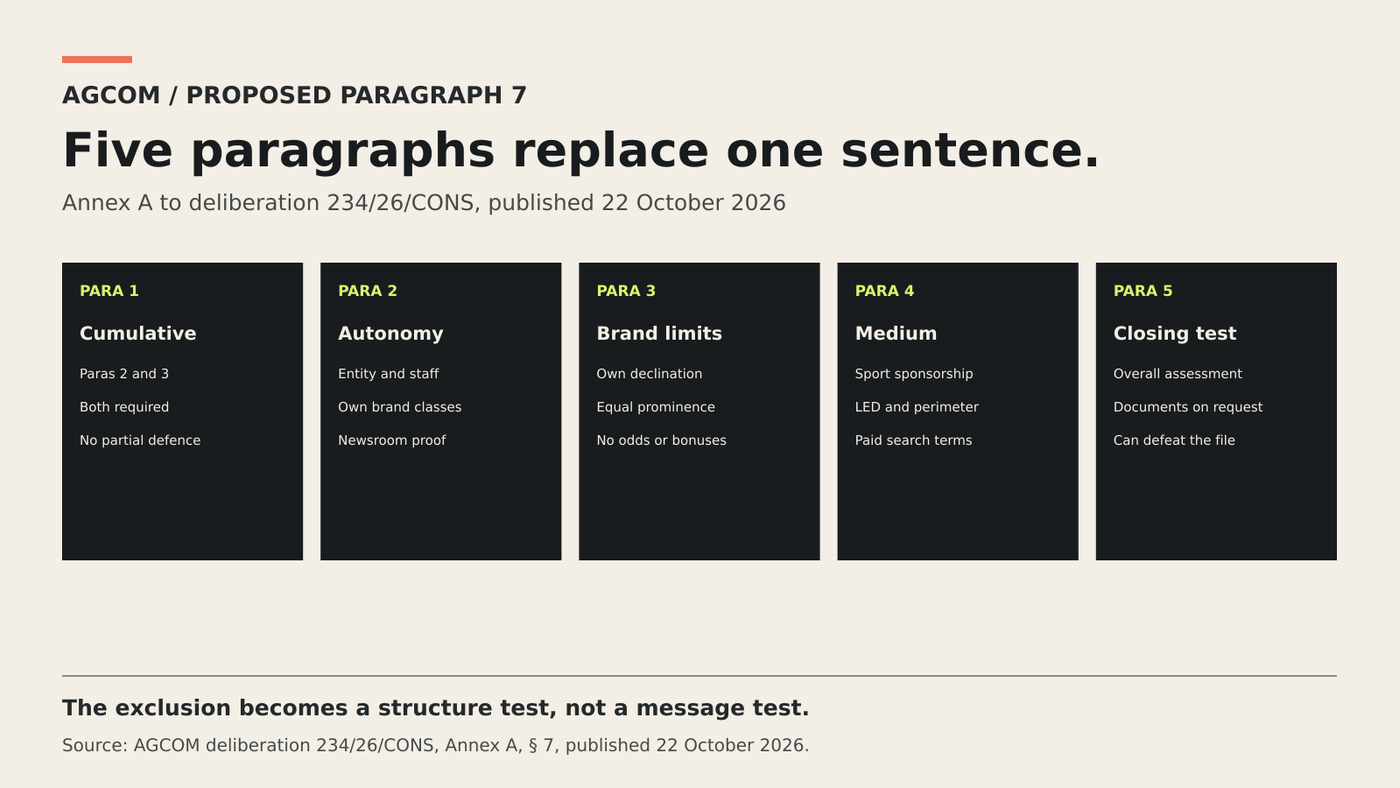
On 22 October 2026 the Autorità per le Garanzie nelle Comunicazioni published a deliberation that opens a thirty-day public consultation on replacing paragraph 7 of its 2019 gambling-advertising guidelines. The paragraph that exists today is one sentence long. The replacement proposed in Annex A is five numbered paragraphs, a cumulative two-part test, a list of five editorial limits, a medium-specific escalation and a closing clause that lets the Authority demand brand, organisational, traffic and economic-relationship documentation. The change is not a marginal tidy-up of wording. It converts Italy’s only formal route for a betting brand to sit inside an apparently non-gambling media business into a structural test of whether that business is real.
Executive takeaway: for any operator, affiliate, publisher or brand-licensing team using a shared betting brand in Italy, the compliance question stops being “does this message look ambiguous?” and becomes “can we document that the further activity is genuinely separate?” The draft text asks for entity-level organisation, its own production processes, its own registered brand in unrelated merchandise classes, a registered newsroom with a named editor and verifiable periodicity where the activity is editorial, and no hyperlink, redirect, banner, promo code, shared credential, single-account system or prize mechanism that reaches the betting account. Meeting those conditions is necessary but not sufficient: paragraph 5 preserves an overall assessment of message, medium, context and audience. Comments close on 21 November 2026, and the text published on 22 October is a proposal, not a rule in force.
What paragraph 7 actually said
The 2019 guidelines implement article 9 of the Dignity Decree, which prohibits advertising, sponsorship and other promotional communication relating to money-win gambling on any medium. Against that general ban, paragraph 7 listed categories that fall outside it. One of those categories is the one now in play: “the use of the brand that identifies, in addition to money-win or gambling services, further activities having an autonomous character, provided that no ambiguity exists about the object of the promotion and that no gambling-evocative elements appear in it other than the provider’s mere denomination.”
Two conditions sat inside that sentence: the promotion must not be ambiguous about what it is promoting, and the message must not carry gambling cues beyond the provider’s name. The operative phrase — “autonomous character” — was never defined. Nothing in the text asked how the further activity was staffed, funded, organised, edited or technically separated from the betting business. The test was applied to the communication, not to the company behind it. That is the loophole: a betting brand could appear inside football coverage, sports news or lifestyle content as long as the individual page or spot avoided odds, bonuses, jackpots and other gambling markers. The business relationship underneath — shared ownership, shared traffic routing, shared accounts — sat outside the test.
For an operator or affiliate, the practical consequence was predictable. Build or buy a media property that wears the newsroom’s shape, keep the gambling cues off the page, and the shared brand could stay in front of an audience that the advertising ban would otherwise keep it away from. The Authority’s own later finding describes the pattern more sharply: in deliberation 200/26/CONS it observed that distinctive signs referable to concessionaires, combined with denominations or extensions such as “.live”, “.sport” or “.news”, can take on a promotional or evasive function.
Why the Authority moved now
The sequence matters, because it shows the Authority deliberately separated two questions and answered them in order. Deliberation 200/26/CONS, adopted at the Council meeting of 29 July 2026, set supplementary guidelines for communication campaigns against gambling disorders. In its recitals it flagged the extension problem. But it also suppressed its own section on the boundary between permitted information and prohibited promotion — including the passages on advertising overcrowding during live sports broadcasts and on infotainment — on the ground that those matters belong to article 9 and the 2019 guidelines and are handled through supervision and sanctions. In other words, the responsible-gaming instrument named the problem and then declined to solve it, because the solution belonged somewhere else.
Deliberation 234/26/CONS is that elsewhere. Adopted on 7 October 2026 and published on 22 October 2026, it opens the consultation on replacing paragraph 7. Its recitals cite article 9, paragraph 7 and the paragraph 42 finding from the July deliberation, and state that the opportunity to clarify the premises and limits of the exclusion emerged in implementation of what 200/26/CONS had anticipated. The thirty-day term runs from publication. On the Authority’s own calendar that puts the deadline at 21 November 2026. The deliberation names Davide Gallino of the Direzione servizi media e tutela dei diritti fondamentali as responsible official and is signed by President Giacomo Lasorella and Secretary General Giovanni Santella.
Three independent Italian publications reported the publication on 22 October 2026. One of them records the Authority’s language directly: submissions must arrive within the mandatory term of thirty days from publication of deliberation 234/26/CONS on the Authority’s website, “which is today, 22 October”.
The replacement: five paragraphs, one gate
Annex A keeps the structure of a numbered paragraph but fills it with conditions. Read as a whole, it is a gate rather than a list.
| Paragraph 7 today (2019) | Proposed paragraph 7 (Annex A to 234/26/CONS) | |
|---|---|---|
| Length | One alinea | Five numbered paragraphs |
| Unit of assessment | The communication’s appearance | The further activity’s structure and the communication’s appearance |
| Autonomy | Undefined “autonomous character” | Paragraph 2(a)–(d): stable, continuous, habitual exercise with autonomous organisation, resources and production processes; not accessory, instrumental or traffic acquisition; specific brand registered in unrelated classes; editorial conditions where applicable |
| Editorial proof | None | ROC registration where applicable, named editor-in-chief, identifiable newsroom, actual verifiable periodicity, original content; a site declared not to be a newspaper for lack of periodicity cannot invoke the exclusion |
| Link surface | Not addressed | No hyperlinks, redirects, banners, promo codes, shared credentials, registration or single-account systems, prize events or other routes to the same operator’s or group’s gambling offer — nor the statutory responsible-gambling initiatives |
| Brand use | No gambling cues except the provider’s name | Brand reproduced only in the further activity’s own declination; no lettering, colour range, payoff or figurative symbol of the gambling brand; equal prominence where names overlap |
| Medium | Uniform | Paragraph 4: particular rigour for sponsorship, billboards and LED systems in sports contexts; same caution for paid search on gambling keywords and on comparison or review pages |
| Closing test | None | Paragraph 5: exclusion fails where the overall assessment shows an advertising hook; documentation can be requested |
Paragraph 1 makes the structure explicit: the exclusion operates only where the conditions in paragraphs 2 and 3 are met cumulatively, and remains subject to the verification in paragraph 4 and the closing assessment in paragraph 5. Nothing in the draft preserves the old single-sentence route as an alternative.
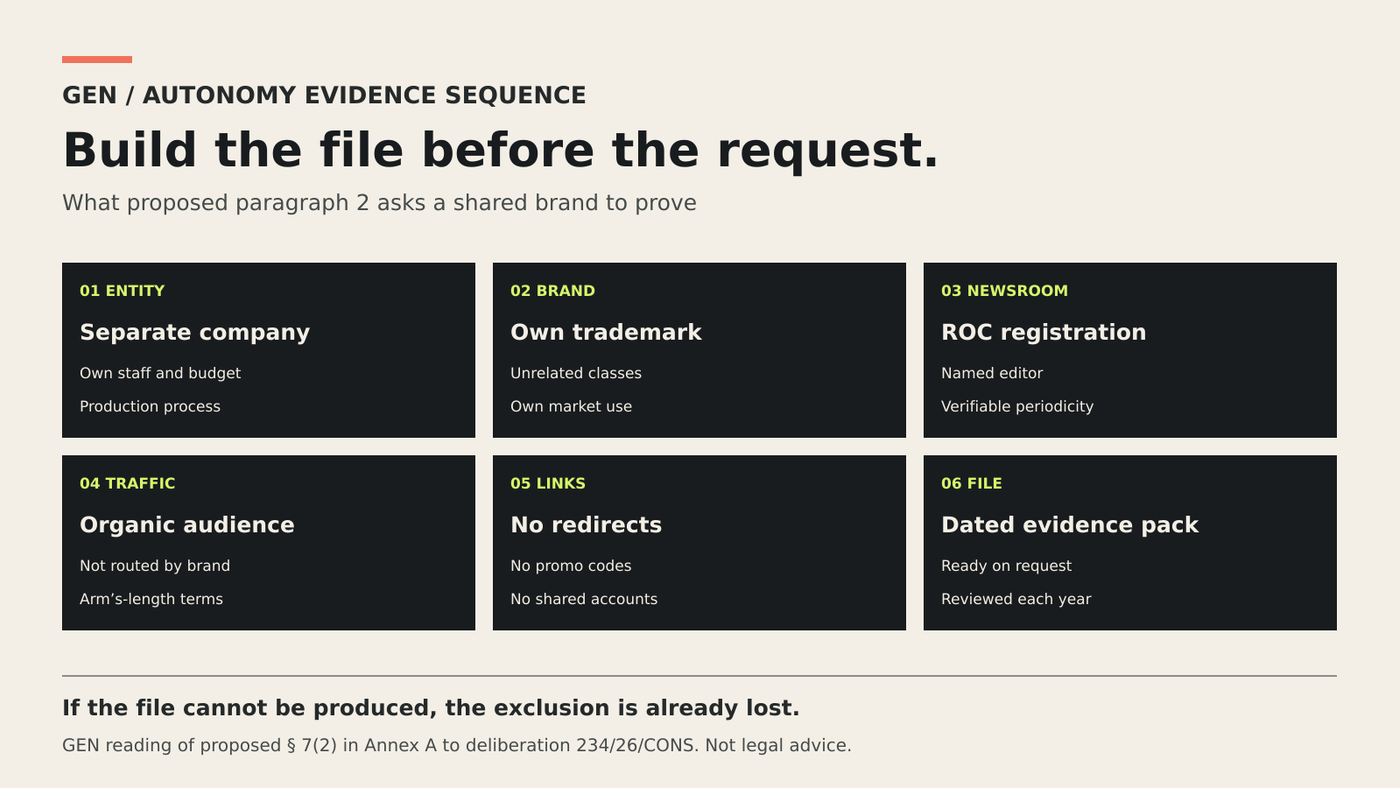
Paragraph 2 is the autonomy test, and it is where most arrangements will fail first. Letter (a) requires the further activity to be genuinely and stably exercised, continuously, habitually and not occasionally, with autonomous organisational structure, resources and production processes, and not resolved into an accessory, instrumental or traffic-acquisition function for the gambling offer. Letter (b) requires a specific brand registered in merchandise classes not connected to money-win gambling products and services. Letter (c) applies to information services and editorial content: registration in the Registro degli operatori di comunicazione where the conditions apply, a named editor-in-chief, an identifiable newsroom, actual and verifiable periodicity of updates and original content. It adds a trap: a subject that declares, in any form, that its site or service is not a newspaper because it lacks periodicity cannot invoke the exclusion. Letter (d) removes the technical bridge — no hyperlinks, redirects, banners, promo codes, shared access credentials, registration or single-account systems, prize events or other means that enable or ease access to the gambling offer of the same operator or of subjects in the same group, and no responsible-gambling initiatives under article 15(2) and (3) of legislative decree 41/2024.
Paragraph 3 governs how the brand may appear in the further activity’s communication. The brand must be reproduced in the declination proper to that activity. The lettering, colour range, payoff, figurative symbol and other visual identity elements of the gambling brand cannot be reproduced. Where the sign shares denominative elements with the gambling brand, the distinctive component must be rendered with characters of size, weight and colour contrast not inferior to the coinciding component and cannot be placed in a subordinate graphic position. The communication must identify explicitly the good or service being promoted; mere display of the sign, without an indication of the further activity, does not fall within the exclusion. Odds, predictions, jackpots, bonuses, betting slips, interfaces or prize mechanisms, and any other element referable to the gaming experience, cannot appear. Nor can the concession identification number, the institutional logo of the Agenzia delle dogane e dei monopoli, the gambling risk warnings or any other element prescribed for communications about the gambling offer — their presence is treated as an index that the message belongs to gambling.
Paragraph 4 escalates by medium. The Authority says it will assess with particular rigour communications carried through sponsorship, billboards, LED systems or other means placed in sports contexts, because of the high contiguity of those means with the gambling offer and the consequent risk that use of the brand, even for an autonomous activity, produces an advertising hook anyway. The same caution applies to paid positioning on keywords referring to gambling, betting or operator brands, and on the pages of sites dedicated to offering, comparing or reviewing gambling services. This is the paragraph that reaches the arrangements most operators actually run: shirt and perimeter sponsorship, stadium LED, and paid search bought against betting terms.
Paragraph 5 is the closing clause and the evidence lever. The exclusion does not operate in any case where, in the light of an overall assessment of the message, the medium, the context of dissemination and the audience reached — taking account of the paragraph 4 cautions — the communication produces an advertising hook to the gambling offer. For the purpose of verifying paragraphs 2 and 3, the Authority may request from the interested party documentation on brand ownership and registration, on the organisational set-up and the manner in which the further activity is exercised, on traffic flows, and on the economic relationships between the further activity and the gambling activity.
What “genuine autonomy” looks like as documents
The draft is unusual among advertising rules in that it describes an evidence file rather than a message style. Translated into the documents a compliance, legal or commercial team would need to hold, paragraph 2 reads like this.
| Condition | Evidence a team should be able to produce |
|---|---|
| Stable, continuous, habitual exercise (2a) | Corporate records for the further activity; staff and contractor list; separate budget and profit-and-loss; production workflow; publication or output calendar showing regularity rather than campaign bursts |
| Not accessory, instrumental or traffic acquisition (2a) | Traffic-source analysis separating organic and direct audience from traffic routed by the betting brand; commercial agreements at arm’s length; evidence that the further activity’s output is not built to feed the betting funnel |
| Own brand in unrelated classes (2b) | Trademark registration certificates; Nice classification list; evidence the registered mark is used in the further activity’s own market |
| Editorial independence (2c) | ROC registration number where applicable; named editor-in-chief with appointment record; newsroom organisation chart; periodicity log; samples of original content; a clear statement that the site does not hold itself out as a non-newspaper |
| No route to the betting account (2d) | Link audit across every section and feature; redirect map; banner and promo-code inventory; identity and account architecture showing no shared credentials or single sign-on; no prize mechanics; confirmation that the operator’s statutory responsible-gambling initiatives are not carried on the further activity |
| Brand discipline (3a–3b) | Approved logo lock-up for the further activity; colour and typography specification; layout examples showing equal prominence for shared names |
| Content discipline (3c–3e) | Page templates; editorial style rules barring odds, predictions, jackpots, bonuses, slips and interfaces; checks that concession numbers, ADM marks and risk warnings are absent |
Two entries in that table deserve emphasis because they are easy to miss. First, letter (d) reaches responsible-gambling initiatives: the draft says the exclusion is lost where the further activity carries the operator’s article 15 campaigns. An operator cannot use its statutory safer-gambling communication as the bridge that keeps its brand inside the media property. Second, letter (c)’s non-newspaper trap closes an argument that was previously available: a site cannot claim the exclusion while telling the Authority or the market that it is not a newspaper because it does not publish periodically.
Where the proposal is stricter than it first reads
Four features make the draft more demanding than a plain restatement of the old test.
- The cumulative gate. Paragraph 1 does not allow a partial defence. An arrangement that satisfies the ownership conditions but leaves one promotional link in place fails paragraph 2(d); one that satisfies the link rules but cannot show periodicity fails paragraph 2(c). The old sentence could be argued clause by clause. The replacement cannot.
- The sports-context escalation. Sponsorship, billboards and LED systems in sport are the media most likely to carry a betting brand into a football audience. Paragraph 4 says they will be assessed with particular rigour, which is the opposite of a safe harbour for the highest-value inventory.
- The closing clause overrides compliance. Even a fully documented arrangement fails if the overall message, medium, context and audience create an advertising hook. Documentation is a condition of entry, not a defence on the merits.
- The document request. Paragraph 5 gives the Authority an explicit power to demand brand, organisational, traffic and economic-relationship records. That converts the exclusion into an audit surface: the question is not only what the page looks like but what the file shows when requested.
What the proposal does not decide
Five limits matter for planning.
- It is a consultation, not a rule. The text published on 22 October 2026 is a proposal annexed to a deliberation that opens a thirty-day consultation. The Authority will review submissions and may change the text. Nothing in the draft is in force yet.
- It does not change article 9. The general prohibition and its sanctions remain. Only the perimeter of the exclusion moves. An arrangement that loses the exclusion does not become lawful by relabelling; it returns to the general ban.
- It does not settle press-law independence. ROC registration is required “where the conditions apply”, and the draft adds editorial conditions. But whether a registered newspaper that is commercially tied to an operator is independent under Italian press law is a separate question that this text does not answer.
- It does not define the group. Paragraph 2(d) refers to the same operator “or subjects belonging to the same group”, and paragraph 5 allows the Authority to request records on economic relationships. How a group is delimited, and how minority stakes or commercial-only relationships are treated, is left to case-by-case assessment.
- It does not grandfather existing arrangements. The draft contains no transition rule for contracts or brand licences signed before 22 October 2026. An arrangement that relies on the old sentence has no stated protection while the consultation runs.
The thirty-day window and what to do with it
The consultation closes on 21 November 2026. Annex B allows submissions to contain observations, proposed amendments and reasoned changes to the provisions in Annex A, and allows a respondent to request a hearing. Submissions are published in full and non-anonymous form unless the respondent marks specific parts for withholding. That is a real opportunity for an operator, publisher or agency with a live arrangement, and a real exposure for one that would rather not describe its structure in public.
For a team that needs to decide rather than lobby, the sequence is:
- Inventory the surface. List every place in Italy where a betting brand appears in a non-gambling context: owned media, licensed brand use, sponsorship inventory, paid search, affiliate content, social accounts, comparison pages.
- Classify each against paragraph 2(a)–(d). For each item, name the document that proves the condition. Where no document exists, treat the condition as unmet.
- Check the editorial file. If the activity is information or editorial, confirm ROC status, the named editor, the newsroom, the periodicity log and original content. If the site declares itself not to be a newspaper, the exclusion is unavailable.
- Audit the link surface. Every hyperlink, redirect, banner, promo code, shared login and prize mechanic that reaches the betting account is a failure under 2(d), including the responsible-gambling pages.
- Re-rate the sports inventory. Treat shirt, perimeter and LED sponsorship as the highest-scrutiny category, and price the risk accordingly.
- Choose: restructure, relabel or withdraw. Restructuring means separating entity, staff, budget, brand, traffic and technical access. Relabelling alone does not satisfy the draft. Withdrawal means ending the brand use before the final measure lands.
- If you want to shape the text, file by 21 November 2026. A submission that documents a real structure is more useful to the Authority than an objection in principle — and Annex B lets you ask for a hearing.
Frequently asked questions
Does this ban betting brands from owning media in Italy?
No. The draft does not prohibit ownership. It tightens the conditions under which a shared brand can be used for further activities, and it makes the further activity’s organisational and editorial reality the object of the test. An owned media business can still qualify — but it has to look and behave like a separate business, not a marketing channel with a masthead.
Is infotainment now banned?
No. The draft does not ban the format. It removes the formal safe harbour and replaces it with an autonomy test. Promotional content about gambling was already caught by article 9; what changes is that an ostensibly informational or sports site can no longer rely on the old one-sentence exclusion without proving its independence.
Does ROC registration settle the question?
No. Registration is required “where the conditions apply”, and it is one condition among several. A registered newspaper that shares ownership, traffic routing, accounts or brand identity with a betting operator still fails paragraph 2. Registration is a threshold, not a certificate.
What happens to sponsorship and stadium LED?
They are not automatically banned, but paragraph 4 puts them in the highest-scrutiny category. A sponsorship that carries the betting brand into a sports context will be assessed for an advertising hook even if the sponsored activity is nominally autonomous. The draft’s caution is explicit, and the closing clause in paragraph 5 applies on top.
When does this take effect?
Not on 22 October 2026. That date is publication of the deliberation and the start of the thirty-day consultation. The deadline for submissions is 21 November 2026. The Authority will then decide the final text, which may differ from Annex A. Until then, the 2019 paragraph 7 remains the applicable text.
The decision rule
Treat the 22 October publication as the start of a documented evidence project, not as a press release. The exclusion is being rewritten from a test of how a promotion looks into a test of what the business is, and the evidence that decides it sits in corporate, editorial, traffic and technical records that most brand-licensing arrangements have never had to assemble. If the file cannot be produced on request, the arrangement is already outside the proposed perimeter — whatever the page looks like. The thirty days to 21 November 2026 are the only window in which the text can still be changed, and the only period in which a team can find out, cheaply, whether its structure would survive the version now on the table.
Visual analysis
Source record and operator framework
The first visual fixes the sourced facts. The second turns those facts into a practical review or decision path.
Evidence record
Sources used on this page
Each source supports a defined claim. Provider pages are identified as provider-supplied evidence.
- Delibera n. 234/26/CONS — Avvio della consultazione pubblica relativa alla modifica del § 7 (Esclusioni) delle linee guida di cui all'allegato A alla delibera n. 132/19/CONSAutorità per le Garanzie nelle Comunicazioni (AGCOM) · accessed Oct 26, 2026
The deliberation records that the Authority adopted it at the Council meeting of 7 October 2026 and published it on its website on 22 October 2026. It fixes a term of thirty days from publication for interested parties to submit observations. Its recitals cite article 9 of decree-law 87/2018, paragraph 7 of the guidelines annexed to deliberation 132/19/CONS, and paragraph 42 of deliberation 200/26/CONS, which found that distinctive signs referable to concessionaires combined with denominations or extensions such as .live, .sport or .news can take on a promotional or evasive function under the gambling advertising prohibition. It names Davide Gallino of the Direzione servizi media e tutela dei diritti fondamentali as responsible official and is signed by President Giacomo Lasorella and Secretary General Giovanni Santella.
- Allegato A alla Delibera n. 234/26/CONS — Proposta di modifica del § 7 (Esclusioni) delle linee guida di cui all'allegato A alla delibera n. 132/19/CONSAutorità per le Garanzie nelle Comunicazioni (AGCOM) · accessed Oct 26, 2026
The annex contains the proposed replacement for paragraph 7 in five numbered paragraphs: cumulative application of paragraphs 2 and 3 in paragraph 1; the conditions of genuine autonomy in paragraph 2 letters (a) to (d), including stable continuous exercise with autonomous organisation, resources and production processes, a specific brand registered in merchandise classes not connected to money-win gambling, registration in the Registro degli operatori di comunicazione where the conditions apply with a named editor-in-chief, identifiable newsroom, actual verifiable periodicity and original content, and the prohibition on hyperlinks, redirects, banners, promotional codes, shared credentials, registration or single-account systems and prize events that enable or facilitate access to the same operator's or group's gambling offer; the editorial and representation limits in paragraph 3 letters (a) to (e); enhanced scrutiny for sponsorship, billboards, LED systems and paid search in paragraph 4; and the closing clause with the Authority's power to request brand, organisational, traffic and economic-relationship documentation in paragraph 5.
- Allegato B alla Delibera n. 234/26/CONS — Modalità di consultazioneAutorità per le Garanzie nelle Comunicazioni (AGCOM) · accessed Oct 26, 2026
The annex sets out the consultation procedure: submissions may contain observations, proposed amendments and reasoned changes to the provisions in Annex A, and respondents may request a hearing. The Authority publishes the observations and documents received in full and in non-anonymous form, taking account of the accessibility level indicated by respondents, and asks respondents to identify precisely which parts should be withheld from access.
- Allegato A alla Delibera n. 132/19/CONS — Linee guida sulle modalità attuative dell'art. 9 del decreto-legge 12 luglio 2018, n. 87Autorità per le Garanzie nelle Comunicazioni (AGCOM) · accessed Oct 26, 2026
The 2019 guidelines set out the implementing rules for article 9 of decree-law 87/2018. Their paragraph 7 excludes, among other things, the use of a brand that identifies further activities beyond money-win or gambling services, provided that there is no ambiguity about the object of the promotion and no gambling-evocative elements appear in it other than the provider's mere denomination. The guidelines also record the general prohibition in article 9 and the procedural and sanctioning rules that accompany it.
- Delibera n. 200/26/CONS — Atto integrativo delle linee guida per le campagne di comunicazione contro i disturbi da gioco d'azzardoAutorità per le Garanzie nelle Comunicazioni (AGCOM) · accessed Oct 26, 2026
The deliberation, adopted at the Council meeting of 29 July 2026, records in the recital cited by deliberation 234/26/CONS that distinctive signs referable to concessionaires combined with extensions such as .live, .sport or .news can take on a promotional or evasive function. Its own text records that it suppressed its section on the boundary between permitted information and prohibited promotion, including the sections on advertising overcrowding during live sports events and on infotainment, on the ground that those matters belong to article 9 of decree-law 87/2018 and the guidelines annexed to deliberation 132/19/CONS, and are handled through the Authority's supervisory and sanctioning powers.
- Article 9, decree-law 12 July 2018, n. 87 (Dignity Decree), converted by law 9 August 2018, n. 96Normattiva (Italian official legal database) · accessed Oct 26, 2026
Article 9 maintains a general prohibition on advertising, sponsorship and other promotional communication relating to money-win gambling on any means of communication. It provides the sanction framework applied by the Authority. The provision is quoted and applied in the 2019 guidelines annexed to deliberation 132/19/CONS.
- Pubblicità giochi, Agcom: stretta su news e marchiAGIMEG · accessed Oct 26, 2026
Independent Italian trade reporting, dated 22 October 2026, records that AGCOM has moved on news sites and brands, that the proceeding was opened with deliberation 234/26/CONS dated 7 October 2026 and published on the Authority's website on 22 October 2026, and that the intervention concerns paragraph 7 of the guidelines approved with deliberation 132/19/CONS.
- Agcom, al via la consultazione sulle Linee guida sull'infotainment: 30 giorni di tempoItalian Gaming News · accessed Oct 26, 2026
Independent Italian trade reporting, published 22 October 2026, records that the Authority invited interested parties to submit contributions within a mandatory term of thirty days from publication of deliberation 234/26/CONS on its website, which it states was 22 October 2026. It summarises the proposed requirements as identifiable newsrooms, named editors-in-chief, autonomous brands and no functional connection with the same group's gambling platforms, and records that entities declaring their site is not a registered newspaper because it lacks periodicity cannot invoke the exclusion.