News · evidence checked Oct 21, 2026
The CFTC's event-contract line: what the 19 October rules settle
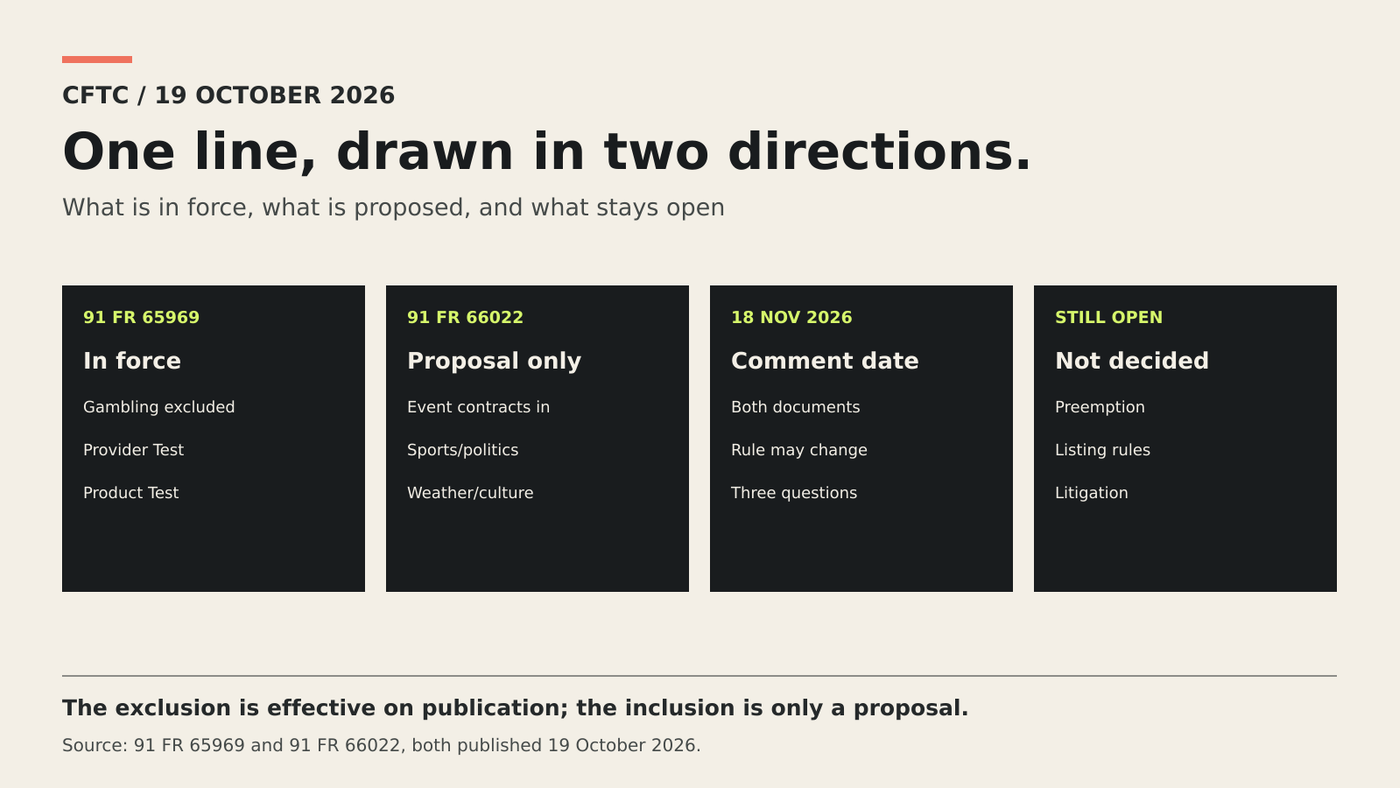
Both documents were signed on 15 October and published in the Federal Register on 19 October, when the exclusion took effect. Comments on each close 18 November 2026; the preemption and listing questions stay open.
- Written by
- Fernando Polti
- Editor
- Fernando Polti
- Published
- Evidence checked
- Next review
- Editorial state
- approved

On 19 October 2026 the Commodity Futures Trading Commission published two documents in the same issue of the Federal Register that draw one line in two directions. The first is an interim final rule, 91 FR 65969, that adds a gambling exclusion to the definition of “swap” in 17 CFR 1.3, became effective on publication, and states that casino-style gambling products — including wagers placed on sportsbooks, and casino games — are not swaps and fall outside the Commission’s jurisdiction. The second is a notice of proposed rulemaking at 91 FR 66022 that would pull the other way: event contracts based on sports, politics, culture and weather would be expressly included in the swap definition. Comments on both close on 18 November 2026.
Executive takeaway: the operational content of the 19 October package is a two-part test, not a market verdict. To sit outside the swap definition, a product must be offered by a provider that is licensed or otherwise authorised under State or Tribal law, acting inside that authorisation, with the transaction regulated as gaming or gambling — and it must not be traded on a board of trade, organised exchange, swap execution facility or any other market where trades are executed multilaterally or subject to individual negotiation. The Commission states plainly that failing the exclusion does not make a product a swap. What the package does not do is decide preemption, amend the listing rules that courts have applied to sports event contracts, or resolve the pending litigation. Those stay where they were, and the comment window that closes on 18 November 2026 is the next dated opportunity to shape the file.
Two documents, one perimeter
The pair should be read as a single instrument: an exclusion that protects the licensed gaming channel, and a proposal that claims the exchange-traded one.
| Interim final rule | Notice of proposed rulemaking | |
|---|---|---|
| Federal Register citation | 91 FR 65969–65979 (FR Doc. 2026–21376) | 91 FR 66022 (FR Doc. 2026–21377) |
| Action | Interim final rule; request for comments | Notice of proposed rulemaking |
| Docket and RIN | CFTC-2026-2214; RIN 3038-AF81 | CFTC-2026-2213; RIN 3038-AF82 |
| Effect on 17 CFR 1.3 | Adds paragraph (7), excluding qualifying casino-style gambling products | Revises paragraphs (2)(i)(E) and (F) and adds paragraph (2)(i)(G) for event contracts |
| Effective date | 19 October 2026, on publication | None; proposal only |
| Comments due | 18 November 2026 | 18 November 2026 |
| Stated purpose | Remove regulatory ambiguity and clarify the boundary between Commission jurisdiction over derivatives and State or Tribal jurisdiction over casino-style gambling | Reduce interpretive uncertainty and facilitate uniform nationwide treatment of event contracts under the Commission’s exclusive jurisdiction |
The Commission’s own account of why it moved now is unusually direct. It records that courts have diverged on whether the swap definition reaches casino-style gambling products: the Sixth Circuit in KalshiEX LLC v. Schuler (25 September 2026) and the Ninth Circuit in KalshiEX, LLC v. Assad (28 August 2026) treated sports event contracts as legally indistinguishable from casino-style sports wagers, while the Third Circuit in KalshiEX, LLC v. Flaherty held that sports-related event contracts traded on a CFTC-licensed exchange fit the statutory definition. Against that split, the rule text records, forty States and the District of Columbia submitted a comment arguing that sports event contracts are “indistinguishable from traditional sports betting”, and states that many courts, States and businesses were operating on what the Commission calls an erroneous premise — that if event contracts are swaps, casino-style gambling products must be too.
Two details in the record matter more than the rhetoric. First, the Commission states it is not aware of any casino-style gambling products that are treated as Commission-regulated instruments or otherwise traded on Commission-licensed designated contract markets or swap execution facilities. Second, it relies on the Administrative Procedure Act’s good-cause exception to make the exclusion effective immediately rather than after notice-and-comment, and asks for comment afterwards instead. An interim final rule is a rule in force today that can still be amended: the Commission states it will consider comments received and may modify the rule if warranted.
The exclusion’s two-part test
The operative text is new paragraph (7) of the definition of swap in 17 CFR 1.3. A transaction falls outside the swap definition only if both limbs are satisfied.
Provider Test. The agreement, contract or transaction must be offered or entered into by a person that is licensed or otherwise authorised to offer gambling or gaming products, or to accept wagers, under the law of a State or under the law of a federally recognised Indian tribe pursuant to the Indian Gaming Regulatory Act; that person must be acting within the scope of that licence or authorisation; and the transaction must be regulated as gaming or gambling under applicable State or Tribal law. The Commission models this on the insurance exclusion it and the SEC adopted in 2012, where the provider test is supervision by an insurance commissioner.
Product Test. The transaction must not be traded on a board of trade, an organised exchange, a swap execution facility, or any other market in which trades are executed multilaterally or subject to individual negotiation. Bets or wagers offered by a sportsbook or casino as principal to its customers, where the material terms follow standard house rules or similar standard terms, satisfy the test. An agreement entered into on a trading facility would not, because its price and other economic terms would be determined by the competitive interaction of multiple buyers and sellers.
Paragraph (7) then names three categories that are excluded when both limbs are met: sports wagers accepted by a licensed sportsbook or sports-wagering operator on the outcome of one or more sporting events; casino games accepted by a licensed casino operator in connection with a table game, slot machine or other electronic gaming device; and other licensed games of chance such as bingo, pool wagering, lotteries and raffles.
Three qualifications narrow the practical comfort this gives a supplier or platform team.
- The exclusion is non-exclusive. The rule text states that other gambling-style transactions may also not be swaps depending on how they are structured and whether they are tradable, and gives a casual bet between friends and a casino-style sportsbook illegally operating in a State that prohibits gambling as examples.
- Failing the test does not create a swap. The Commission states that a transaction that meets none of the exclusion’s requirements is not thereby a swap, and requires further analysis of the applicable facts and circumstances to decide whether it is a gambling product.
- The licence has to actually cover the activity. The Provider Test turns on acting within the scope of the authorisation and on the transaction being regulated as gaming or gambling. A supplier, aggregator or platform that is not itself the licensed provider cannot read the exclusion as a shield for its own role.
Why the Commission says gambling is not a swap
The preamble’s reasoning is worth reading closely, because it is the reasoning a platform will be tested against. The Commission applies the same analysis it used for insurance contracts and ordinary consumer transactions, and relies on five structural characteristics.
| Structural factor | Gambling products, as described in the rule | Event contracts, as described in the rule |
|---|---|---|
| Price formation and tradability | Bilateral between house and customer; terms follow house rules; the customer accepts the price the house sets; not inherently tradable | Traded on CFTC-registered exchanges at market-set prices through bids and offers on a central order book |
| Clearing | Not cleared; the wager obligation is not routinely transferred to a third party | Centrally cleared by CFTC-registered clearing houses, with novation to a creditworthy clearing house |
| Statutory indications | The Commission does not presume Congress intended to include gambling in the swap definition | Second prong of the swap definition covers contracts based on events, and the Special Rule for event contracts contemplates gaming as an excluded commodity |
| Regulatory history | Offered by State-licensed venues or Tribes under a gambling-specific regime | Regulated by the Commission since 1993, when it issued a no-action letter to Iowa Electronic Markets, and from 2004 through a designated contract market for excluded-commodity events |
| Trade usage | The Commission is unaware of any trade usage or market belief that gambling products are swaps | The Commission preliminarily believes event contracts are known to the trade as swaps, so contracts that fail the first or second prongs would still qualify under the fourth |
Two secondary points in the same analysis are the ones a product team will end up arguing about. The Commission notes that a customer can obtain similar economic exposure through a wager or an event contract, but states that this does not make the two products the same or require identical frameworks — its analogy is insurance against a credit default swap. It also notes that a sportsbook or other gambling venue may routinely exclude winners, whereas a designated contract market is subject to an impartial access requirement that does not allow it to bar traders who have profited. It further records that the Commission recently wrote to regulated entities to remind them of their obligation to display prices clearly and not to mislead customers into mistaking market-priced products for casino-style products.
The Product Test is framed as a forward-looking control as much as a description. The Commission states that it ensures State and Tribal-regulated entities do not, in the future, begin offering products properly within its jurisdiction unless they do so consistently with the Commodity Exchange Act and its regulations.
What the proposal would add — and what the Commission counts as the market
The paired proposal is shorter and blunter. It would amend the same definition to add paragraph (2)(i)(G): “Event contracts, including those based on sports-, politics-, cultural, and weather-related events.” It is a proposal, not law, and it does not amend the regulatory text today.
The Commission’s justification rests on the statutory language. It notes that the second prong of the swap definition covers any agreement, contract or transaction whose payment depends on the occurrence, nonoccurrence or extent of an occurrence of an event or contingency associated with a potential financial, economic or commercial consequence; that a binary option is a type of swap; that the fourth prong covers anything commonly known to the trade as a swap; and that the Special Rule added by the Dodd-Frank Act gives the Commission jurisdiction over event contracts in excluded commodities, including the power to prohibit contracts it determines are contrary to the public interest.
It then does the empirical work that a B2B reader can actually use as a sizing input, and it is explicit that these are estimates derived from non-public daily trade and reporting data filed by exchanges under CFTC Rule 16.02:
- As of 1 September 2026, at least seven CFTC-registered designated contract markets offered event contracts based on sports-related events to U.S. persons.
- More than fifteen pending DCM applications have been filed since 2025, and many of those applicants have stated they intend to offer contracts that could be considered event contracts.
- In August 2026, average monthly trading volume in event contracts was about $1.5 billion across all reporting DCMs: about $1.2 billion in sports-related contracts, about $11 million in politics-related contracts including elections, and about $4 million in weather-related contracts.
- For context on the trend, the Commission cites Pew Research for about $24 billion of trading volume in April 2026 across two prediction markets.
The proposal’s own cost-benefit discussion reads like a mature-market caution rather than a promotional document. The Commission states that the proposal would not change legal rights or obligations because it already treats event contracts as swaps under existing law, and that the primary benefit is certainty — market participants spending less on determining which regime applies and complying with multiple State regimes. Among the costs, it identifies possible short-term frictions if firms restructure from State regimes to the federal swaps framework, including unwinding or maintaining State licences in parallel during a transition, and it notes that States might collect less in fees and other revenue. It also raises a competitive point that suppliers should note: because the federal swaps regime requires infrastructure with fixed costs, certainty of classification may favour incumbent exchanges with established infrastructure and customer bases, leaving new entrants with higher fixed costs to reach swaps-compliance scale.
What the package does not settle
Four things remain open, and each one is a live variable for a product roadmap.
Preemption. Neither document decides whether classifying a sports event contract as a swap displaces State gambling law. Independent counsel who reviewed the package note that the Commission’s actions respond to the federal–State dispute without resolving it, and that the Sixth Circuit separately held that the Commodity Exchange Act would not expressly or impliedly preempt the State gambling laws before it even assuming sports event contracts were swaps.
Listing rules. The proposal does not amend CFTC Rule 40.11, which the Ninth Circuit read as prohibiting the listing of the sports event contracts at issue in that case. The same counsel conclude that classifying an event contract as a swap does not establish that it may lawfully be listed or traded, and advise that a CFTC announcement should not be treated as nationwide clearance.
Litigation. The Commission records State-level actions that are already shaping product design, including a criminal prohibition on prediction markets enacted in Minnesota, a twenty-count criminal information filed by Arizona against a designated contract market, emergency injunctive relief sought by New York, and State trial court orders requiring the geofencing of sports-related event contracts in Michigan, Washington and Nevada. Counsel record that New Jersey’s petition for Supreme Court review of the Third Circuit decision was filed on 2 September and remains pending, with a response due on 9 November, and that federally recognised tribes have brought separate litigation alleging that sports event contracts offered on tribal lands violate the Indian Gaming Regulatory Act.
The exclusion itself. Because the exclusion is an interim final rule, it can be modified. The Commission invites comment on three specific questions rather than endorsing the test as final: whether the Provider Test should cover additional categories of providers beyond State-regulated gaming companies and Tribes; whether it is clear which agreements, contracts or transactions are regulated as gaming or gambling under applicable State or Tribal law, and whether there are better ways to define how that regulation applies; and whether there are better ways to draw an objective, functional distinction between swaps and traditional gambling products.
What this means for operators, aggregators and platforms
Operators with licensed sportsbooks and casino products have the most to gain and the most to document. The exclusion now gives an express textual basis for the position that a State-licensed wager accepted as principal on standard house terms is not a swap. But the Provider Test is written around the licensed entity and the scope of its authorisation, so the operational work is evidence: which legal entity holds which licence, which activities the licence covers, and that the product is regulated as gaming where it is offered. For teams that already maintain licence-scope files for market-entry work, this is the same record with a new consumer.
Event-contract exchanges and their sponsors should read the proposal as a change in the reason, not the behaviour. The Commission states it already treats event contracts as swaps, so the immediate effect is a firmer statutory basis to cite in litigation and a longer public paper trail — plus a comment deadline on 18 November 2026 in which the design of the eventual rule can still move. Nothing in the package lifts the listing restrictions that courts have applied.
Platforms, aggregators and RGS providers sit on a boundary that the rule text does not resolve for them individually. A platform supplying game content to a licensed operator is not the licensed provider, and the Provider Test is written around the person offering the product. Where a platform or aggregator holds the player-facing surface, the price-formation question — house-set terms or market-set prices through interaction of multiple buyers and sellers — is the one that decides which side of the line the product sits on. That is a specification and contract question before it is a regulatory one, which is why the practical fix is to fix the product terms in writing and keep them with the integration evidence.
Suppliers selling into both channels should expect the question in procurement. An operator buying an event-market product will want to know whether the supplier treats the product as a derivatives instrument or as a licensed gambling product, and which legal entity is the provider. An exchange will want the opposite. Suppliers that take both positions with different products should be able to show that the products are structurally different, not just differently marketed — the Commission’s own framing makes price formation and clearing the tests that survive scrutiny.
Compliance and legal teams should put one thing on the calendar now: 18 November 2026, when comments close on both documents. The interim final rule is effective today and can still be amended, which makes the comment file the only near-term lever on the exclusion’s scope. Beyond that, three dated watch items sit outside the comment window: a response due on 9 November in the Supreme Court petition, any final action on the proposal, and any separate Commission action on the listing rule.
A product-classification evidence sequence
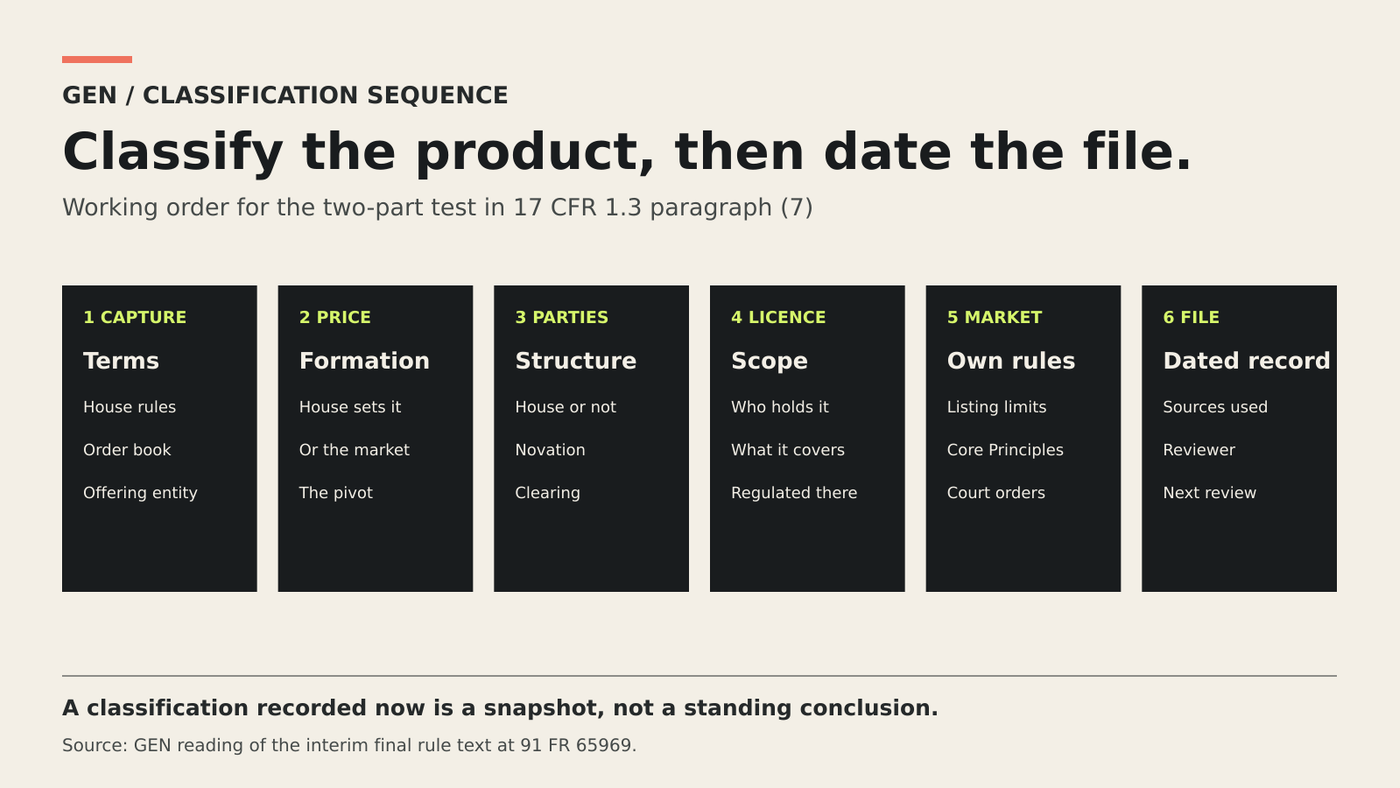
- Capture the product terms. The contractual mechanics, house rules or order-book specification, and the entity that offers the product. The Product Test turns on how the transaction is traded, so the evidence has to describe execution, not intent.
- Test price formation. Ask who sets the price: the operator as principal with the customer accepting the terms, or multiple buyers and sellers interacting. This is the pivot of the exclusion.
- Test counterparties and clearing. Confirm whether the counterparty is the house, and whether the obligation is novated to a clearing house. A bilateral wager and a cleared contract produce different answers.
- Map the licence to the activity. Identify the licence or authorisation, the entity holding it, and the activities it covers in each jurisdiction, then check that the activity is regulated as gaming or gambling there.
- Check the market’s own rules. Listing rules, exchange core principles and any court order or State restriction that applies to the product or jurisdiction stay relevant whatever the classification.
- File it with a date. Record the assessment, the source versions used, the reviewer, and the next review date. Because the exclusion is an interim final rule and the proposal is open, a classification recorded on 21 October 2026 is a snapshot, not a standing conclusion.
Frequently asked questions
Are sportsbook wagers now excluded from the CFTC’s swap definition?
Yes, for transactions that satisfy both limbs of the exclusion: a provider licensed or otherwise authorised under State or Tribal law, acting within the scope of that licence, with the transaction regulated as gaming or gambling, and a transaction that is not traded on a board of trade, organised exchange, swap execution facility or any other multilateral or individually negotiated market. The rule text identifies sports wagers accepted by a licensed sportsbook or sports-wagering operator on the outcome of one or more sporting events as an example.
Does that mean every sports bet is outside the CFTC’s jurisdiction?
No. The exclusion is expressly non-exclusive, and the Commission states that other gambling-style transactions may also not be swaps depending on their structure and tradability — it gives a casual bet between friends and a casino-style sportsbook operating illegally in a State that prohibits gambling as examples. Equally, a product that misses both limbs is not automatically a swap; the Commission says further facts-and-circumstances analysis is needed.
Are sports event contracts now swaps?
Not by the 19 October documents alone. The interim final rule only excludes products; the inclusion of event contracts sits in a proposal published the same day, with comments due on 18 November 2026. The Commission states it already treats event contracts as swaps under existing law, which is why it presents the proposal as reducing uncertainty rather than changing the law.
Does the package decide whether States can regulate event contracts?
No. It addresses the CFTC’s own definitional perimeter. Independent counsel who reviewed the two documents note that they do not resolve whether classifying a sports event contract as a swap preempts State gambling laws or displaces Tribal gaming authority, and that the CFTC’s actions respond to the State litigation rather than settling it.
What is the dated next step?
Comments on both documents must be received by 18 November 2026. The interim final rule states that the Commission will consider comments and may modify the rule if warranted, and it asks three specific questions about the Provider Test’s scope, the clarity of the State and Tribal gaming regulation reference, and better ways to draw an objective distinction between swaps and traditional gambling products.
The decision rule
Read the 19 October package as a perimeter test with a comment window, not as clearance. Decide, product by product and entity by entity, whether the offering satisfies both the Provider Test and the Product Test, and write the evidence down while the rule is still open — because the exclusion can be modified after 18 November 2026, the inclusion proposal is not yet law, and neither document touches the State-law, listing or litigation questions that decide whether a product can actually be offered where its customers are.
Visual analysis
Source record and operator framework
The first visual fixes the sourced facts. The second turns those facts into a practical review or decision path.
Evidence record
Sources used on this page
Each source supports a defined claim. Provider pages are identified as provider-supplied evidence.
- Further Definition of "Swap" To Exclude Casino-Style Gambling Products (91 FR 65969, interim final rule)Federal Register / Commodity Futures Trading Commission · accessed Oct 21, 2026
The document record gives the publication date of 19 October 2026, an effective date of 19 October 2026, a comment deadline of 18 November 2026, citation 91 FR 65969 spanning pages 65969 to 65979, docket CFTC-2026-2214, RIN 3038-AF81 and 17 CFR part 1, and the summary that the Commission is codifying its position that casino-style gambling products, including wagers placed on sportsbooks and casino games, are excluded from the swap definition.
- Further Definition of "Swap" To Exclude Casino-Style Gambling Products (full rule text, FR Doc. 2026–21376)U.S. Government Publishing Office (GovInfo) · accessed Oct 21, 2026
The published rule text supplies the operative amendment adding paragraph (7) to the definition of swap in 17 CFR 1.3, with a Provider Test requiring a person licensed or otherwise authorised to offer gambling or gaming products or accept wagers under State law or the law of a federally recognised Indian tribe acting within the scope of that licence and regulated as gaming or gambling under applicable State or Tribal law, and a Product Test requiring that the transaction is not traded on a board of trade, an organised exchange, a swap execution facility or any other market in which trades are executed multilaterally or subject to individual negotiation. It lists sports wagers, casino games and other licensed games of chance, records the Commission's five distinguishing characteristics and its statement that the exclusion is non-exclusive, gives the three specific comment questions, and records the issuance date of 15 October 2026 with Chairman Selig voting in the affirmative and no Commissioner voting in the negative.
- Further Definition of "Swap"—Inclusions (91 FR 66022, notice of proposed rulemaking)Federal Register / Commodity Futures Trading Commission · accessed Oct 21, 2026
The document record gives the publication date of 19 October 2026, citation 91 FR 66022, docket CFTC-2026-2213, RIN 3038-AF82 and a comment deadline of 18 November 2026, and records that the Commission proposes to further define the term swap to explicitly include event contracts, including those based on sports-, politics-, cultural- and weather-related events.
- Further Definition of "Swap"—Inclusions (full proposed rule text, FR Doc. 2026–21377)U.S. Government Publishing Office (GovInfo) · accessed Oct 21, 2026
The proposed rule text supplies the proposed amendment adding paragraph (2)(i)(G) to the definition of swap in 17 CFR 1.3 for event contracts including those based on sports-, politics-, cultural- and weather-related events; records that as of 1 September 2026 at least seven CFTC-registered DCMs offered event contracts based on sports-related events to U.S. persons and that more than fifteen pending DCM applications have been filed since 2025; states that in August 2026 average monthly trading volume in event contracts was about $1.5 billion across all DCMs, of which about $1.2 billion was sports-related, about $11 million politics-related including elections and about $4 million weather-related, estimated from non-public daily trade and reporting data reported under CFTC Rule 16.02; cites Pew Research for $24 billion of trading volume on two prediction markets in April 2026; and records the State actions, circuit decisions and the Commission's reading that the word "potential" in the swap definition reaches consequences that may never materialise.
- Proposed CFTC rules seek to define sports contracts as swapsiGaming Business · accessed Oct 21, 2026
Independent trade reporting records that the CFTC released the notice of proposed rulemaking on 9 October 2026, quotes Chairman Michael Selig describing event contracts as commodity derivatives squarely within the CFTC's remit under the Commodity Exchange Act and within its exclusive jurisdiction, records the Third Circuit's April decision and the contrasting August Ninth Circuit decision, and reports the American Gaming Association's estimate that the contracts are responsible for more than $1 billion in lost state tax revenue.
- CFTC Moves to Reinforce Federal Authority over Event Contracts as New Jersey Seeks Supreme Court ReviewProskauer Rose LLP · accessed Oct 21, 2026
Independent legal analysis, published 13 October 2026, describes the gambling exclusion's provider and product tests, records that the CFTC announced both actions on 9 October 2026, notes that forty states and the District of Columbia submitted a comment arguing sports event contracts are indistinguishable from traditional sports betting, records New Jersey's certiorari petition filed on 2 September with Kalshi's response due 9 November, states that neither action amends CFTC Rule 40.11 or resolves preemption or tribal-gaming questions, and advises that classifying an event contract as a swap does not establish that it may lawfully be listed or traded.
- Derivatives, Legislative and Regulatory Weekly Update (October 16, 2026)Gibson Dunn & Crutcher LLP · accessed Oct 21, 2026
Independent legal update, published 16 October 2026, records that the Commission published both the interim final rule and the notice of proposed rulemaking on 9 October 2026, that the interim final rule takes effect immediately upon publication in the Federal Register, and that written comments must be received via Regulations.gov within 30 days of that publication.