News · evidence checked Sep 22, 2026
Nevada’s proposed gaming technical standards: an implementation map
The drafts are not yet effective. Teams can still use the consultation window to map system scope, reporting gaps, account controls and evidence ownership without treating 23 October as final.
- Written by
- Fernando Polti
- Editor
- Fernando Polti
- Published
- Last material update
- Evidence checked
- Next review
- Editorial state
- approved

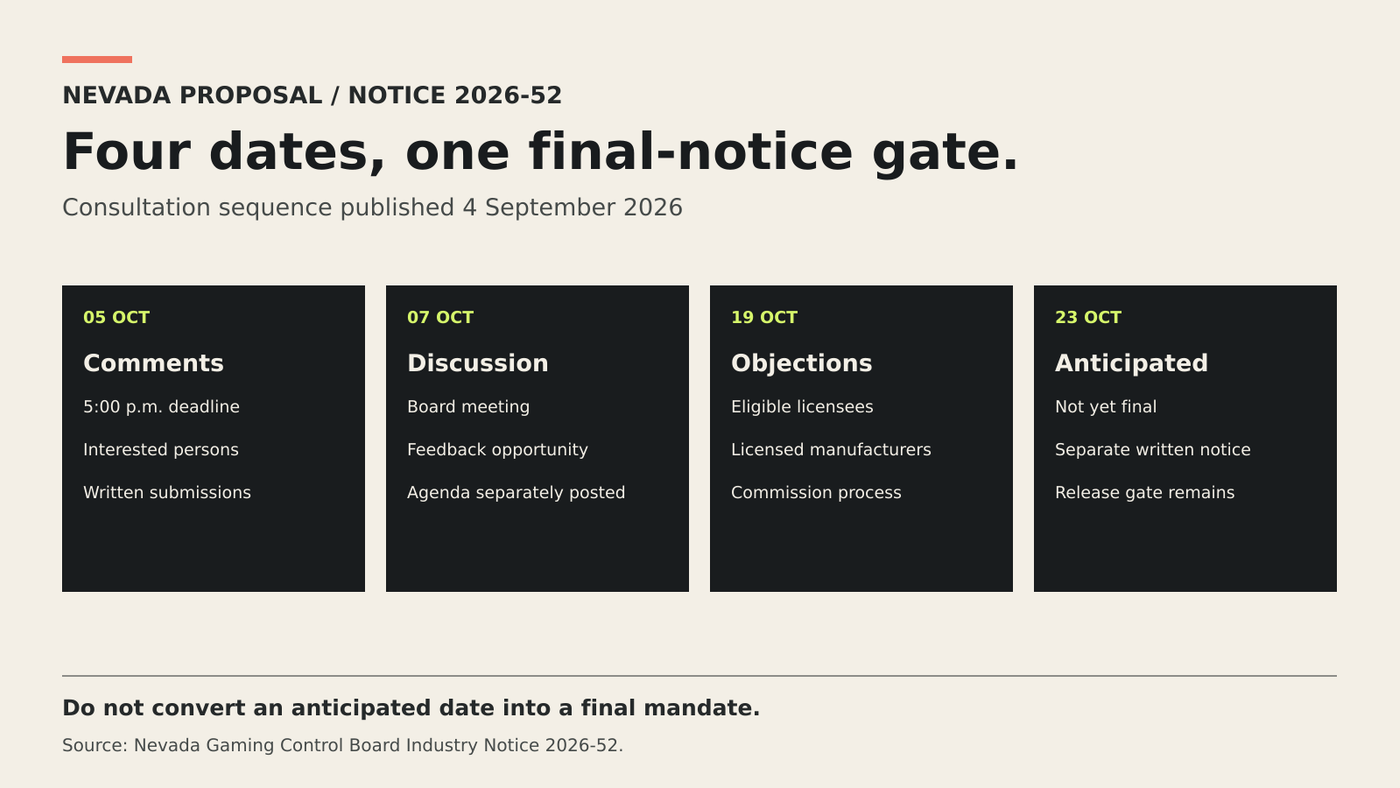
Nevada’s Gaming Control Board has proposed revisions to ten technical standards covering systems from interactive gaming and sportsbooks to cashless wagering, kiosks and accounting. The drafts are not yet effective. Written comments are due by 5:00 p.m. on 5 October 2026, the Board plans to discuss the revisions on 7 October, and eligible licensees or manufacturers may file objections through 19 October. The Board calls 23 October the “currently anticipated” effective date and says a separate written notice will confirm the actual date.
Executive takeaway: do not deploy against 23 October as if it were final. Build a controlled delta register now: identify each in-scope system, compare the marked draft with the current approved version, assign an evidence owner, test whether required reports and controls can be demonstrated, and keep configuration changes behind the final-notice gate.
What Nevada proposed—and what it did not
Industry Notice 2026-52 names proposed revisions to Standards 3, 5, 6, 7, 8, 9, 10, 11, 12 and 13. That reaches online slot systems, cashless wagering kiosks, interactive gaming, shared associated-equipment controls, race and sports, pari-mutuel, keno, bingo, cashless and wagering accounts, and cage, credit, card-game and table-game systems.
The notice begins a process under Nevada Gaming Commission Regulation 14.050. Interested persons can comment; nonrestricted licensees and licensed manufacturers have a separate objection route. The Chair must consider timely submissions before final action, and the Commission considers timely objections. This means the public drafts are a planning basis, not a final control set.
That distinction should remain visible in every backlog ticket. Label requirements “proposed,” record the draft date, preserve the source link, and state which assumption is waiting for final notice. A ticket titled “Nevada compliance due 23 October” overstates what the notice establishes.
The implementation problem is wider than ten PDF files
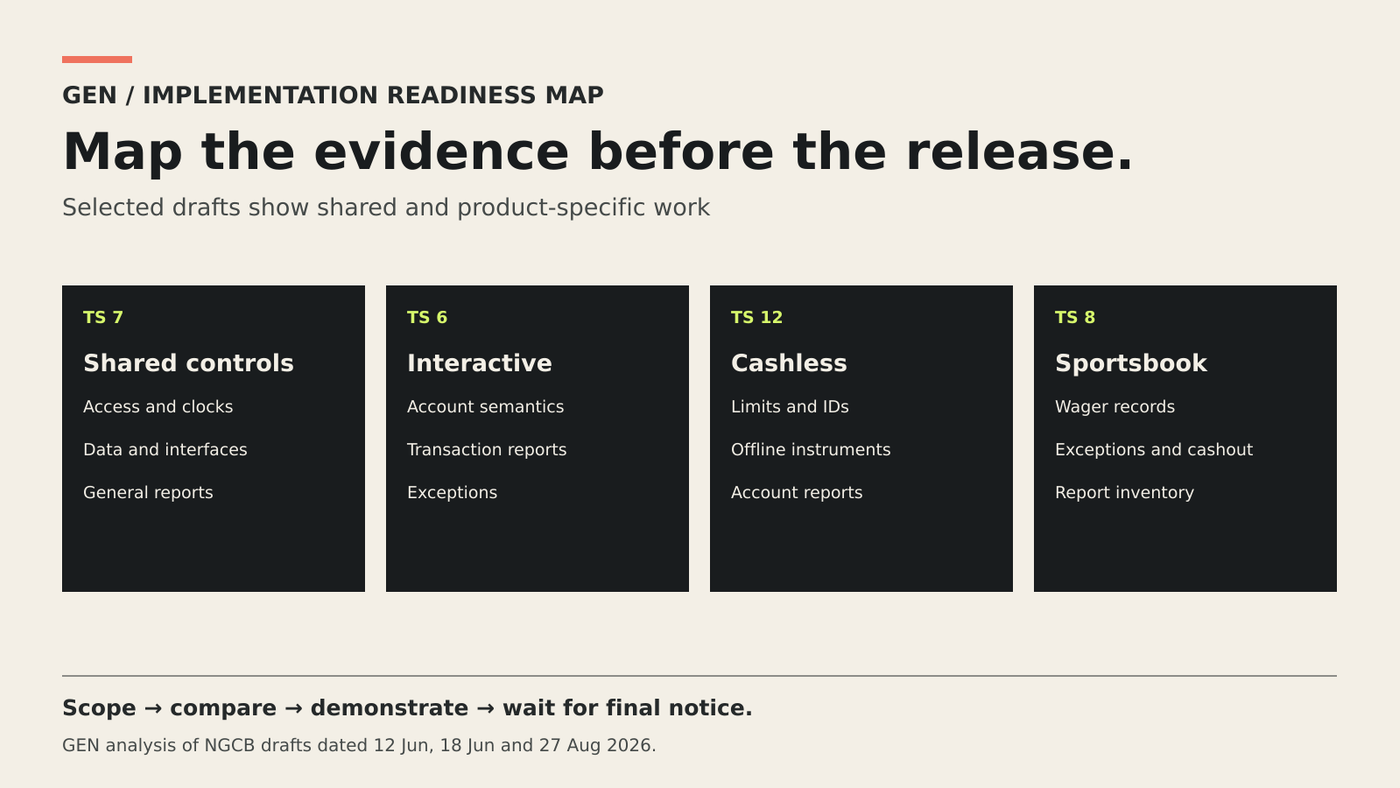
The drafts divide requirements by system, but most deployments divide ownership by supplier, service and team. A general control in proposed Standard 7 may sit in an identity provider, reporting service or infrastructure layer shared by a sportsbook, wagering account and cashless product. A product-specific report in Standard 6, 8 or 12 may depend on data generated by several services.
The first task is therefore an applicability and ownership map—not a generic standards checklist.
| Layer to map | Evidence question | Likely owners to involve |
|---|---|---|
| Licensed entity and approved product | Which entity, system approval and Nevada activity put the component in scope? | Compliance, qualified Nevada counsel, regulatory affairs |
| System and interface inventory | Which application, database, gateway, kiosk, EGD interface or mobile channel produces each required record? | Architecture, platform, supplier engineering |
| Shared controls | Where are user access, clocks, communications, critical data, exports and exception events controlled? | Security, IAM, infrastructure, data |
| Product reports | Can the named report be generated on demand with the required fields, periods, totals and filters? | Product, reporting, finance, operations |
| Supplier boundary | Which vendor performs the function, supplies the evidence and supports a regulator or audit request? | Procurement, vendor management, supplier compliance |
| Change decision | What can be prepared now, and what must wait for final language and effective-date notice? | Release management, change advisory board, accountable executive |
GEN’s RGS, aggregator, platform and operator responsibility map can help expose system boundaries, but it cannot decide Nevada applicability. That requires the actual product, approval, entity and current official record.
Proposed Standard 7 becomes the shared-control layer
The Standard 7 draft is the place to start because it proposes definitions, system-integrity controls and general reporting requirements across associated equipment systems. Its general statements list a broad set of systems, including interactive gaming, race and sports, cashless wagering, wagering accounts, mobile gaming, player tracking and progressives.
The draft addresses:
- logical and role-based access, including vendor account enablement and disabling;
- encryption and error controls for critical communications;
- isolation of external interfaces from alterable system data;
- redundant storage for critical data;
- internal clocks, significant-event and configuration-change timestamps;
- synchronization or identification of clock variation across communicating components;
- mobile-device integrity and secure storage concepts;
- protection of transaction history and event logs from alteration;
- export of report data for analysis, audit and verification;
- on-demand and historical reporting, report metadata, user-access listings, event reports and application-level exception reports.
The operational consequence is not “buy a Standard 7 module.” It is to prove that shared services expose the required behavior to every applicable product. If access data comes from an external directory, the draft allows multiple systems to support the user-list and provisioning report. Your evidence pack still needs to show how the records join and who owns the assembled result.
The clock provision deserves a cross-supplier test. The draft says communicating components used for regulatory purposes should synchronize or identify variation. Teams should record authoritative sources, offsets, original timestamps and how a report reveals drift. The incident-reconstruction guide explains why synchronized-looking dashboards are not enough when source uncertainty is hidden.
Interactive gaming: check account and reporting semantics
The Standard 6 draft says its purpose is to align the technical standard with MICS version 9. It shows marked changes rather than a clean-room requirement list, so teams should compare the proposal to their current approved design before calling any item new.
The visible deltas include account-information wording, closed or inactive account fields, transaction-type terminology, balance-summary categories, progressive-pool fields, contest or tournament reporting and exception reports. The transaction detail proposal references credit and debit types defined in Regulation 5.225 and retains online and offline availability notes for player transaction history. The progressive language broadens identifiers and adjustment fields. The contest or tournament section separates detail and monthly summary concepts.
A useful test packet should start with three accounts: active, suspended and inactive. Generate the proposed reports, trace each field to its authoritative store, reconcile opening and ending balances, and verify that an operator can explain employee interventions and adjustments. Do not populate missing fields with derived guesses simply to make a report render.
Cashless and wagering accounts: treat identifiers as controlled value
The Standard 12 draft proposes a dedicated standard for cashless wagering systems and wagering account systems. It addresses critical stored data, debit-instrument transfers, wagering instruments, account records, reports and reconciliation.
Several proposed controls deserve early design review:
- Critical stored data would include instrument validation numbers and values, account balances, unpaid winning-ticket information and EGD coupons, with an approved non-alteration method.
- The cashless system’s daily debit transfer limit would be configurable by both the establishment and patron, with a 24-hour delay before a patron increase takes effect.
- Patron-initiated transactions would carry a unique identifier of at least eight digits that includes the EGD or game designation.
- The draft describes controlled behavior when an EGD interface loses communication with the cashless system, including retained data and a limit on instruments issued while disconnected.
- Active wagering-instrument validation numbers would be masked across system-generated reports.
- Wagering account reports would detail transactions, balances and transfers by account and gaming area.
Those are not only UI requirements. They cross limit-policy configuration, transaction identity, offline state, security, reporting and finance reconciliation. The acceptance plan should pair every patron-visible outcome with ledger and report evidence. GEN’s wallet retry and rollback guide provides a failure-injection frame, but the proposed Nevada language and approved system scope remain authoritative for this work.
Sportsbooks: inventory records before changing workflows
The Standard 8 draft is dated 27 August, later than the three other drafts reviewed here. It lays out proposed controls for wager acceptance and cutoff, payouts, wagering accounts and communications, transaction records, retention and a substantial report set.
The proposed reporting section includes past-post voids, cashier activity, transaction detail, future events, unpaid winners, wagering instruments, account activity, accrual reporting, customer transactions, statistical reporting, exception events and early cashout. Many drafter’s notes say language is adapted from existing regulations or MICS. Teams should not assume every paragraph creates a new build requirement.
Start with a report inventory: exact report name, current equivalent, fields, source tables, retention, access, sample output, owner and variance. Then run one trace from accepted wager through settlement, account posting and final reports. Include a void, a future event, an exception and an early cashout if those functions exist in the approved product. This shows whether the proposed documentation can be produced without redesigning a live workflow before the text is final.
What this means for operators, aggregators and platforms
Operators should own the consolidated applicability decision and the final evidence pack. Contracting a report or control to a supplier does not remove the need to know which system produces it, how it is retrieved and who answers a Board request.
Aggregators and gateway providers should identify which proposed shared controls touch their interfaces: transaction identity, secure communications, clock variation, event records, data exports and external access. Document what passes through unchanged, what is transformed and what is not available.
Platform, sportsbook and cashless-system providers should offer a marked-draft response rather than a marketing compliance statement. For each applicable clause, show current capability, configuration, planned change, test evidence, release dependency and unresolved interpretation. A buyer can make this structure part of the platform RFP evidence checklist.
Testing and certification teams should separate design review from final submission scope. Prepare test data, sample reports and interface evidence now, but tie formal conclusions to the final adopted text, approved configuration and regulator or laboratory process that actually applies.
A four-gate readiness sequence
- Scope: identify the regulated entity, approved system, draft standard, current standard and exact component owner.
- Compare: create a clause-level delta register that distinguishes moved language, changed language, new language and unresolved interpretation.
- Demonstrate: generate sample reports, test access and clocks, trace account and wagering transactions, and record every unavailable field or manual dependency.
- Release: wait for final action and the separate effective-date notice, then update the register, approve the production change and preserve the tested release identity.
The sequence keeps useful work moving without converting an anticipated date into a fabricated mandate.
Frequently asked questions
Are the revised Nevada technical standards effective now?
No. Notice 2026-52 describes proposed revisions. It says 23 October 2026 is the currently anticipated effective date and that the Chair will provide separate written notice of the effective date.
What are the Nevada consultation dates?
Written comments are due by 5:00 p.m. on 5 October 2026. The Board plans to discuss the revisions on 7 October. The notice gives nonrestricted licensees and licensed manufacturers until 19 October to file a written objection with the Commission.
Should a supplier claim compliance with the drafts?
A supplier can document how its current system maps to proposed language. It should not present that exercise as final compliance, approval or certification. Final conclusions need the adopted text, the applicable system scope and the authorized review path.
Which draft should a multi-product platform review first?
Start with proposed Standard 7 because it contains shared definitions, integrity and general reporting controls. Then map the product-specific standard—such as 6, 8 or 12—to the same components and owners. This is an implementation-order recommendation, not a statement of legal priority.
The decision rule
Use the consultation period to remove uncertainty from system ownership, report availability and evidence retrieval. Do not make the opposite mistake of implementing every draft phrase as final. The safe decision is a versioned delta register with a clearly marked final-notice gate.
Visual analysis
Source record and operator framework
The first visual fixes the sourced facts. The second turns those facts into a practical review or decision path.
Evidence record
Sources used on this page
Each source supports a defined claim. Provider pages are identified as provider-supplied evidence.
- Industry Notice 2026-52 — Proposed Revisions to Technical StandardsNevada Gaming Control Board · accessed Sep 16, 2026
The notice identifies ten proposed standards, the comment and objection deadlines, the October 7 discussion, and the currently anticipated October 23 effective date subject to separate notice.
- Proposed Technical Standard 6 — Interactive Gaming Systems and Associated EquipmentNevada Gaming Control Board · accessed Sep 16, 2026
The draft shows proposed interactive-gaming account, transaction, progressive, contest or tournament, and exception-report language aligned to MICS version 9.
- Proposed Technical Standard 7 — System Integrity and General ReportingNevada Gaming Control Board · accessed Sep 16, 2026
The draft proposes shared definitions, access, communications, data-integrity, clock, export and general reporting requirements across associated-equipment systems.
- Proposed Technical Standard 8 — Computerized Race and Sports SystemsNevada Gaming Control Board · accessed Sep 16, 2026
The draft sets out proposed wager acceptance, record, retention, account, reporting, exception and early-cashout requirements for computerized race and sports systems.
- Proposed Technical Standard 12 — Cashless Wagering and Wagering Account SystemsNevada Gaming Control Board · accessed Sep 16, 2026
The draft proposes a dedicated standard for critical data, transfer limits, wagering instruments, cashless transactions, wagering accounts and related reports.