News · evidence checked Nov 16, 2026
Chile's online betting bill turns to prohibition: the blocking clock
Two substitute indications approved on 9 November would replace the licensing bill with a prohibition. The mechanics — a twelve-month wind-down, a ten-day blocking duty and void contracts — are now what operators and suppliers must price.
- Written by
- Fernando Polti
- Editor
- Fernando Polti
- Published
- Evidence checked
- Next review
- Editorial state
- approved
Chile’s Senate Economy Committee voted on 9 November 2026 to replace the text of the country’s online betting bill with a prohibition. By three votes to one with one abstention, the committee declared admissible and then approved two substitute indications: one from senators Diego Ibáñez and Gastón Saavedra that bans private online betting outright, and one from Senate President Paulina Núñez and senator María José Gatica that reserves the activity for legally enabled entities and criminalises unlicensed operation.
Nothing is law yet. But the vote changed what suppliers, platforms and payment teams should be modelling. For two years the working assumption around Boletín N° 14.838-03 was a licensed Chilean market with a tax rate and a compliance build. The text now on the committee’s table would instead give existing platforms a maximum of twelve months to stop, ban new accounts and advertising from day one, and impose a ten-day blocking duty on internet providers, app stores and anyone participating in the processing of payments. Contracts concluded in breach would be void for illicit object.
That is a different project. This article sets out what the committee approved, what remains unresolved in the text, and what the change means for the people who would have to implement it.
The short version
- The committee replaced the bill rather than amending it. Both approved proposals were substitute indications, which replace the entire text. The executive’s 114-page package presented on 27 October was left unreviewed.
- The prohibition text has a defined clock. Advertising and new-account opening would stop immediately; existing platforms would have twelve months to cease definitively and return balances in full.
- Blocking is an obligation with a deadline, not a request. Internet providers, app distribution companies and payment-chain participants would have ten calendar days from detection or judicial notification to block access, download and transactions.
- Penalties attach to profit, and contracts become void. Profit-making infringement carries 541 days to five years and a fine of 200 to 1,000 UTM; acts and contracts in breach are void for illicit object.
- The two texts differ on whether a licensed market survives at all. One bans private operation with a small carve-out for the state lottery, racetracks and land-based casinos; the other keeps a habilitación route but criminalises unlicensed operation and advertising.
- Six procedural steps remain before any of this binds anyone. The texts must be merged, reported out of the Economy Committee, reviewed by the Finance Committee, voted on the Senate floor, and returned to the Chamber of Deputies.
What the committee actually decided
The bill has been in the Senate’s second constitutional stage since the Chamber of Deputies approved it in December 2023, and the Senate approved it in general in August 2025. That general approval is why the November vote is procedurally awkward: a chamber that has already accepted the idea of regulating the activity has now seen its committee back texts whose organising principle is prohibition.
The committee secretariat flagged exactly that. According to reporting of the session, it warned that both substitutes departed from the bill’s core ideas by proposing prohibition rather than regulation. The committee declared them admissible anyway, by the same three votes, and then approved the substance. Senator Ibáñez’s justification was that circumstances had changed since the general approval — including, he said, a Supreme Court ruling that declared the platforms illegal and ordered their sites closed. GEN has not verified that ruling in this article; it is recorded here as the argument a senator made on the record, not as a finding.
The committee also agreed that the secretariat would produce a single merged text at its next session. As of 16 November 2026, GEN found no published merged text.
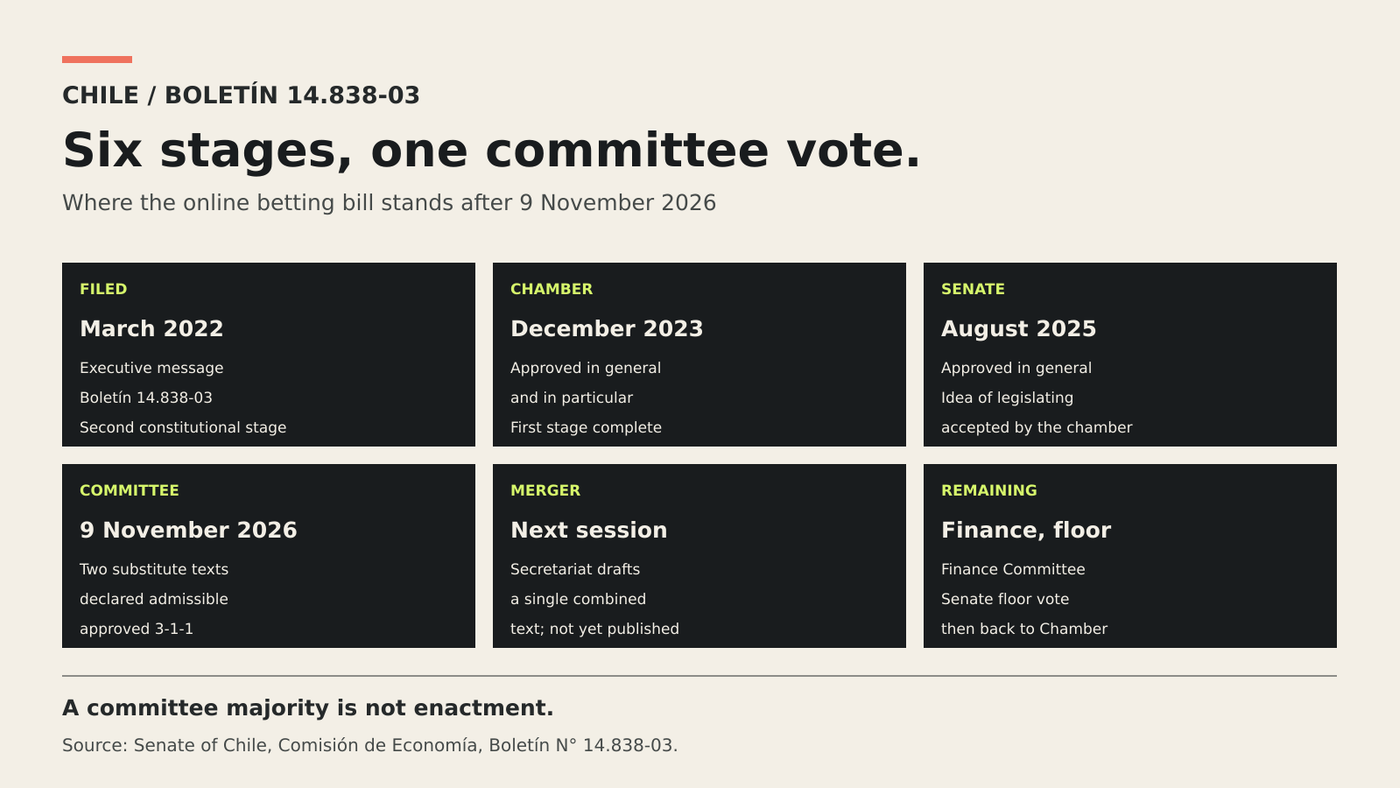
| Stage | Status as of 16 November 2026 | What it means |
|---|---|---|
| Filed | March 2022, executive message | Bill exists as Boletín N° 14.838-03 |
| Chamber of Deputies | Approved December 2023, general and particular | First constitutional stage complete |
| Senate, general | Approved August 2025 | Idea of legislating accepted |
| Senate Economy Committee, particular | Two substitute indications declared admissible and approved, 9 November 2026 | Prohibition texts now carry the committee’s majority |
| Merged text | Agreed for the next committee session; not published at the time of writing | The operative wording is not yet fixed |
| Finance Committee | Pending | Fiscal and tax review |
| Senate floor | Pending | Could amend or reject |
| Return to Chamber | Pending | Third stage if the Senate changes the text |
The prohibition text, provision by provision
The Ibáñez and Saavedra indication is short — three operative provisions and one transitional article — and unusually specific about mechanics. Read as a whole, it is a blocking and wind-down statute rather than a licensing statute.
Scope. Article 1 prohibits the exploitation, administration, offer of services and direct or indirect advertising of online betting platforms in Chile. A platform is any mechanism, installation, equipment, system or combination of them through which users can place bets remotely on games of chance, forecasts, draws or any activity whose result depends on future or uncertain events. The jurisdictional test is deliberately broad: a platform operates in Chile if it allows bets to be placed from national territory, “without regard to the place where its infrastructure is located or its domain is hosted”.
Exceptions. Games run under existing special laws by Polla Chilena de Beneficencia, Lotería de Concepción, racetracks authorised under Law 4.566 and casinos authorised under Law 19.995 stay outside the prohibition. That is a narrow list, and it is the provision that decides which incumbents benefit.
Penalties. Article 2 imposes presidio menor in its medium to maximum degree — 541 days to five years — and a fine of 200 to 1,000 UTM on anyone who infringes the prohibition with intent to profit. At the November 2026 UTM value used by Chilean reporting, that range is roughly CLP 14.5 million to CLP 72.4 million.
Blocking duties. The same article requires internet access providers, digital application distribution companies and entities participating in the issue, operation or processing of payment methods to block, respectively, access, download and transactions for platforms that breach Article 1, within ten calendar days of detection or of the relevant judicial notification.
Contract consequences. Acts and contracts concluded in breach of Article 1 are void for illicit object. This is the provision with the widest commercial reach, because it does not depend on a criminal finding against the platform: sponsorship, media, affiliate, technology and payment contracts touching a prohibited platform would carry a defect in their object.
Transition. Platforms operating in Chile at the date of publication would have a maximum of twelve months to cease definitively, with new user accounts and all forms of advertising prohibited from the outset, and full restitution of user balances required within that window. After the deadline, Article 2 applies.
What the competing text would do instead
The Núñez and Gatica indication is a different instrument. It regulates exploitation by legally enabled entities, prohibits unlicensed exploitation regardless of where the responsible party is constituted or where its servers sit, treats tax payment, registry entry, bank accounts and payment contracts as insufficient authorisation, and criminalises specific conduct: unlicensed exploitation, deliberate financing and facilitation, and advertising or promotion of unlicensed platforms — including paid promotions and affiliate programmes.
Reported accounts of that text put its sanctions higher, with up to fifteen years in prison in aggravated cases, fines reaching 10,000 UTM (about CLP 724 million at the November value) and permanent judicial blocking of illegal platforms. Those figures come from Chilean reporting rather than from a consolidated text GEN has read in full, and they should be treated as reported pending the merged draft.
The two texts therefore converge on three things and diverge on one. They converge on a hard prohibition of unlicensed operation, on blocking infrastructure, and on criminal exposure for the people who finance, advertise or process payments for prohibited platforms. They diverge on whether a licensed commercial market continues to exist: the Ibáñez and Saavedra text says no, with a carve-out for the lottery, racetracks and land-based casinos; the Núñez and Gatica text keeps a habilitación route for entities that meet the standard, which is why industry associations read it as restrictive rather than prohibitive.
The obligations that would land first
If a merged text keeps the Ibáñez and Saavedra mechanics, the implementation sequence is compressed and front-loaded. The table below separates what starts on publication from what follows.
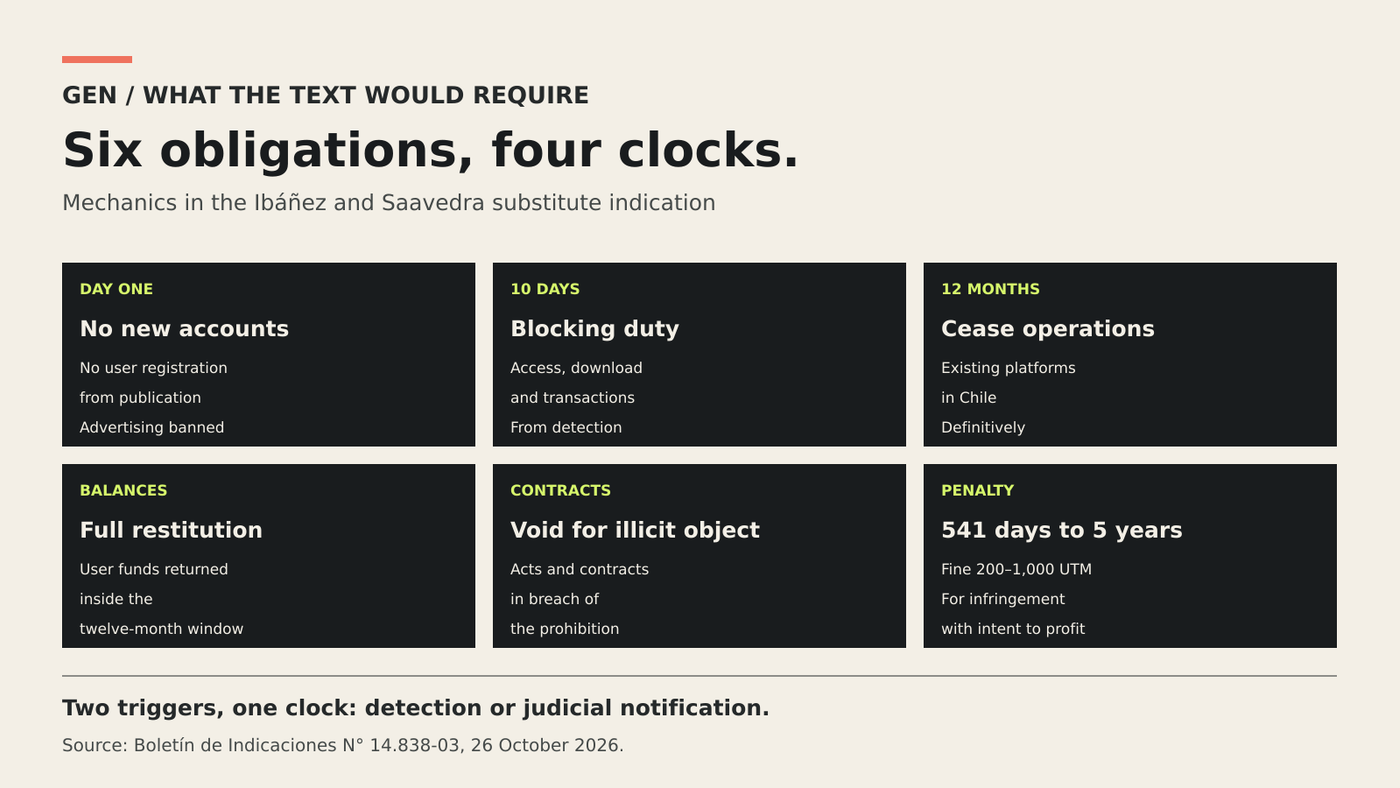
| Timing | Obligation | Who carries it |
|---|---|---|
| Day one | No new user accounts; no advertising, direct or indirect | Platforms, and any third party producing or placing the advertising |
| Day one | Blocking of access, download and transactions for prohibited platforms | Internet providers, app stores, payment-chain participants |
| Within 10 calendar days of detection or judicial notification | Blocking executed and evidenced | Same as above |
| Within 12 months | Definitive cessation of operations in Chile | Platforms |
| Within 12 months | Full restitution of user balances | Platforms |
| Continuous | No contracts whose object is a prohibited platform activity | Operators, suppliers, media, affiliates, payment firms |
| After the deadline | Criminal exposure for profit-making infringement | Individuals and entities operating the platform |
The ten-day duty is the clause most likely to be tested in practice, because it is short, it applies to entities that are not gambling licensees, and it is triggered by “detection or judicial notification” — two different standards that the text does not reconcile. A payment processor that detects a prohibited merchant and a payment processor that receives a court notification would be on the same clock but not on the same evidentiary footing.
Where the text is unresolved
Who blocks. “Entities that participate in the issue, operation or processing of media of payment” is broad enough to cover acquirers, issuers, gateways, orchestrators and wallet providers — and possibly merchants of record. The Senate committee’s own advisers’ table discussed a version in which the blocking duty falls on whoever has effective capacity to block; that refinement is not in the approved substitute text as published.
How detection is evidenced. The text does not define what counts as detection, who records it, or how a provider demonstrates that it acted within ten days. In a dispute, the date of detection becomes the whole case.
What happens to open contracts. Voidness for illicit object is retroactive in effect on existing agreements but the text does not set a transition for unwinding them, nor does it address whether performed obligations must be restored.
How the fines behave over time. UTM-denominated fines move with the monthly tax unit, so the real value of the 200 to 1,000 UTM range drifts. The 10,000 UTM figure reported for the competing text would move further.
What the tax authority does with registrations. Chilean reporting records that platforms outside the licensed perimeter have been able to register for digital VAT through a mechanism the tax service enabled in June 2026. A prohibition text that also treats tax registration as non-authorisation creates an administrative question the bill does not answer.
Whether the states survive challenge. Industry associations have signalled constitutional objections, and the committee’s own secretariat questioned admissibility. A prohibition adopted through a substitute indication on a bill whose core idea was regulation is exposed to exactly that argument.
What this means for operators, aggregators, and platforms
1. Treat Chile as a jurisdiction-risk decision, not a launch decision. If your Chile business case assumed licensing, the assumption is now conditional on a text that would close the market. Do not spend certification or localisation budget against the 27 October package until a merged text and a Finance Committee report exist.
2. Price the contract risk before the licence risk. Voidness for illicit object reaches sponsorship, media, affiliate, technology and payment agreements. A supplier with a Chilean-facing operator should know which of its contracts would be void under Article 1, which are severable, and what suspension or termination rights it holds if the market closes.
3. Map your position in the payment chain. The blocking duty attaches to participation in issuing, operating or processing payment methods. Acquirers and processors need a documented answer to three questions: can you identify a prohibited platform, can you block within ten days, and can you evidence the date you detected it?
4. Do not assume the app-store channel is someone else’s problem. The text names digital application distribution companies explicitly. Studios and platform providers whose distribution runs through an app should plan for removal cycles that are shorter than a commercial notice period.
5. Keep the two texts separate in your scenario planning. A merged text could keep a habilitación route. If it does, the compliance build is not wasted, but the terms, the cooling-off rule and the tax base would all be set by a text that has not been published.
6. Read the Supreme Court thread. Senator Ibáñez’s argument rests on a ruling he says declared the platforms illegal and ordered closure. If such a ruling exists and stands, the legislative track may not be the binding constraint. GEN has not verified the ruling and does not rely on it here; a supplier making a Chilean decision should verify it directly.
What to watch, and in what order
The next committee session matters more than the next news cycle. The merged text will reveal which mechanics survived: whether the blocking duty stays at ten days, whether the transition stays at twelve months, whether balance restitution is retained, and whether any habilitación route remains. After that, the Finance Committee’s report will show whether the fiscal machinery of the displaced package is rebuilt inside a prohibition, and the Senate floor vote will show whether the general approval from August 2025 can be reversed without a constitutional argument.
For anyone with Chilean exposure, the practical order is: verify the merged text, verify the Finance Committee outcome, verify the floor vote, and only then treat either prohibition or licensing as the operating assumption.
Frequently asked questions
Has Chile banned online betting?
No. On 9 November 2026 the Senate Economy Committee approved substitute indications that would ban private online betting, but the bill is still in its second constitutional stage. A merged text, a Finance Committee report, a Senate floor vote and a return to the Chamber of Deputies all remain outstanding.
What would happen to platforms already serving Chilean customers?
Under the Ibáñez and Saavedra text they would have a maximum of twelve months from publication to cease definitively, with new accounts and all advertising prohibited immediately and user balances returned in full within that window.
Would payment providers have to block transactions?
Yes, under that text: entities participating in the issue, operation or processing of payment methods would have to block transactions for prohibited platforms within ten calendar days of detection or judicial notification. Internet providers and app stores carry equivalent duties for access and download.
Is the licensing model dead?
Not established. The second approved indication keeps a habilitación route for legally enabled entities and criminalises unlicensed operation, so a merged text could preserve a licensed market with much tighter terms. The executive’s own package — five-year licences, an annual 1,000 UTM charge, VAT on gross gaming revenue plus 3%, and a 1% responsible-gaming contribution — is displaced but not withdrawn.
Does this affect suppliers that never contract with a Chilean operator?
It can, through the contract provision. Any agreement whose object is a prohibited platform activity would be void, and the advertising and affiliate provisions reach third parties who promote unlicensed platforms. A supplier’s exposure depends on the destination of its content, not only on the identity of its contracting party.
Sources and methodology
This article is based on two Senate of Chile documents: the Economy Committee’s presentation of 27 October 2026, which records the bill’s procedural history and the executive’s package, and the Boletín de Indicaciones N° 14.838-03 of 26 October 2026, which publishes both substitute texts. The procedural account of the 9 November session, the vote, the secretariat’s admissibility warning and the reactions of the Finance Undersecretary and industry associations are taken from Spanish-language reporting by Emol, BioBioChile, La Tercera, T13 and Diario Estrategia, read in the original. Figures attributed to the Núñez and Gatica text — up to fifteen years, fines of up to 10,000 UTM, permanent judicial blocking — come from that reporting and are labelled as reported because GEN has not read a consolidated version of that text.
All monetary conversions use the November 2026 UTM value implied by Chilean reporting that 1,000 UTM equals CLP 72,440,000. They are indicative only. Statements about what the text “would” do describe a committee-approved indication, not law in force. GEN makes no finding about any operator, supplier or payment provider, and this article is not legal advice. Reviewed 16 November 2026.
Visual analysis
Source record and operator framework
The first visual fixes the sourced facts. The second turns those facts into a practical review or decision path.
Evidence record
Sources used on this page
Each source supports a defined claim. Provider pages are identified as provider-supplied evidence.
- Proyecto de ley que regula el desarrollo de las plataformas de apuestas en línea — Boletín N° 14.838-03, Comisión de EconomíaSenate of Chile · accessed Nov 16, 2026
The committee document dated 27 October 2026 records the bill history — a March 2022 message, Chamber approval in December 2023, general Senate approval in August 2025, an indications period and an advisers' table between June and August 2026 — and sets out the government package: five-year licences, an annual 1,000 UTM charge per licence, VAT on gross gaming revenue with a 3% additional charge, a 1% responsible-gaming contribution, a 60,000 UTM ludopathy fund, transitional licences with a 3,000 UTM habilitating payment, and a twelve-month cooling-off for companies that operated without a licence. It also states the executive's position that comparative experience shows no successful cases of absolute prohibition.
- Boletín N° 14.838-03 — Indicaciones, 26 October 2026Senate of Chile (published indications bulletin; copy hosted by InfoPlay) · accessed Nov 16, 2026
The indications bulletin publishes the substitute text of senators Ibáñez and Saavedra: Article 1 prohibits the exploitation, administration, offer of services and direct or indirect advertising of online betting platforms in Chile, treats platforms as operating in Chile wherever they allow bets from national territory regardless of infrastructure or domain location, and excepts games run by Polla Chilena de Beneficencia, Lotería de Concepción, racetracks authorised under Law 4.566 and casinos authorised under Law 19.995; Article 2 sets a penalty of presidio menor in its medium to maximum degree and a fine of 200 to 1,000 UTM for profit-making infringement, requires internet access providers, app distribution companies and entities participating in the issue, operation or processing of payment methods to block access, download and transactions within ten calendar days of detection or judicial notification, and provides that acts and contracts concluded in breach are void for illicit object; the transitional article gives platforms operating at publication a maximum of twelve months to cease definitively, prohibits new user accounts and all advertising from the outset, and requires full restitution of balances. The bulletin also publishes the alternative substitute text of senators Núñez and Gatica, which regulates exploitation by legally enabled entities, prohibits unlicensed exploitation, criminalises funding, facilitation and advertising of unlicensed platforms, and provides for permanent judicial blocking.
- Apuestas online: Hacienda lamenta que no se hayan revisado sus indicaciones e industria rechaza posible prohibiciónEmol · accessed Nov 16, 2026
Reporting dated 10 November 2026 records that the Economy Committee approved two proposals that would prohibit online betting by three votes to one with one abstention, that both were substitute indications replacing the bill text in full, that the executive package presented on 27 October was thereby displaced without review, that the package ran to 114 pages with five-year licences at an annual 1,000 UTM payment equal to CLP 72,440,000 at the November value, a total advertising ban, 19% VAT on the difference between amounts staked and prizes paid plus an additional 3% tax and a ludopathy fund, and that Finance Undersecretary Sebastián Vallebona said the government regretted that its indications could not be reviewed. It also records that Senator Saavedra said both texts would be merged at the next Economy Committee session before the bill proceeds to the Finance Committee.
- Admiten indicación para prohibir casas de apuestas extranjeras en el proyecto que buscaba regularlasBioBioChile · accessed Nov 16, 2026
Reporting dated 9 November 2026 records that the committee secretariat warned that both substitute indications departed from the bill's core ideas by proposing prohibition instead of regulation, that the committee nevertheless declared them admissible by three votes, that the bill had been approved by the Chamber and in general by the Senate and was in its second constitutional stage, and that Senator Diego Ibáñez argued the scenario had changed since the general approval, citing a Supreme Court ruling he said declared the platforms illegal and ordered their sites closed.
- Comisión de Economía del Senado aprueba indicación para prohibir las casas de apuestas onlineLa Tercera · accessed Nov 16, 2026
Reporting records the three-to-one vote with one abstention, the two indications sponsored respectively by Senate President Paulina Núñez and by senators Gastón Saavedra and Diego Ibáñez, the Núñez text's penalties of up to fifteen years in prison, permanent judicial blocking of illegal platforms and aggravated sanctions where criminal organisations are involved, the government bill's 3% specific tax, 1% responsible-gaming contribution and a 60,000 UTM contribution to a new ludopathy fund over three years, and the agreement to merge both proposals at the next session.
- Comisión de Economía del Senado aprueba indicación para prohibir casas de apuestas onlineT13 · accessed Nov 16, 2026
Reporting dated 10 November 2026 records the three-to-one vote with one abstention, the prohibition on exploiting, offering and advertising online betting houses, penalties of 541 days to five years and fines of 200 to 1,000 UTM for profit-making infringement, the duty on internet providers, app stores and payment companies to block access, download and transactions, the exceptions for Polla Chilena, Lotería de Concepción, authorised racetracks and casinos under Law 19.995, and that platforms operating in Chile would be covered regardless of where their infrastructure or domain is hosted.
- Senado: Comisión de Economía aprueba prohibir plataformas de apuestas en líneaDiario Estrategia · accessed Nov 16, 2026
Reporting records that admissibility was voted first and carried three to one with one abstention, that the indications were then approved by majority, that the committee agreed the secretariat would prepare a single text combining both proposals for the next session, and that the Núñez and Gatica indication would bar unlicensed sites, close the licensing route and provide for penalties of up to fifteen years and fines of up to 10,000 UTM with permanent site blocking.