News · evidence checked Nov 9, 2026
Britain's illegal-gambling index: what the first 0.6% measures
The 0.6% headline is a weighted classification, not a self-report. The useful output for platform, payments and compliance teams is the threshold rule behind it — and the dashboard's separate supply, demand and disruption measures.
- Written by
- Fernando Polti
- Editor
- Fernando Polti
- Published
- Evidence checked
- Next review
- Editorial state
- approved

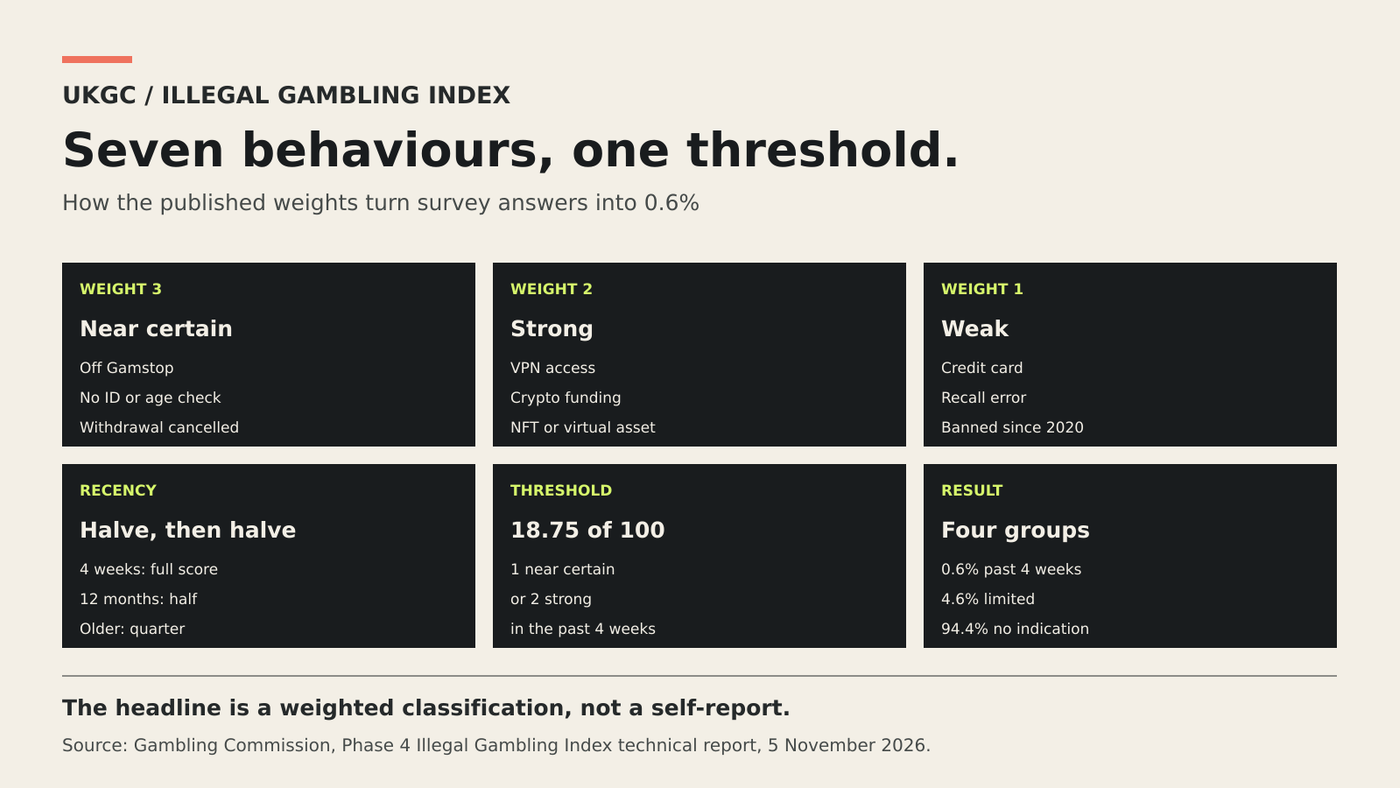
The Gambling Commission published the first Gambling Survey for Great Britain estimates scored through its new Illegal Gambling Index on 5 November 2026, and the number that travelled was 0.6%. That figure is not the share of people who told the Commission they used an illegal gambling website. It is the share of respondents whose answers to seven weighted behavioural questions reached a composite score of 18.75 out of 100, and a single “near certain” indicator reported in the past four weeks is enough to reach it.
That distinction matters commercially. Operators, aggregators and platform suppliers are being asked to take positions on illegal-market competition, affiliate leakage, payment controls and self-exclusion integrity — often in consultations and board papers where the illegal market is invoked as a number. The Commission has now published the machinery behind its number, including the weights, the threshold, the recency discounts and the limits it attaches to each dashboard metric. Read together, the package is less a market-size estimate than a measurement standard that other parties can audit, and, in places, reuse.
The short version
- The population estimate is small and stable on the Commission’s own reading. 94.4% of respondents showed no indication of illegal-site use, 0.6% were classified as users within the past four weeks and a further 0.4% within the past 12 months. Among people who gambled online in the past 12 months, the equivalent figures are 2.5% and 1.5%.
- The threshold is behavioural, not confessional. One near certain indicator in the past four weeks scores exactly 18.75, the qualifying threshold. Two strong indicators also clear it. One strong indicator on its own (12.5) does not.
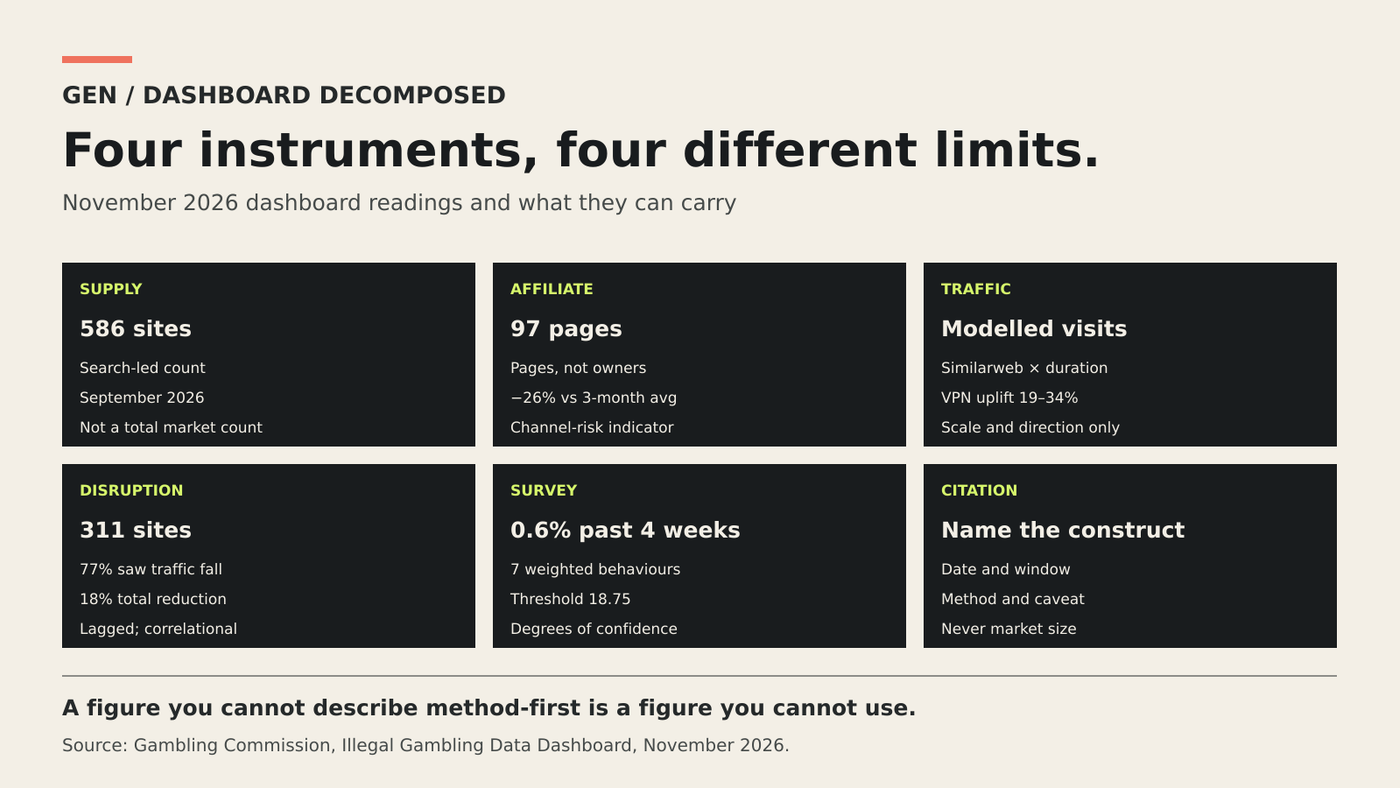
- The dashboard is four instruments, not one index. Supply counts, traffic estimates, search volumes and disruption outcomes each use a different method, a different denominator and a different caveat.
- The Commission has pre-empted the two most common misreadings. It states that the site count “is not a complete count of the illegal market” and that the traffic reduction following disruption “should not be interpreted as evidence that all changes were caused solely by the disruption”.
- Nothing here supports a market-size or revenue figure. The index measures degrees of confidence in individual engagement, and the Commission says so explicitly.
What was published, and why the method changed
The release is Phase 4 of the Commission’s Consumer Voice research programme, run with Yonder Consulting, and it marks the end of a multi-phase development process that began with qualitative work on how consumers find and use unlicensed sites. The first year of Gambling Survey for Great Britain data, covering April 2025 to April 2026, is the first to be scored through the resulting Illegal Gambling Index. The GSGB collects data from 20,000 respondents a year.
The Commission’s stated reason for building an index rather than asking a direct question is the one that matters for anyone who wants to reuse the data. Its release says simply asking consumers whether they have used an illegal gambling website “is not a reliable measure, as responses depend on individuals being aware that an illegal market exists, being able to identify an illegal gambling website, and accurately recalling their past behaviour”. Its technical report adds that respondents do not always know whether, or when, they used an unlicensed site, because operators deploy tactics to disguise legality.
So the Commission replaced a question with a model. That is a defensible choice and it is also a commitment: a model has parameters, and the parameters are published.
How seven behaviours become a 0.6% estimate
Seven self-reported behaviours are scored by strength and recency. Three are treated as near certain because they map onto licensing requirements that a GB-licensed operator must meet: knowing a site was not on Gamstop, signing up because age or identity verification would be avoided, and cancelling a withdrawal before it reached a bank or wallet. Three are strong but not conclusive: using a VPN to reach a site unavailable in Great Britain, funding play with cryptocurrency, and funding play with NFTs or virtual assets. One is weak: paying directly by credit card, where the Commission expects recall error and confusion between credit and debit cards.
Each indicator is halved for the past 12 months rather than the past four weeks, and halved again for activity more than 12 months ago. The raw maximum is 16, scaled by 6.25 to a 0–100 range.
| Indicator | Strength | Index score, past 4 weeks | What the behaviour describes |
|---|---|---|---|
| Knew the site was not on Gamstop | Near certain | 18.75 | Self-exclusion bypass |
| Signed up knowing age or ID checks were not required | Near certain | 18.75 | Verification bypass |
| Cancelled a withdrawal before it reached bank or wallet | Near certain | 18.75 | Payment control outside licensed rails |
| Used a VPN to reach a site not otherwise available in GB | Strong | 12.50 | Geo-block circumvention |
| Funded play with cryptocurrency | Strong | 12.50 | Payment rail outside the licensed perimeter |
| Funded play with NFTs or virtual assets | Strong | 12.50 | Payment rail outside the licensed perimeter |
| Paid directly by credit card | Weak | 6.25 | Recall and card-type confusion |
The distribution of indicators among classified users is the best available guide to what is driving the classification. Among users, 58.0% reported knowing a site was not registered with Gamstop in the past 12 months, and 56.6% reported cancelling a withdrawal. Those are two of the three near certain indicators. In other words, the 0.6% is largely a measure of self-exclusion and withdrawal-control circumvention, not of cryptocurrency adoption or VPN sophistication.
There is a second, subtler consequence of the threshold. Because one near certain indicator is sufficient, the index produces a likelihood classification for an individual respondent, not a verified finding about a website. The Commission classifies four groups and publishes all four: past-four-week users at 0.6%, past-12-month users at 0.4%, respondents with limited indications at 4.6%, and no indications at 94.4%. Those four add to 100. That reconciliation is a useful check when someone quotes a different subset as “the” illegal market.
Why 0.6%, 2.5% and 4% are all correct
The estimates differ by denominator and recall window, and most of the confusion in circulation comes from mixing them.
- 0.6% is the past-four-week classification across all respondents, including people who do not gamble.
- 1.0% is the 12-month equivalent (0.6% plus 0.4%) across the same population. It is not a past-month figure and should not be described as one.
- 2.5% is the past-four-week classification among respondents who gambled online in the past 12 months, excluding National Lottery-only players.
- 4.0% is the 12-month equivalent for that online-gambling group (2.5% plus 1.5%).
The Commission also flags a definitional trap in the historic data. A respondent who recalls using a credit card on a gambling website years ago may answer “more than 12 months ago” even though that behaviour was lawful on licensed sites before the 2020 ban. The same logic applies to cancellation of withdrawals, restricted at licensed operators in 2021. Those responses sit in the limited-indications category rather than being counted as current illegal-site use, which is the right treatment but is easy to lose when the underlying questions are quoted without the method.
The dashboard measures four different things
The November 2026 Illegal Gambling Data Dashboard sits alongside the survey work and answers a different question in each of its three sections. The readings below are for September 2026 or, for disruption, the second quarter of 2026 to 2027.
| Instrument | Latest reading | Method | What it can support | What it cannot |
|---|---|---|---|---|
| Supply: identified sites | 586 sites, 4% below the prior 3-month average and 4% above September 2025 | Targeted searches for illegal-market terms, manual review, geographic blocking test | Trend in availability via search | A total count of the illegal market |
| Supply: affiliate pages | 97 pages, 26% below the prior 3-month average | Unique pages carrying affiliate or referral links found in the same searches | A channel-risk indicator for affiliate and paid-search teams | Number of affiliate organisations, or of pages beyond monitored terms |
| Supply: search visibility | 4% of gambling-related Google results led to illegal sites, 0.5 points above the prior average | Snapshot of defined queries grouped by category | Relative visibility against the legal market | Stability, or results outside the tested terms and location |
| Demand: estimated traffic | 12% above the prior 3-month average, 11% below September 2025 | Similarweb modelled monthly visits multiplied by average visit duration, with a graduated VPN uplift | Scale and direction of engagement | Precise traffic, or coverage of smaller sites |
| Demand: illegal-market search volume | 53% below the prior 3-month average, 22% below September 2025 | Estimated volumes for monitored terms such as “Not on Gamstop” | Relative prominence of search themes | Searchers, visits or confirmed participation |
| Disruption | 311 sites actioned, 38% more than the prior quarter; 77% of disrupted sites saw traffic fall; 18% total traffic reduction | Actions recorded by type, compared with modelled traffic before and after | Operational output and an observed association | Causation, and current-quarter effect |
The disruption numbers are the ones most likely to be over-read. They are strong operational evidence that action is being taken at scale, and they are explicitly correlational on the Commission’s own page: traffic is compared before and after, only sites with sufficient data are included, and the result is reported one quarter behind because three months of post-action data are required. A 77% success rate is a statement about websites with usable traffic data, not about the illegal market as a whole.
What this means for operators, aggregators, and platforms
1. Cite the construct, not the headline. If you use 0.6% in a board paper, a consultation response or a marketing claim, describe it as a classified share of survey respondents over a four-week window. Quoting it as “0.6% of the British market” or converting it into revenue is not supported by the publication and invites a correction.
2. Screen the channel before the player. The most immediately actionable figure is 97 affiliate pages carrying links to illegal sites, down 26% on the prior three-month average. That is a supply-chain metric for acquisition teams: referral pages, paid-search destinations and content partners need destination checks and licensing disclosure, and the count behaves like a leading indicator of leakage. The practical test is whether each referred destination can be matched to a current licence in the market it serves, with the evidence retained before spend scales.
3. Treat the payment indicators as typologies, not as your own data. On a GB-licensed site, most of the seven behaviours should be structurally impossible: GamStop checks, identity verification and the credit-card prohibition are licence conditions, not optional controls. The index is therefore descriptive of behaviour on unlicensed sites. Its practical value to a licensed operator is in adjacent jurisdictions, in crypto-adjacent products and in fraud and AML monitoring, where the same rails — crypto, virtual assets, card funding, withdrawal cancellation — recur. The KYC and fraud framework is the right place to test whether a provider’s controls actually observe them.
4. Use the self-exclusion and verification indicators as integrity tests. Two near certain indicators account for most classified users. That gives compliance teams a small, defensible set of tests: match rates against GamStop, attempts to re-register after self-exclusion, and evidence that verification cannot be deferred by design. Those tests are cheap to automate and hard to dispute.
5. Do not benchmark across index versions. The Commission states that indicators may be added, revised or removed and that the multiplication factor may change as a result. Any time series that spans a version change is a different instrument. Record the version, the weights and the threshold with any figure you keep.
6. Aggregators and platform suppliers should read the supply metrics as distribution risk. Content and game distribution reaches unlicensed operators through routes that are often several steps removed from the contract. The monitored-site count is a crawl, not a defendant list, but a rising count is a reasonable trigger to re-run destination checks across resellers and affiliates.
Where the evidence stops
The Commission is unusually explicit about the limits, and they should travel with the numbers.
The index is “not intended to be a definitive measure of the size and scope of the illegal gambling market”. The indicators are proxies, not evidence. Recall beyond four weeks is weak. The development surveys used a panel of recent online gamblers and are not representative of all gamblers. The traffic estimate is modelled, applies a static VPN uplift and covers smaller sites poorly. Search volume counts searches, not people. Disruption effects are correlational and lagged. And the Phase 4 data tables had not been published at the time of writing — the release says they will follow — so the published percentages cannot yet be recomputed from microdata by an outside analyst.
One question the publication leaves open is how the index will behave in the next wave. The Commission says the VPN uplift will in future be derived from GSGB data rather than a fixed assumption, and that a further suite of questions from Phase 3 will enter the survey in 2027. Both changes are improvements and both are discontinuities. Anyone building a dashboard on these series should expect a break and plan for it.
Illegal Gambling Awareness Week opens a consumer channel
Separately from the Commission’s work, IAGR is running its first Illegal Gambling Awareness Week from 9 to 13 November 2026, with coordinated member communications and a consumer-facing licensing lookup at CheckBeforeYouPlay.org that launches on the same day. IAGR describes the tool, contributed by Paris-based regulatory technology company Sharp Vision, as drawing on regulatory records and other verified public sources for “covered IAGR member jurisdictions”. The release does not name the jurisdictions covered, and coverage is the first thing to check before treating a result as authoritative.
For operators, the practical consequence is a rise in consumers arriving with a licensing question already formed. Three checks are worth running this week: that the licence status and issuing authority are visible without a search, that brand and domain impersonation is monitored, and that affiliate and referral pages point at licensed destinations rather than lookalikes. IAGR’s campaign does not change any operator’s obligations. It does change the likelihood that a customer asks about them.
Frequently asked questions
Is 0.6% the size of Britain’s illegal gambling market?
No. It is the share of survey respondents classified as likely illegal-site users in the past four weeks, using a weighted index with a published threshold. It is not a share of gambling revenue, not a count of unique websites and not a measure of the market’s value.
Does the index prove that a respondent used an illegal website?
No. The Commission describes the output as degrees of confidence. A single near certain indicator in the past four weeks produces a score of 18.75, which is the qualifying threshold, so the classification is a likelihood statement about behaviour rather than confirmation of the site used.
Does the 18% traffic reduction prove that disruption works?
Not on its own. The Commission compares modelled traffic before and after action, includes only sites with sufficient data, reports one quarter behind, and states that the change should not be interpreted as evidence that all of it was caused solely by the disruption. It is consistent with effect; it is not a causal estimate.
Will next year’s figures be comparable?
Only if the weights, indicators and threshold are unchanged. The Commission has said it may add, revise or remove indicators and recalculate the factor, and it plans to move the VPN uplift onto a GSGB basis. Check the technical report before comparing waves.
The decision rule
Treat the 5 November package as a measurement standard with a press release attached. The press release gives you a defensible statement that engagement with identified illegal sites looks low and stable at population level while a distinct cohort of online gamblers uses them. The technical report gives you the right to interrogate every figure behind that statement, and the dashboard tells you which of its numbers can carry which argument.
The commercial mistake is to use the 0.6% as a market-size input, or to use the 18% as proof of enforcement effect. The commercial opportunity is narrower and more useful: an officially weighted set of behaviours that describes how self-exclusion, verification and payment controls are being circumvented, published with enough method to let a compliance, payments or acquisition team build the same tests against its own traffic. That is a better basis for a decision than a headline, and it is the part of the release most likely to still be cited in twelve months.
Sources and methodology
This article is based on the Gambling Commission’s 5 November 2026 news release and Phase 4 statistics release, the accompanying Illegal Gambling Index technical report (executive summary, calculation, reporting and limitations sections), the November 2026 Illegal Gambling Data Dashboard and its methodology notes, and the Commission’s Gambling Survey for Great Britain page. The IAGR campaign details come from IAGR’s own media release of 26 October 2026. Independent trade reporting was used only to confirm that the headline figures were read consistently elsewhere; every figure quoted here is taken from the Commission’s or IAGR’s own publication.
All percentages are as published. The index scoring table is GEN’s summary of the Commission’s published weights and threshold, not a reproduction of the survey instrument. The dashboard readings are September 2026 data, except disruption, which covers the second quarter of 2026 to 2027. Reviewed 9 November 2026.
Visual analysis
Source record and operator framework
The first visual fixes the sourced facts. The second turns those facts into a practical review or decision path.
Evidence record
Sources used on this page
Each source supports a defined claim. Provider pages are identified as provider-supplied evidence.
- New survey data to help tackle illegal gambling and protect consumersGambling Commission · accessed Nov 9, 2026
The release, dated 5 November 2026, publishes the initial Gambling Survey for Great Britain estimates: 94.4% of respondents showing no indication of using an illegal gambling website, 0.6% engaging within the past four weeks, a further 0.4% in the past 12 months but not the past four weeks, 2.5% and 1.5% among respondents who gambled online, higher engagement among males and younger adults, and the statement that motivations are varied. It records the publication alongside the updated Illegal Gambling Data Dashboard and the Commission's CEO Briefing, and quotes Sue Young, Executive Director for Operations.
- Illegal online gambling - Phase 4: Initial findings from new data on consumer engagement with illegal gambling websitesGambling Commission · accessed Nov 9, 2026
The statistics release, published 5 November 2026, records that Phase 4 concludes the Consumer Voice research programme undertaken with Yonder Consulting, presents the first year of GSGB data covering April 2025 to April 2026, and introduces the Illegal Gambling Index. It states that 4.6% of respondents demonstrated limited indications of engagement, that the seven indicators are combined with strength ratings and recency, and that among illegal gambling website users the most common past-12-month indicators were knowing a site was not registered with Gamstop (58.0%) and cancelling a withdrawal before it reached a bank and/or wallet (56.6%). It also states that data tables for the release would be published in due course.
- Phase 4: Illegal Gambling Index - Technical ReportGambling Commission · accessed Nov 9, 2026
The technical report, published 5 November 2026 and produced by Yonder Consulting with the Commission, sets out the development and application of the index across its executive summary, statement development, analysis approach, final index and appendices sections. It records that the aim is to identify varying degrees of confidence in consumer engagement rather than to provide a definitive measure of illegal gambling participation.
- Phase 4 technical report - Calculating the indexGambling Commission · accessed Nov 9, 2026
The section publishes the final indicator weights: near certain indicators (not on Gamstop, avoiding age or identity verification, cancelling a withdrawal) score 3, strong indicators (VPN use, cryptocurrency, NFTs or virtual assets) score 2 and the credit-card indicator scores 1, with values halved for the past 12 months and halved again for more than 12 months ago. It records a maximum raw score of 16, a multiplication factor of 6.25, and a resulting maximum index score of 100. It also notes that the factor may change if indicators are added, revised or reweighted.
- Phase 4 technical report - Reporting the findingsGambling Commission · accessed Nov 9, 2026
The section defines the classification threshold: respondents demonstrating at least one near certain indicator, or two strong indicators, within the past four weeks, corresponding to an index score of 18.75. It defines the limited-indications category, advises that interpretation should focus on respondents meeting the likely-use threshold rather than that category, and warns that some historic responses reflect behaviours available before the 2020 credit-card ban and the 2021 change on cancelling withdrawals at licensed operators.
- Phase 4 technical report - Strengths and limitationsGambling Commission · accessed Nov 9, 2026
The section states that the index is not intended to be a definitive measure of the size and scope of the illegal gambling market, that the indicators act as proxies rather than explicit evidence, that consumer understanding and recall are limited, that survey recall beyond four weeks is limited, and that the development surveys used a panel sample of people who had gambled in the past four weeks excluding National Lottery-only players, which is not representative of all gamblers.
- Illegal gambling data dashboard - November 2026Gambling Commission · accessed Nov 9, 2026
The dashboard, published 5 November 2026, reports 586 illegal gambling websites accessible to consumers in Great Britain identified in September 2026 (4% below the previous three-month average and 4% above September 2025), 97 affiliate web pages (26% below the previous three-month average), 4% of gambling-related Google search results leading to illegal gambling websites, estimated engagement with identified illegal sites 12% above the previous three-month average and 11% below September 2025, illegal-market search volume 53% below the previous three-month average and 22% below September 2025, 311 websites disrupted in the second quarter of 2026 to 2027 (38% more than the previous quarter), 77% of disrupted websites showing a traffic reduction, and an 18% reduction in total estimated traffic for disrupted websites with sufficient data.
- Illegal gambling data dashboard - November 2026 methodology detailGambling Commission · accessed Nov 9, 2026
The dashboard's detail section states that the site count reflects sites found through its monitoring method and is not a complete count of the illegal market; that the affiliate measure counts pages rather than organisations or domains; that search visibility is a snapshot that varies by location, personalisation and Google's systems; that the traffic estimate multiplies Similarweb modelled monthly visits by estimated average visit duration, applies a graduated VPN uplift of 19% to the lower bound, 26% to the point estimate and 34% to the upper bound, and has limited coverage for smaller websites; that search volume represents searches rather than people; and that disruption traffic changes should not be interpreted as evidence that all changes were caused solely by the disruption, with disruption measures reported one quarter behind.
- Gambling Survey for Great Britain (GSGB)Gambling Commission · accessed Nov 9, 2026
The Commission's survey page describes the GSGB as collecting data from 20,000 respondents each year and links the survey methodology technical report, the official statistics series and guidance on using GSGB statistics. The page also records that the 2025 annual report was released on 16 July 2026.
- IAGR announces first Illegal Gambling Awareness WeekInternational Association of Gaming Regulators (IAGR) · accessed Nov 9, 2026
IAGR's media release, dated 26 October 2026, announces the first Illegal Gambling Awareness Week on 9-13 November 2026, states that campaign materials would be available to members from 6 November, and describes CheckBeforeYouPlay.org as a free licensing information tool contributed by Sharp Vision that launches on 9 November and checks licensing information for covered IAGR member jurisdictions using regulatory records and other verified public sources. It quotes IAGR President Ben Haden and CEO Kevin Mullally.
- UKGC survey: 0.6% of adults used illegal gambling sitesGambling Industry News · accessed Nov 9, 2026
Independent trade reporting dated 6 November 2026 records the same headline estimates and attributes them to the 5 November release and the updated dashboard. It is used only as corroboration that the figures were read the same way by an independent desk; every material figure in this article is taken from the Commission's own records.