News · evidence checked Nov 23, 2026
Isle of Man's 16 December reset: fitness, personal penalties, and the exit door
The Gambling Supervision Commission has published the instruments behind three changes: who must prove they are fit and proper, which individuals can now be fined personally, and how a licence can be surrendered.
- Written by
- Fernando Polti
- Editor
- Fernando Polti
- Published
- Evidence checked
- Next review
- Editorial state
- approved

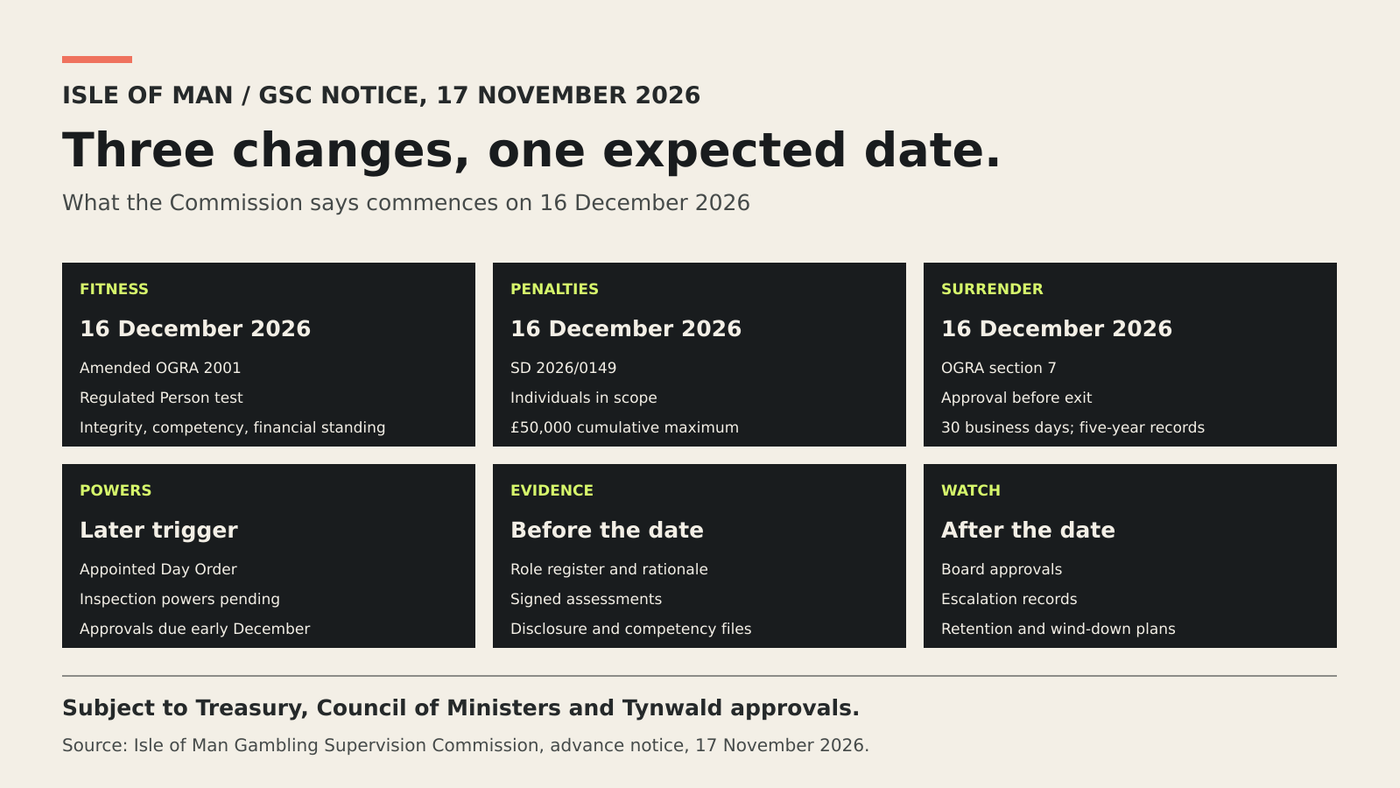
The Isle of Man Gambling Supervision Commission used a single notice on 17 November 2026 to line up three changes that reach further into a licensed business than a routine rule update. Subject to remaining approvals from Treasury, the Council of Ministers and Tynwald, all three are expected to come into operation on 16 December 2026: a rewritten fitness and propriety test for the people who control and run a licensee, a civil penalty regime that can fine controllers, key persons and senior managers personally for AML/CFT failures, and an approval process that must be completed before an online gambling licence can be surrendered.
The instruments are already published. The Commission has issued Fitness and Propriety Guidance V1.0, Guidance for Civil Penalties Individuals V1.0 and Guidance for Surrendering an Online Gambling Licence V1.0, and the Gambling (Civil Penalties) Regulations 2026 (SD 2026/0149) were made on 5 and 13 November. Royal Assent for the Gambling Legislation (Amendment) Act 2026 was announced on 20 October 2026.
What follows is an implementation reading: which roles are in scope, what evidence the Commission says it will assess, where the personal liability gate sits, and what a controlled exit now requires. The commencement date is expected rather than achieved, and nothing here is legal advice.
The short version
- Three changes, one date. Fitness and propriety, individual civil penalties and licence surrender are all expected to commence on 16 December 2026. A fourth change — revised inspection and investigation powers — waits for a separate Appointed Day Order, with approvals expected in early December.
- The fitness test is role-based, not title-based. The guidance tells licensees to assess whether a person has the responsibilities and influence of a “Regulated Person” regardless of what the organisation calls the job.
- The duty is continuous. Fitness and propriety is assessed at application and throughout the licence or appointment, and the amended Act gives the Commission powers where a director, senior manager, controller or beneficial owner is no longer fit and proper.
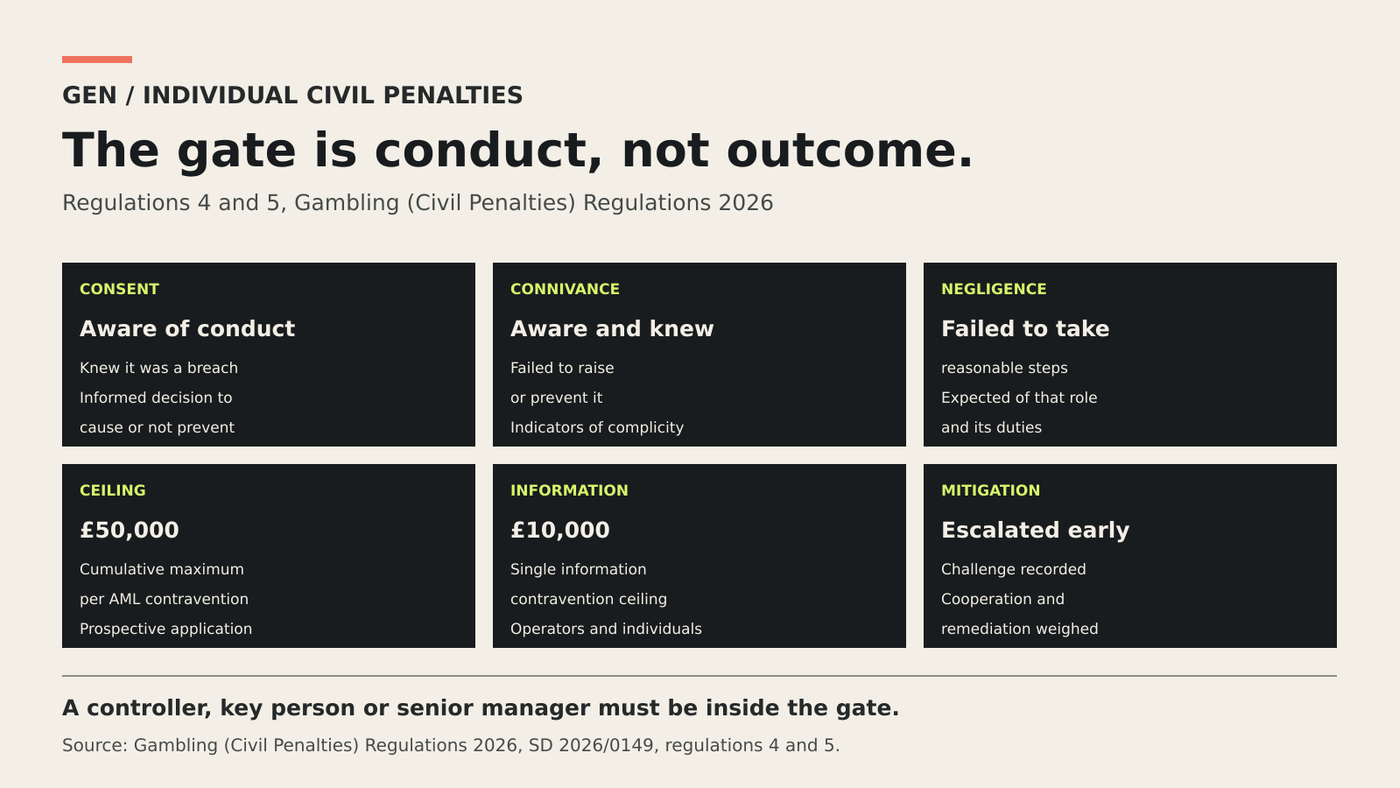
- Personal penalties need a gate, not just a failure. An individual penalty requires an operator AML/CFT contravention committed with that person’s consent or connivance, or attributable to their neglect.
- The ceilings are modest; the consequences are not. The maximum cumulative individual penalty is £50,000 per AML contravention, with £10,000 for a single information contravention. Publication of an enforcement outcome is the part most executives will price.
- Surrender is now a supervised wind-down. A valid notice needs two directors including the designated official, a proposed date at least 30 business days ahead, a full wind-down plan and a five-year retention plan — and the licence stays in force until the Commission confirms the effective date.
What actually changes on 16 December
| Change | Instrument | Who it reaches | What must exist before the date |
|---|---|---|---|
| Fitness and propriety | Amended OGRA 2001; Fitness and Propriety Guidance V1.0 | Controllers, beneficial owners, directors, designated officials, senior managers, MLRO and compliance roles | A role-by-role assessment, a declared pre-application assessment, and a live file per Regulated Person |
| Individual civil penalties | Gambling (Civil Penalties) Regulations 2026 (SD 2026/0149); Guidance for Civil Penalties Individuals V1.0 | Controllers, key persons and senior managers of operators | Documented governance, escalation and challenge evidence for AML/CFT decisions |
| Licence surrender approval | Amended OGRA section 7; Surrender Process Guidance V1.0 | All OGRA licence categories | A wind-down plan, customer communications, retention plan and clean returns |
| Inspection and investigation powers | Amended OGRA, Schedule 1 | Licensees and connected persons | Separate Appointed Day Order; approvals expected early December 2026 |
Two timing details matter. The regulations themselves commence “the day after they are approved” by Tynwald, and the approval field on the published statutory document is still blank; the Commission’s 16 December date is therefore an expected commencement built on the remaining approvals, not a fixed statutory fact. And the fitness guidance carries an effective date of “XXXX” in its version-control table, which is what a pre-commencement text looks like rather than a settled one.
Who counts as a Regulated Person
The guidance’s list is deliberately wide. It covers beneficial owners directly or indirectly; designated officials; the operations manager; company directors and chief executives; directors of corporate directors, including where those directors are themselves beneficial owners; stakeholders who make critical non-financial contributions; investors investing without a beneficial-ownership reward; MLROs and deputy MLROs; AML/CFT compliance officers and nominated AML/CFT officers; and senior managers accountable for corporate strategy, the IT and security of registration systems and gaming or betting infrastructure, regulatory compliance, financial control or commercial development.
Three features of that list will shape how groups organise the work.
It is a responsibility test, not a job-title test. The guidance says the Commission expects a licensed entity to decide whether a person must meet the standard “based on the responsibilities and influence associated with the role rather than its title”, and that the Commission may apply the requirement to other people who hold influence or control where it considers that proportionate.
Proportionality runs in both directions. Being inside the definition does not guarantee the same depth of assessment. The Commission says the nature and extent of assessment will be risk-based, having regard to the role, the ability to influence or control the entity and other risk factors — and where a person formally fits but has little or no meaningful ability to influence or control, the Commission may decide that the full information set is not required, provided the entity still identifies the person and gives enough information for the Commission to decide.
The licensee does the first pass and declares it. The assessment must be carried out before the application is submitted, and the Regulated Entity declares that it has done so. That is the sentence to read twice: the file the Commission sees is one the licensee has already stood behind.
The glossary also treats software suppliers as a distinct category of regulated entity, with their own nominated AML/CFT officer role under licence conditions, so the assessment burden is not confined to consumer-facing operators.
Integrity, competency and financial standing
Fitness and propriety is assessed against three criteria, and the guidance is explicit that all three are assessed at application and then on an ongoing basis.
Integrity covers honesty, ethical conduct, sound judgment and commitment to law and regulatory standards, assessed on what a person did or failed to do where there was a duty to act. The disclosure standard is broad: Regulated Persons must disclose convictions, spent or otherwise — the prohibition on disclosing spent convictions does not apply to proceedings before the Commission — and must disclose ongoing investigations or pending criminal or civil proceedings of which they are aware, in any jurisdiction.
Competency is role-specific in a way that makes a single template inadequate. The guidance’s competency table sets different expectations for an MLRO, a deputy MLRO, an AML/CFT compliance officer and a nominated AML/CFT officer — independence from the enterprise functions, reporting lines to the board, annual AML/CFT reporting, and the Commission’s ability to interview previously unknown or concerning appointees. A group that gives every Regulated Person the same questionnaire will not be able to show it applied that table.
Financial standing completes the set, and the guidance treats the entity’s overall fitness as assessed by reference to the fitness of its Regulated Persons. For a group with layered holding companies, that is where the ownership map has to be accurate rather than aspirational.
The personal penalty: the gate, the ceiling, the mitigation
The civil penalty power is not a general duty to keep executives out of trouble. Section 22(1A) of the Gambling (AML/CFT) Act 2018 allows the Commission to require an individual to pay a penalty only where an operator has contravened AML/CFT legislation and the contravention was committed with the consent or connivance of, or was attributable to neglect on the part of, a controller, key person or senior manager.
The guidance defines those three routes closely:
- Consent requires that the individual was aware the conduct was occurring or likely to occur, knew it constituted a contravention, and that the contravention resulted directly or indirectly from their informed decision to cause it or not to prevent it.
- Connivance requires awareness and knowledge of the contravention, a failure to take reasonable steps to raise it or prevent it, and circumstances indicating complicity — without directly causing it.
- Negligence is a failure to take steps a person in that role could reasonably have been expected to take, given the duties and responsibilities attached to it.
The ceilings sit in the regulations rather than the guidance. For an individual, the maximum cumulative penalty for an AML contravention is £50,000; for a single information contravention — false, inaccurate or misleading information furnished to the Commission — the maximum is £10,000, and that ceiling applies to operators too. Operator penalties for an AML contravention are the greater of £1 million or twice the benefit reasonably derived. The Commission’s civil penalties guidance tabulates a £1,000 starting point per individual contravention within the £50,000 overall maximum, which is a tariff indication rather than a regulation.
Regulation 5(2) then sets the factors the Commission must weigh for an individual: whether the contravention arose from consent, connivance or negligence; the person’s seniority and AML/CFT responsibilities; the extent to which their actions caused the contravention directly or indirectly; what they did once aware, and how quickly; the individual’s and operator’s prior compliance history; whether they raised concerns in a timely and appropriate manner and what happened afterwards; and whether they knowingly or recklessly supplied false, misleading or inaccurate information.
That last pair is the operational point. “Whether the individual raised concerns … and what happened as a consequence” turns an escalation record into mitigation evidence. So does the guidance’s governance factor, which treats a person who could not discharge their functions but escalated sufficiently as mitigating, and a person who knew they could not perform their functions and failed to act as aggravating. In practice, a board that cannot produce a dated escalation trail for an AML/CFT decision has a weaker answer than one that can — regardless of whether the underlying decision was right.
The regime applies prospectively: penalties will not be imposed for a contravention occurring before commencement, except to the extent a continuing contravention continues afterwards. The Commission’s decision-making process, settlement, publication and prohibition policies sit alongside the new power rather than being replaced by it.
The exit door now has a procedure
Before the amendment, surrender was a notice. Section 7 now makes it an approval: the holder gives notice with the information the Commission requires, and the Commission may either require more information or determine the steps to be taken, any conditions, and the date the surrender takes effect — or the steps required before it can take effect. Conditions can continue after surrender for up to five years where they concern retention of information, and up to two years otherwise.
The surrender guidance turns that into a document set. A valid notice must be signed by two directors, one of whom is the designated official, give the reasons, propose an effective date at least 30 business days ahead, and attach a wind-down plan covering the timeline, dependencies that could delay surrender, mitigation for customer or regulatory impact, contingency if the wind-down overruns, how player funds will be settled, how existing remediation plans will be managed, server closure, unresolved complaints, termination or transition of B2B arrangements, and the key staff responsible during the wind-down. It also expects proposed customer communications, a record-retention plan with access arrangements, and submission of outstanding returns — AML and general quarterly returns, the annual STRIX return, audited financial statements and anything else required by licence conditions.
The process assumptions are worth planning against. The Commission will ordinarily confirm within five working days whether it has the information it requires, but that confirmation does not approve the proposed date. During the surrender period the Commission will ordinarily require weekly evidence of player balances and the steps taken to repatriate them, regular updates on complaints, and immediate notification of issues or delays. Fees and other amounts remain due until the surrender takes effect, the licence stays in force until the Commission confirms it, and any required step that is missed can delay the date.
After surrender, the retention table is specific: AML/CFT information not previously submitted follows the Code’s retention periods; business-partner records — due diligence, contracts, service-level agreements, risk assessments, payments and monitoring — covering the year before the notice must be kept for five years from the effective date; and customer details from that same year, including name, player ID, contact details, date of birth, currency and balances, must also be kept for five years. There is a right of appeal against a requirement or determination, a condition, or a direction.
There is also an exceptional-circumstances route under section 7(2E) — corporate insolvency or a formal winding-up where the holder cannot provide the information, situations where obtaining it is not reasonably possible, or cases where delay would increase risk to customers or the public interest. That route exists for failure, not for convenience.
What this means for operators, aggregators and platforms
1. Build the Regulated Person register before the assessment. Start from the guidance’s list and then apply the influence test to the roles it does not name. The failure mode is a register that mirrors the org chart: a “chief of staff” or a platform owner with de facto control over registration systems can be in scope while a non-executive director may not be. Document the reasoning for both inclusions and exclusions, because the Commission can ask.
2. Separate the entity assessment from the person file. The guidance makes the entity responsible for assessing and declaring fitness before application. That means a repeatable evidence pack per person — identity, ownership chain, directorships, regulatory history, convictions including spent ones, live investigations in any jurisdiction, references and role-specific competency evidence — plus a decision record showing who signed off and on what basis.
3. Make the board approval calendar a compliance control. From 16 December the Commission must be satisfied a person is fit and proper before approving a new director or designated official. A group that appoints first and notifies later is building a defect into the appointment. For platform groups with multiple licensed entities, the approval calendar needs to sit with company secretarial rather than being a by-product of HR onboarding.
4. Treat AML/CFT escalation as personal evidence. The individual-penalty factors reward timely escalation and punish silence. In practice that means minutes, risk-committee papers, dissent records and remediation logs are not administrative clutter; they are the material that distinguishes neglect from a person who flagged the problem and was overruled.
5. Re-read supplier and white-label contracts for who is a Regulated Person. Where a licensee relies on a supplier or platform provider for registration, payments or IT security, the guidance’s senior-management category reaches the people accountable for those functions. A supplier group with its own OGRA licence and nominated AML/CFT officer has a second file to maintain, and a B2B contract that does not allocate that responsibility will not answer the Commission’s question.
6. If an exit is conceivable, prepare the wind-down pack now. The 30-business-day proposed date, the two-director signature, the five-year retention plan and the weekly balance evidence make surrender a project rather than a letter. Groups running a market review, a platform migration or a brand consolidation should know today which records they would need to retain from the year before a notice.
Implementation sequence
| Window | Work | Evidence produced |
|---|---|---|
| Before 16 December 2026 | Confirm commencement approvals; map Regulated Persons by role and influence; re-run integrity disclosures including spent convictions and live investigations | Role register with rationale; signed assessment declarations; refreshed disclosure files |
| Before 16 December 2026 | Align competency evidence to the guidance’s role table; confirm board reporting lines and independence for MLRO and compliance roles | Competency matrix per role; interview-ready files |
| Before 16 December 2026 | Document governance and escalation for AML/CFT decisions; test that minutes record challenge and response | Escalation trail; committee terms of reference |
| December 2026 – January 2027 | Update the approval workflow for new directors and designated officials; brief the board on individual exposure | Revised appointment procedure; board briefing record |
| First quarter 2027 | Refresh wind-down and retention plans; reconcile B2B termination and transition rights | Dated wind-down plan; retention schedule with access arrangements |
| Ongoing | Repeat the assessment as roles, ownership and investigations change; record the trigger and the review | Change log tied to licence and appointment dates |
What is not settled
Commencement is expected, not achieved. The Commission’s own notice conditions the 16 December date on Treasury, Council of Ministers and Tynwald approvals, and the regulations commence the day after Tynwald approval. Until those steps are recorded, treat the date as a planning assumption with a live risk of slippage — and note that the inspection and investigation powers sit on a different, later trigger.
The interaction with group supervision is untested. The guidance says fitness of the entity is assessed by reference to its Regulated Persons, but it does not set out how the Commission will treat a controller who is fit and proper for one licensee and problematic for another in the same group, or how a shared services arrangement is assessed when the accountable executive sits outside the licensed entity.
The tariff is guidance, not regulation. The £1,000 per-contravention figure appears in the Commission’s guidance appendix; the regulations set the ceiling. How the Commission calibrates between those points will only be visible in decided cases and published settlements.
Surrender timing depends on completeness. The five-working-day completeness check is a service standard for the information request, not an approval clock. The guidance does not state a maximum period between a complete notice and a determination, so a wind-down timetable that assumes a fixed regulatory turnaround is exposed.
The consolidated Act is unofficial. The Commission publishes readable versions of the amended Acts and states that complete accuracy cannot be guaranteed pending the Attorney General’s Chambers versions. Anyone relying on a specific subsection should check the official text when it issues.
Frequently asked questions
What changes for an Isle of Man licence holder on 16 December 2026?
Three things are expected: amended fitness and propriety requirements under the Online Gambling Regulation Act 2001 with new guidance on how the Commission assesses integrity, competency and financial standing; a civil penalty regime that can reach controllers, key persons and senior managers personally for AML/CFT contraventions; and an approval process that must be completed before an online gambling licence can be surrendered. All three remain subject to Treasury, Council of Ministers and Tynwald approvals.
Can the Commission fine an executive for an AML failure?
Only where an operator has contravened AML/CFT legislation and the contravention was committed with the individual’s consent or connivance, or was attributable to their neglect. The maximum cumulative individual penalty is £50,000 per AML contravention, with £10,000 for a single information contravention. The regime applies prospectively except for continuing contraventions.
Does fitness and propriety only apply at licensing?
No. The guidance says fitness and propriety is assessed during the application process and on an ongoing basis while the person holds the role, and the amended Act gives the Commission powers where a director, senior manager, controller or beneficial owner is no longer fit and proper. The Commission must also be satisfied a person is fit and proper before approving a new director or designated official.
How long does it take to surrender an OGRA licence?
There is no published maximum. A valid notice must propose an effective date at least 30 business days ahead, the Commission ordinarily confirms within five working days whether it has the information it needs, and the surrender takes effect only when the Commission confirms the date or that required steps are complete. Fees remain due until then, and records must be retained for up to five years.
Sources and methodology
This article is built from the Commission’s own publication set: the 17 November 2026 advance notice; Fitness and Propriety Guidance V1.0; Guidance for Civil Penalties Individuals V1.0; Guidance for Surrendering an Online Gambling Licence V1.0; the Gambling (Civil Penalties) Regulations 2026 (SD 2026/0149); and the Commission’s unofficial consolidated Online Gambling Regulation Act 2001. The regulations and guidance were read in full; the Act was read at the sections cited. One independent trade report from March 2026 is used only to record that the individual-penalty policy reached consultation stage.
Statements about what “will” happen describe instruments that are expected to commence on 16 December 2026 subject to approvals; statements about what the Commission “must” do follow the text of the regulations and the amended Act. The article does not assess any licensee, individual, supplier or adviser, does not describe the Commission’s enforcement practice beyond its published policies, and is not legal advice. Figures are taken from the instruments rather than from trade summaries. Reviewed 23 November 2026.
Visual analysis
Source record and operator framework
The first visual fixes the sourced facts. The second turns those facts into a practical review or decision path.
Evidence record
Sources used on this page
Each source supports a defined claim. Provider pages are identified as provider-supplied evidence.
- 17 November 2026: Advance Notice of Key Changes Affecting Existing Licence HoldersIsle of Man Gambling Supervision Commission · accessed Nov 23, 2026
The Commission records Royal Assent for the Gambling Legislation (Amendment) Act 2026 on 20 October 2026 and gives advance notice that amended fitness and propriety requirements under the Online Gambling Regulation Act 2001, the expanded civil penalties framework and the new licence surrender approval process are expected to come into operation on 16 December 2026, subject to remaining approvals from Treasury, the Council of Ministers and Tynwald. It also records that the other amendments, including revised inspection and investigation powers, commence the day after the relevant Appointed Day Order, with Treasury and Council of Ministers approvals expected in early December 2026.
- Fitness and Propriety Guidance V1.0 — December 2026Isle of Man Gambling Supervision Commission · accessed Nov 23, 2026
The guidance defines a Regulated Person to include beneficial owners, designated officials, operations managers, company directors, chief executives, directors of corporate directors, stakeholders making critical non-financial contributions, investors investing without a beneficial ownership reward, MLROs and deputy MLROs, AML/CFT compliance officers, nominated AML/CFT officers and named senior management roles; states that the test applies to responsibilities and influence rather than title and must be assessed before an application is submitted; sets integrity, competency and financial standing as the three criteria; requires disclosure of spent and unspent convictions and of ongoing investigations or pending proceedings in any jurisdiction; and states that fitness and propriety is assessed at licensing and on an ongoing basis. Its version-control page is still marked with an effective date of XXXX.
- Guidance for Civil Penalties Individuals V1.0 — December 2026Isle of Man Gambling Supervision Commission · accessed Nov 23, 2026
The guidance sets out the section 22(1A) test — an operator contravention committed with the consent or connivance of, or attributable to neglect on the part of, a controller, key person or senior manager — defines consent, connivance and negligence, states that the regime applies prospectively except for continuing contraventions, and tabulates £1,000 per individual contravention against a £50,000 overall maximum, with aggravating and mitigating factors covering integrity, competency, cooperation, governance, timeliness and prior compliance history.
- Gambling (Civil Penalties) Regulations 2026, SD 2026/0149Isle of Man Government (Tynwald statutory document) · accessed Nov 23, 2026
The regulations are made under section 22(6A) and (7) of the Gambling (Anti-Money Laundering and Countering the Financing of Terrorism) Act 2018, were made on 5 and 13 November 2026, revoke the 2018 Civil Penalties Order, and set maximum cumulative individual penalties of £50,000 for an AML contravention and £10,000 for a single information contravention, with operator penalties of the greater of £1 million or twice the benefit derived. Regulation 5(2) lists the factors the Commission must weigh for an individual. The Tynwald approval field is blank and regulation 2 commences the regulations the day after approval.
- Guidance for Surrendering an Online Gambling Licence V1.0 — December 2026Isle of Man Gambling Supervision Commission · accessed Nov 23, 2026
The guidance requires a valid surrender notice signed by two directors including the designated official, a proposed effective date at least 30 business days ahead, a wind-down plan covering timeline, dependencies, customer impact, player funds, remediation, server closure, complaints, B2B terminations and responsible staff, proposed customer communications, a record-retention plan, and outstanding returns including AML and general quarterly returns, the annual STRIX return and audited financial statements; it sets a five-working-day completeness check, weekly evidence of player balances and repatriation steps, continued fees, retention of business-partner and customer records for five years after surrender, continuing conditions of up to five years for information and two years otherwise, and an exceptional-circumstances route.
- Online Gambling Regulation Act 2001 — consolidated text as amendedIsle of Man Gambling Supervision Commission (unofficial consolidated version) · accessed Nov 23, 2026
Section 7 as amended provides for a surrender notice containing the information the Commission requires, a Commission determination of the steps, conditions and effective date, conditions continuing for up to five years for information retention and two years otherwise, an exceptional-circumstances power and a duty to publish guidance on the surrender function. Section 10 requires Commission approval of a designated official only where the Commission is satisfied the person is fit and proper, and section 10(3A) requires written guidance on the criteria normally applied. The Commission states that complete accuracy of the unofficial version cannot be guaranteed.
- Isle of Man gambling legislation considers civil fines for individuals as bill reaches consultation stageiGaming Business · accessed Nov 23, 2026
Independent trade reporting dated 25 March 2026 records that the proposed amendment would empower the Isle of Man regulator to impose civil penalties on individual executives for compliance failures, a shift from sanctioning companies alone, and that the measure had reached consultation stage.